
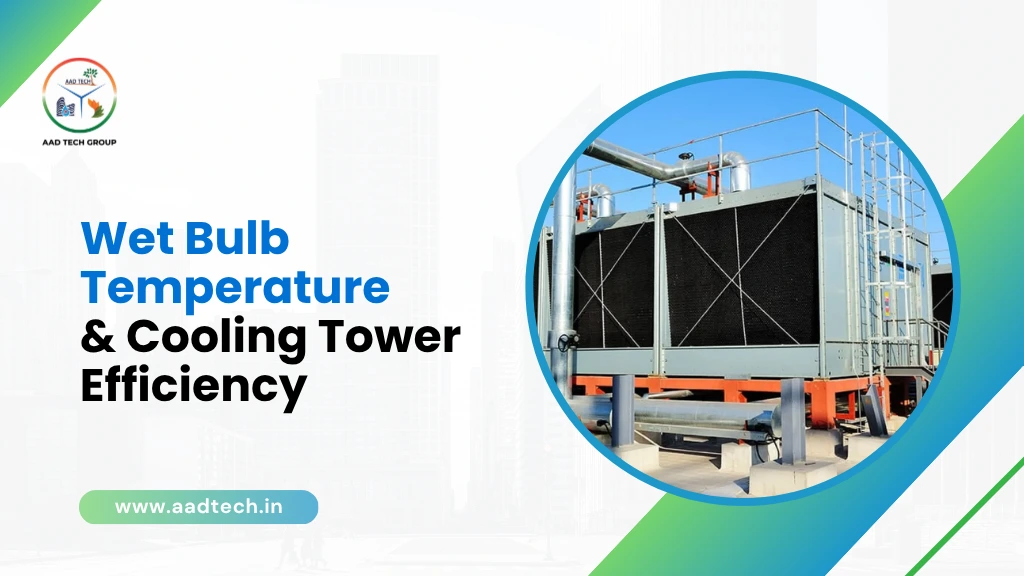
In the world of industrial cooling, the primary enemy of efficiency is not the heat load itself, but a fundamental misunderstanding of atmospheric science. While many plant operators diligently track ambient dry-bulb temperatures, they remain blind to the psychrometric reality governing their equipment.
The air temperature on your thermometer does not drive cooling towers. The wet-bulb temperature in the cooling tower governs performance metrics. Failing to account for this is why your system’s performance fluctuates wildly, even when the heat load remains constant. For the design and maintenance engineer, mastering this variable is the difference between reactive firefighting and proactive plant optimisation.
What Is Wet Bulb Temperature in Cooling Tower Systems?
At its core, a cooling tower is an evaporative heat exchanger. It functions by rejecting sensible and latent heat by evaporating a small fraction of the circulating water into the incoming air stream.
- Dry Bulb (DB) Temperature: The ambient air temperature measured by a standard thermometer. It ignores moisture content and is not the primary driver of evaporative cooling.
- Wet Bulb (WB) Temperature: The lowest temperature air can reach through evaporative cooling at a given humidity level.
- Psychrometric Basics: As defined by NOAA, the wet-bulb temperature is a critical indicator of air enthalpy and moisture content, directly defining the evaporative limit.
- Evaporative Potential: When air is dry, evaporation is strong, and the wet bulb temperature is significantly lower than the dry bulb temperature.
The Thermodynamic Limit: Why Towers Cannot Cool Below Wet Bulb
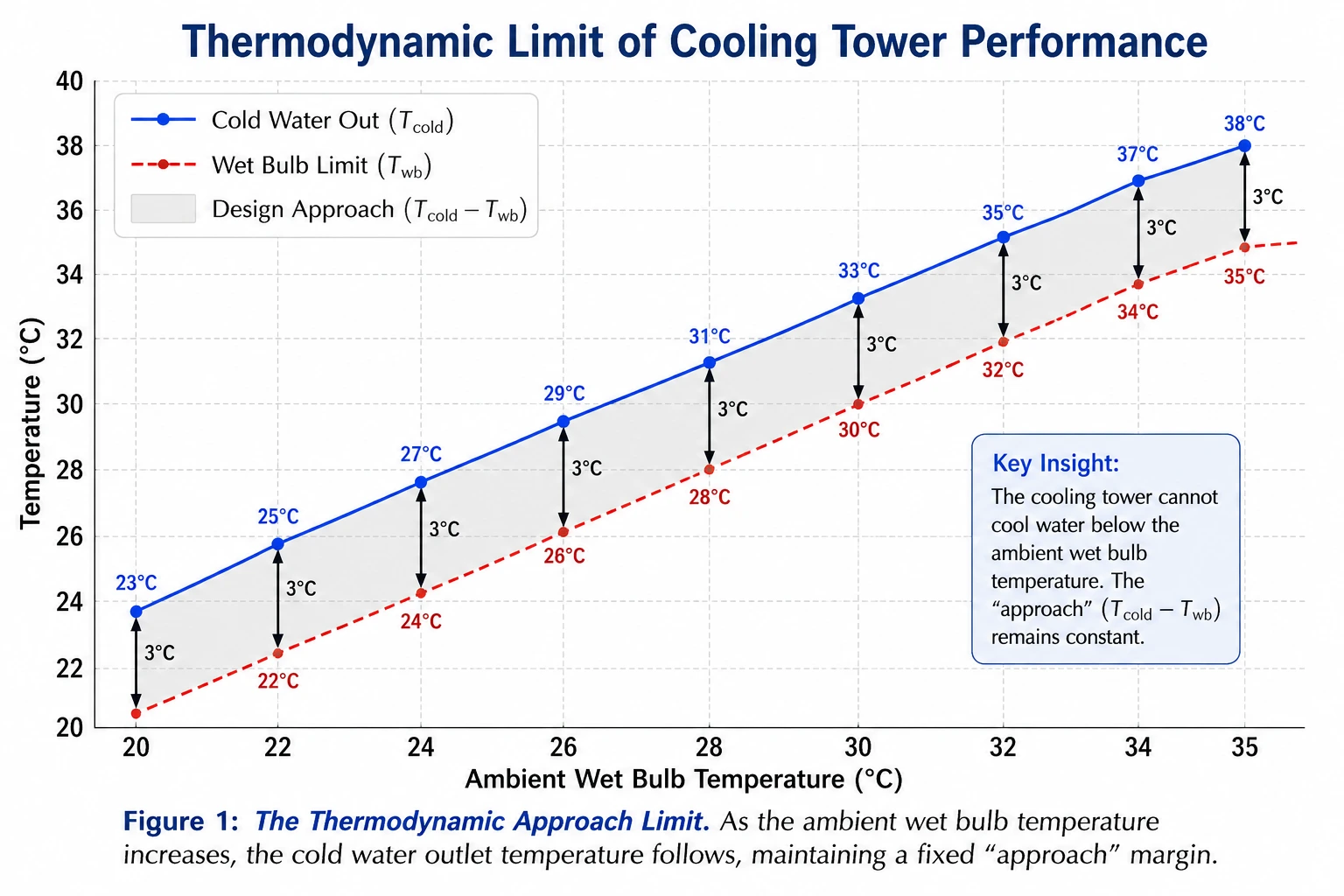
Thermodynamically, a cooling tower can never reach the wet bulb temperature under normal operating conditions. It represents the absolute, unbreachable psychrometric limit of the heat rejection process. As an engineer, you must recognise this inequality as the baseline for your system’s physical capacity:
$$T_{cold\ water} \approx T_{wet\ bulb} + \text{Approach}$$
No amount of fan speed, surface area, or chemical treatment can overcome this atmospheric constraint. Academic resources, such as those provided by Ohio University, demonstrate that as the air approaches saturation, the evaporation potential vanishes, rendering the cooling tower ineffective regardless of mechanical input.
Key Cooling Tower Performance Metrics
To gain control over your process, you must move beyond singular readings. Use this table to standardise your field interpretations:
Table: Key Cooling Tower Performance Metrics
| Term | Formula | Simple Meaning | Field Interpretation |
| Wet Bulb | – | Air moisture reference | The base limit for tower cooling performance. |
| Range | $T_{hot} – T_{cold}$ | Heat removed | Shows actual heat rejected from circulating water. |
| Approach | $T_{cold} – T_{wet\ bulb}$ | Performance indicator | Shows how close the tower is to the evaporative limit. |
| Drift | – | Water loss | Indicates the eliminator condition and carry-over risk. |
| Cycles of Concentration | – | Dissolved solids ratio | Supports blowdown and scale-control decisions. |
Understanding Cooling Tower Range and Approach
The approach is the true performance indicator of your tower. A low approach (typically $2.5\text{ °C} \pm 0.5\text{ °C}$) indicates high performance.
If your approach begins to deteriorate (widening significantly), you are likely facing an airflow obstruction, poor water distribution, fouled fill, or a pump/fan malfunction. If your approach exceeds your established baseline by more than $1\text{ °C}$, trigger an immediate inspection.
The Humidity Factor: India’s Operational Reality
In coastal India and monsoon-prone industrial belts, the wet-bulb temperature is often deceptively high. In these high-humidity environments, the air is near saturation, leaving little room for evaporation.
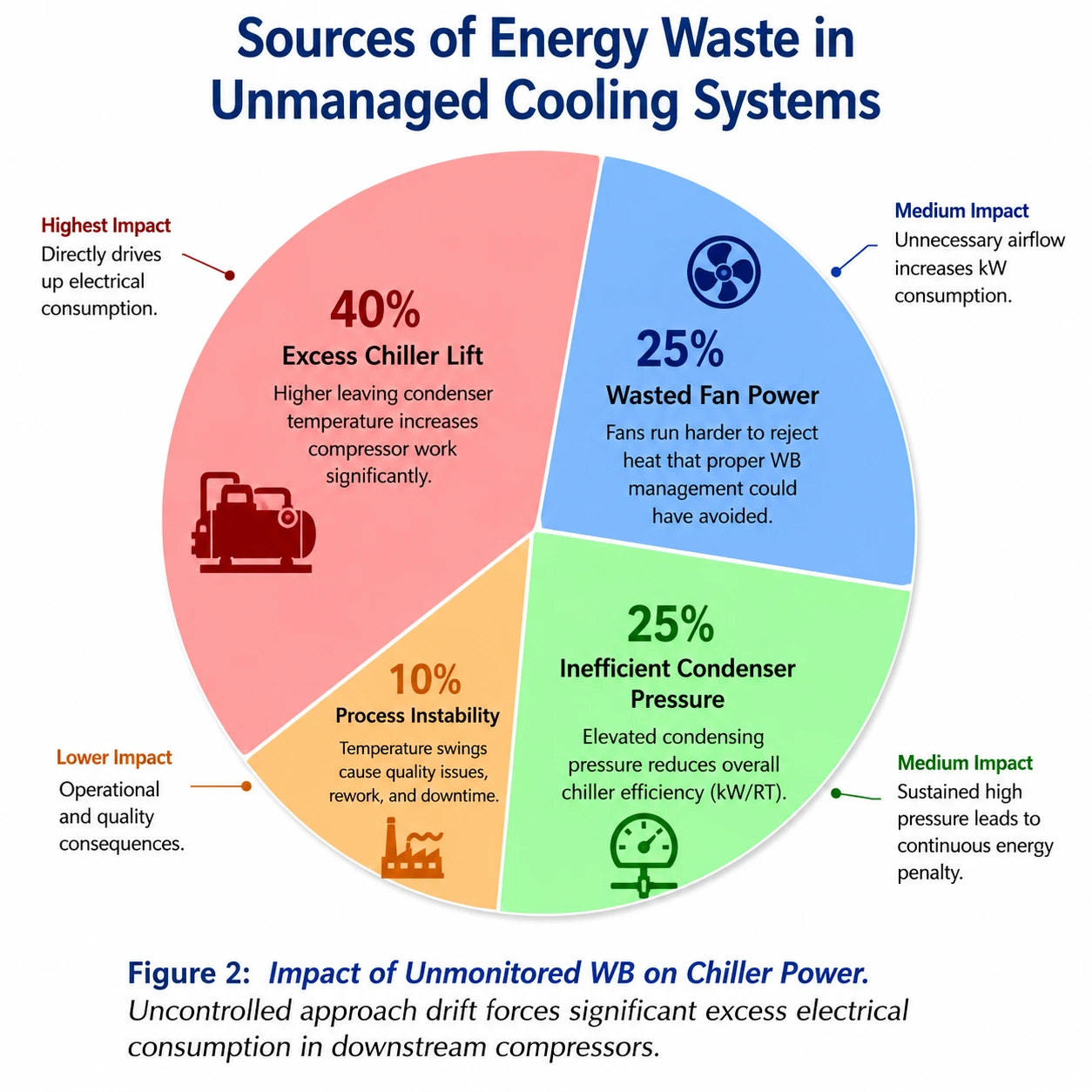
As detailed in AAD Tech’s operational analysis, when the wet bulb climbs into the $30\text{ °C}+$ range during pre-monsoon and monsoon seasons, standard cooling tower ratings often fail to hold, forcing your cooling tower to struggle to reject heat, leading to higher condenser pressures and increased energy consumption in downstream chillers.
How Smart EC Fan Systems Adapt to Variations
Modern industrial cooling requires intelligence, not just raw power. AAD Tech Group’s Smart EC Fan Systems respond to real-time psychrometric data:
- Real-time Optimisation: Automatically adjust fan speeds based on ambient WB and $T_{cold\ water}$ to match actual cooling demand.
- Approach Maintenance: Identify and alarm on performance drift, separating weather-driven performance loss from actual mechanical fouling.
- Energy Efficiency: Utilise EC motor part-load efficiency to achieve non-linear power savings, ensuring that every watt of fan energy is spent on tangible cooling.
- Dynamic Modulation: The system continuously balances airflow against changing humidity levels, protecting your process from temperature spikes.
Is Your Cooling Tower Actually Dying—Or Just Misunderstood?
The data is clear: plants that monitor only their water temperatures are merely reacting to symptoms, not diagnosing the root cause. Plants that track wet bulb conditions, however, finally understand the physics driving their entire cooling process. By aligning your cooling strategy with the harsh realities of your local environment (especially during our unpredictable Indian monsoon cycles), you shift from constantly struggling against the elements to leveraging them to achieve peak plant efficiency.
Frequently Asked Questions
It is the lowest temperature to which air can reach through evaporative cooling at a given humidity level, serving as the theoretical limit for cooling tower performance.
Thermodynamically, you need a positive temperature difference (the approach) to drive heat transfer. Achieving a zero approach is physically impossible, as it would require an infinite tower size.
Track your approach. If it remains stable as the cold-water temperature rises, the issue is weather-driven (wet-bulb), but if the approach increases, your equipment is likely fouled or obstructed.
To ensure reliable performance calculations, sensors should be calibrated at least once per season, especially before peak monsoon months.
Yes, EC fans allow variable airflow to track the wet-bulb temperature, preventing massive energy waste during low-load or low-wet-bulb conditions.