
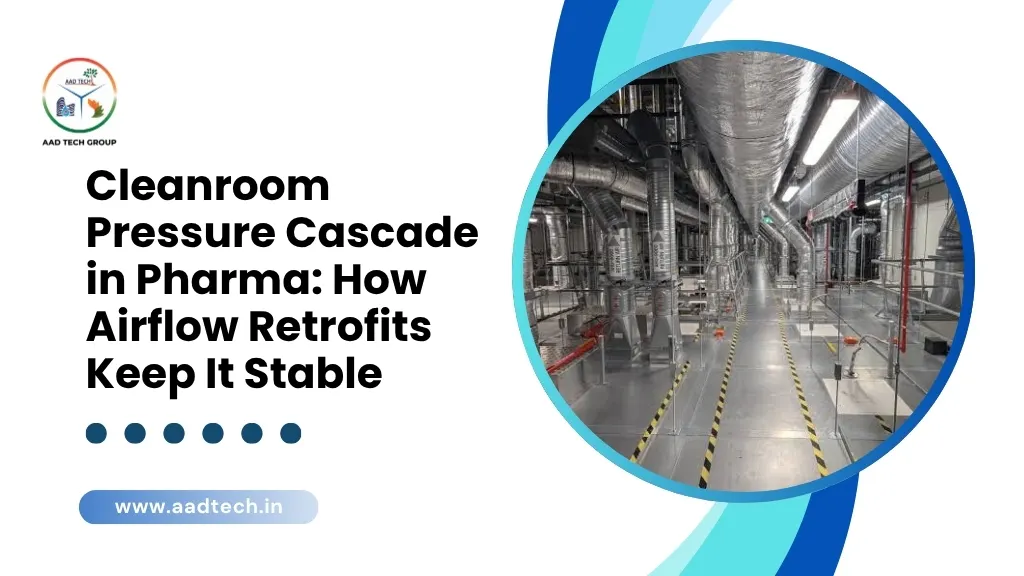
A cleanroom pressure cascade pushes air from cleaner rooms towards less clean ones, typically in steps of 10–15 Pa. Ageing belt-driven fans drift as filters load. Direct-coupled EC fans with closed-loop controls maintain set points more precisely and cut fan energy by 40–50%.
Key takeaways
- Regulators expect at least 10 Pa of pressure between adjacent grades, with pressure monitored continuously.
- Fan drift is a common, fixable cause of set-point misses.
- An EC retrofit is plug-and-play with minimal downtime.
- In one example, a 200 kW fan system fell to 100–115 kW.
It’s 2 a.m. The alarm trips. A door stayed open too long, or a HEPA bank has quietly loaded up, and the differential between two rooms has slipped below the limit. Now QA wants a deviation report by morning.
Most teams blame the door. Sometimes the fan is the real culprit. Here’s how your cleanroom pressure cascade depends on airflow hardware, and what a retrofit changes, in numbers.
What Inspectors Actually Check
Open any cleanroom pressure cascade diagram in a pharma inspector’s review, and the pattern repeats: pressure steps up as ISO cleanliness classification rises. The cleanroom pressure differential requirements below are based on the FDA’s aseptic guidance (FDA, 2004) and EU GMP Annex 1.
| Condition | Benchmark |
| Adjacent rooms, different grade (doors closed) | ≥10 Pa (Annex 1); 10–15 Pa (FDA) |
| Aseptic room vs unclassified room | ≥12.5 Pa (FDA) |
| Monitoring | Continuous; alarms documented; deviations investigated |
These clean-room differential-pressure guidelines assume continuous monitoring. A gauge read twice a shift won’t catch a two-minute dip. Doors matter too: with them open, outward airflow must still limit ingress, and ajar time should be strictly controlled. Your room recovery time depends on the air change rate.
The Hidden Reason Your Cleanroom Pressure Cascade Keeps Drifting
Three fan-side factors erode set-points:
- Belt slips and wear. Airflow drops as belts stretch, and the fan’s alarm doesn’t flag it.
- Filter loading. As HEPA banks clog, resistance rises, and a fixed-speed fan delivers less air.
- Damper throttling. Oversized fans choked by dampers waste energy and respond coarsely.
Each one weakens cleanroom pressure control long before an alarm makes it obvious, which is the gap AADTech’s cleanroom solutions address.
How an EC Fan Retrofit Holds the Line
An EC fan retrofit swaps the belt-and-pulley fan for a direct-coupled, integrated fan, along with sensors and a controller. In practice:
- No belt, so no slip.
- The controller trims speed as filters load, keeping airflow steady.
- Three smaller ones can replace one large fan; if one fails, the others can compensate.
- Fan-level fault and energy data flows into PMS or IoT systems, complementing clean room pressure monitoring.
The Numbers Behind the Retrofit
| Metric | Belt-driven fan | Integrated EC fan |
| Motor efficiency | ~85% (IE2/IE3) | 94~95% |
| Transmission | Belt and pulley losses | Direct-coupled, none |
| Example fan draw | 200 kW | 100–115 kW |
| Energy saving | Baseline | 40–50% |
In that example, the 85–100 kW saving avoids roughly 520–700 tonnes of CO₂ a year if the fan runs continuously (grid factor 0.7–0.8 kg per kWh).
Physics amplifies this. Fan power follows the cube of speed, so running at 50% speed uses roughly 13% of the power (IPI, 2017). At one large pharmaceutical plant, AADTech’s retrofit delivered around 50% energy savings. Model your own with the savings calculator.
Frequently Asked Questions
No. A retrofit replaces the fan assembly, not the whole unit.
Minimal. EC fans are plug-and-play and modular, which matters in 24/7 plants where every shutdown needs approvals.
Fewer moving parts. No belts or pulleys to replace, and less vibration and noise.
Treat it as a change-control event. Re-verify room pressures and confirm your clean room differential pressure monitoring alarms still perform as qualified.
Frequent alarms tied to filter loading or belt wear are the clue. Send your AHU data via the contact page, and AADTech’s engineers (working since 1994) will size the retrofit and the savings.