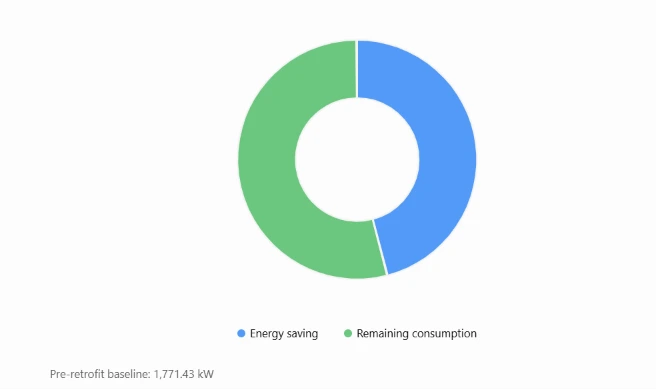
| 360+ AHUs | 600+ EC fans | 46%+ energy reduction | 823.029 kWh saved to date | 4,30,17,195.80 kWh saved to date |
| 360+ of 360+ installed | 600+ of 600+ installed | 1,771.43 kW to 948.40 kW | 11 purchase orders | Manual rebalancing dependency eliminated at retrofitted fans |
A leading pharmaceutical manufacturer operates a large-scale manufacturing facility in Baddi, Himachal Pradesh, which is part of one of India’s densest pharmaceutical production clusters. The site is served by 360 air handling units across areas of different cleanliness classes, each with its own validated airflow, ACPH and pressure differential. The fan fleet alone drew 1,771 kW before the retrofit. Holding that many controlled environments within their validated ranges continuously is the operating challenge at this scale.
Energy was never the problem. Control at scale was. Across 360+ AHUs, fixed-speed fans could only run at a single output, regardless of the room’s needs. Filter loading drifts the airflow over time: as resistance builds, a fixed-speed fan cannot compensate, and CFM and ACPH fall outside their validated range between manual checks. Door openings and leakage disturb the pressure cascade between different class areas in the same way.
Manual rebalancing does not scale to 360+ AHUs. Even with a dedicated team, there is always a gap between a parameter drifting and someone catching it, and in that gap particle recovery time after an intervention or cleaning cycle becomes inconsistent and unpredictable. Each AHU is a separate drift point, so the facility carried 360+ of them. The real question was not how to cut energy. It was about how to hold constant ACPH, maintain a stable pressure cascade, and achieve fast, repeatable particle recovery across every class area of the facility.
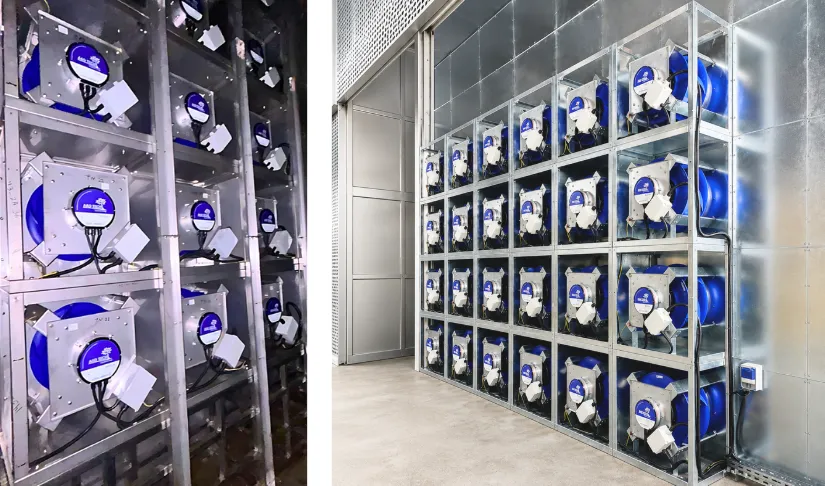
AAD Tech retrofitted all 600+ fans across all 360 AHUs with EC fan technology paired with closed-loop smart controllers, engineered to solve the control problem first. Sensors monitor the room’s real condition, airflow and pressure differential, live rather than periodically. The controller compares that reading with the facility’s validated target, the required ACPH and pressure cascade, not a fixed fan speed. The EC fan then speeds up or slows down in real time to keep the room within its validated range, compensating for filter loading, door events, and occupancy shifts the moment they occur.
Particle recovery time becomes consistent and repeatable because the system responds the same way every time, instead of depending on how recently a technician rebalanced that AHU. The rollout was phased across 11 purchase orders, without disrupting ongoing production, allowing the facility to validate results on early batches before committing to full coverage. Average fan power per AHU fell from 4.9 kW to 2.6 kW. Energy reduction occurs when a fan works only as hard as the room requires. It was the consequence of solving the control problem, not the objective around which the system was designed.
Energy efficiency is not the objective of a cleanroom retrofit. It is the by-product of getting control right. When every AHU holds its validated ACPH and cascade automatically, the facility gets audit-ready control and stops paying for airflow it never needed.
The same architecture also addresses the manual rebalancing workload and unplanned belt and bearing maintenance.