
EC Fan Retrofit for a Pharmaceutical Manufacturer | India
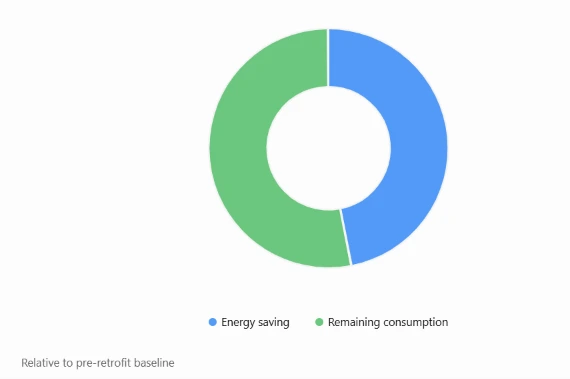
| 106+ AHUs | 277+ EC fans | 47%+ energy reduction | 391.764 kW saved | 2,69,55,177.39 kWh saved to date |
| 106+ of 106+ installed | 277+ of 277+ installed | 7 purchase orders | 32,08,242.24 kWh projected per year | 2.6 fans per AHU, one closed-loop response |
A pharmaceutical manufacturer operates a production facility served by 106 air-handling units, most of which carry more than one fan, for a total of 277. The AHUs supply controlled manufacturing areas of different classifications, each with validated ACPH, airflow and room-to-room pressure differentials. In a plant of this size, the ventilation fleet is a compliance asset as much as a utility, and its behaviour has to be predictable on every shift.
The challenge
The facility’s fans ran at a single fixed output, regardless of the room’s requirements. As filters load, resistance rises, and airflow falls, so CFM and ACPH leave their validated range between manual checks. Door openings and leakage disturb the pressure differential between classified areas, and a fixed-speed fan has no means of correcting it.
Multi-fan AHUs make this harder. With 277+ fans on 106+ units, any imbalance between fans on the same AHU changes what the room receives, and manual rebalancing has to be repeated fan by fan. Between rounds, particle recovery time after an intervention or cleaning cycle becomes inconsistent. The real question was how to hold constant ACPH, a stable pressure cascade across classes and fast, repeatable particle recovery across all 106 AHUs, with the room condition as the control target and not a fan speed.
The solution
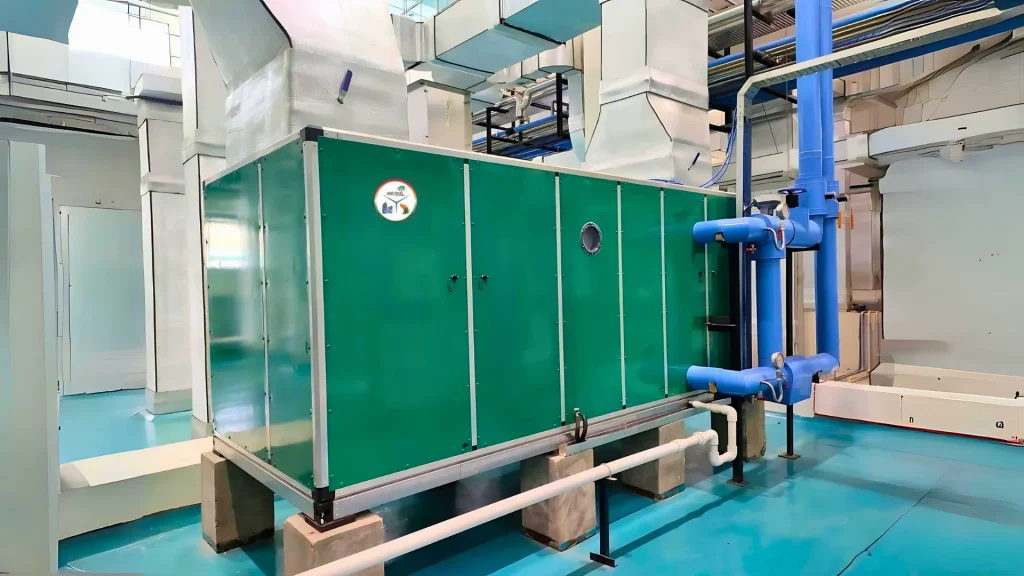
AAD Tech retrofitted all 277+ fans across all 106+ AHUs with EC fans and closed-loop controllers. Sensors continuously read the room’s airflow and pressure differential. The controller compares the reading with the validated target and commands the EC fans to the speed that holds it, whether an AHU carries one fan or several. Filter loading, door events, and leakage are corrected as they occur, not at the next manual round.
Because the response to a disturbance is the same every time, particle recovery becomes consistent and repeatable. The programme was delivered through 7 purchase orders, with all 277+ fans dispatched and installed. It saves 391.764 kW, about 3.7 kW per AHU. Cumulative savings stand at 2,69,55,177.39 kWh. Projected savings are 2,67,353.52 kWh per month and 32,08,242.24 kWh per year, assuming 30-day months and a system running 365 days. Those savings are the result of each fan working only as hard as the room requires.
Industry insight
A fixed-speed fan delivers the same output whether the room needs it or not, and AHUs spend 70 to 80 per cent of their life at part load, per AAD Tech engineering data. Controlling to room conditions removes that mismatch.
The same architecture also addresses pressure-cascade stability, belt and bearing maintenance, and live energy and alarm visibility.
Client snapshot
- Segment: Pharmaceutical manufacturing
- Facility: 106+ AHUs and 277+ EC fans. Cleanroom size and ISO class are not provided.
The results
- 47%+ — Average energy reduction
- 391.764 kW — Absolute power saved
- 2,69,55,177.39 kWh — Cumulative energy saved
- 2,67,353.52 kWh — Projected saving per month
- 32,08,242.24 kWh — Projected saving per year
- 106+ of 106+ AHUs, 277+ of 277+ fans — Dispatched and installed across 7 purchase orders
- ACPH and pressure cascade — Held by closed-loop control on every retrofitted AHU