
Cooling tower performance evaluation starts where the datasheet ends. Judge suppliers on approach at your real wet-bulb, part-load fan behaviour, redundancy and retrofit scope. Run your own cooling tower efficiency calculation and test every cooling tower performance parameter before you sign.
Key takeaways
- Approach at your site’s wet-bulb matters more than nominal TR.
- Part load is where fan energy is won or lost.
- One large fan is a single point of failure.
Your tower passed every datasheet check. Then May arrived, cold-water temperatures crept up, and the fans ran flat out anyway.
Most purchase engineers don’t get burned by price. They get burned by what the catalogue never showed: airflow that starves half the fill, fans with no part-load logic, one drive that takes the whole tower down. So how do you compare cooling tower manufacturers in India?
Cooling Tower Performance Evaluation: Why Datasheets Fail in Indian Summers
A tower selected only on nominal TR can underperform the moment wet-bulb climbs. Three cooling tower performance parameters carry the weight. Range is the gap between hot and cold water. Approach is the cold-water temperature minus the ambient wet-bulb temperature, and the Bureau of Energy Efficiency treats it as the better indicator of tower performance. Effectiveness is range divided by range plus approach. That is your cooling tower efficiency calculation in one line.
Run it at your peak summer wet-bulb, not the catalogue’s friendliest point. A good industrial cooling tower supplier will do this with you, using your flow, hot-water inlet and site conditions.
EVALUATE YOUR COOLING TOWER PERFORMANCE
Compare your tower’s efficiency, airflow and retrofit options with expert guidance from AAD Tech.
Contact UsWhat the Datasheet Won’t Tell You
How evenly the air reaches the fill
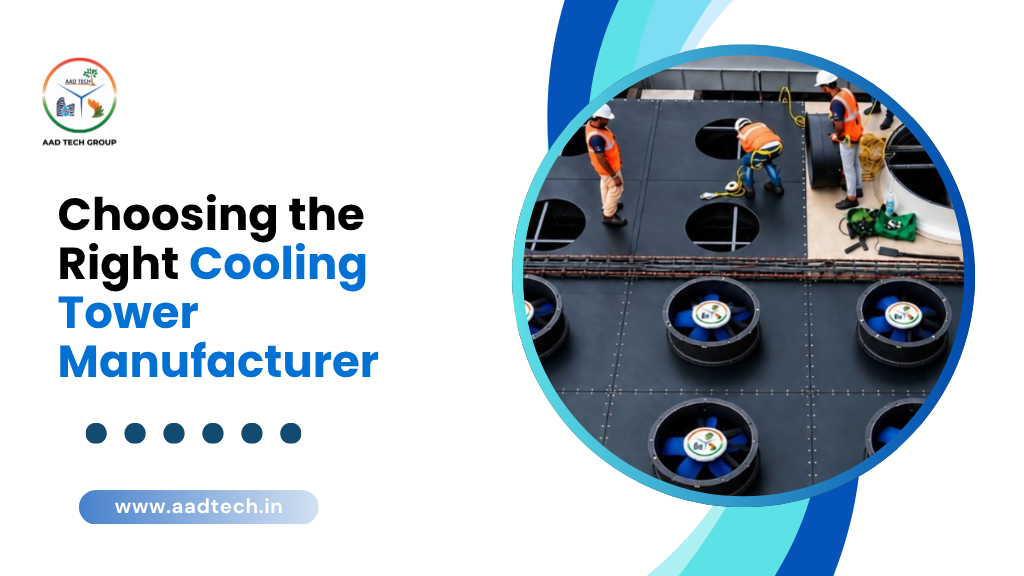
A single big fan can hit the stated airflow and still starve parts of the fill. The result is uneven heat transfer, recirculation and extra fan power for the same duty. AAD Tech’s retrofit swaps that one fan for an array of smaller EC axial fans, which spreads airflow more evenly and keeps the tower running if one fan trips.
What happens at part load
Towers rarely run at design load. A fixed-speed fan burns energy whenever it delivers more air than the load needs. AAD Tech’s Smart Controller reads live operating data and modulates fan speed to match demand, with BMS, Auto and Manual modes and Modbus connectivity. Ask every supplier for fan power at several load points, not just one.
Whether it survives your site
Voltage swings, humidity, dust and corrosion are routine in Indian plants. AAD Tech designs its EC fan assemblies for wide voltage ranges, surge and swell protection, high-humidity and corrosive environments, with bearings designed to reduce routine bearing maintenance. Validate these against your own water chemistry and power quality.
Retrofit or Replace? Often, You Don’t Need a New Tower
If the shell and basin are sound, retrofitting usually beats scrapping. AAD Tech removes the large fan and drive, fits an EC fan array with a smart controller, and keeps the usable structure. Fan energy savings of 40%+ are typical, depending on system size and load. One industrial unit in Gujarat reported energy use falling 35%+ within months. With 800+ projects and 25,000+ EC fan installations behind it, the approach is proven.
Questions to Ask Before You Shortlist
- What cold-water temperature can you guarantee at our wet-bulb, and how will it be tested?
- What is fan power at part load, not just design load?
- Is the fan system redundant? What capacity remains if one fan fails?
- Which spares do you recommend for 2 years, and what is the lead time?
- How will savings be measured and verified after commissioning?
FAQs
How do I start a cooling tower performance evaluation?
Measure the range and approach at your actual wet-bulb temperature, then compare them against the manufacturer’s design curve.
Can an old tower be retrofitted?
Yes, if the structure and basin are sound. EC fan arrays, smart controls, and fill upgrades slot in with minimal downtime.
What if one fan fails?
The remaining fans keep running, so the tower stays available.
Does it integrate with our BMS?
Yes. Controllers talk over Modbus and other protocols, with Auto and Manual modes.
Who can review our cooling tower efficiency calculation?
Our engineers can. Please find our contact page, share your flow, hot-water inlet, and summer wet-bulb, and we will map out approach, part-load, and retrofit options.