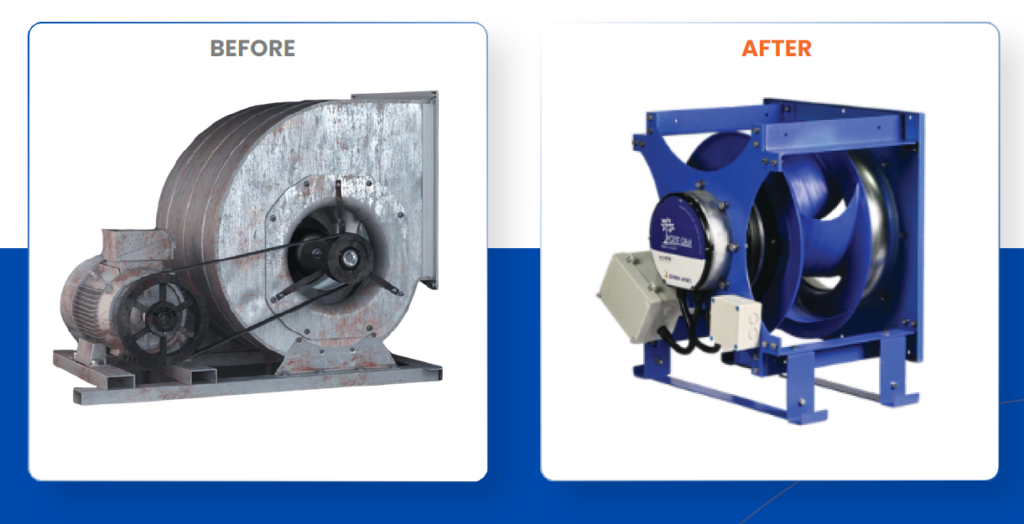
Replace the belt-driven centrifugal blower in your AHU with an electronically commutated fan, 30-50% less fan energy than traditional AC options, inside the casing you already have, with lower operating noise.

EC Drives Installed
Experts in Energy Efficient Retrofits

Lowering CO2 Footprint
600,000 tonnes of CO2 emissions saved

Equivalent to Planting Trees Reduced Carbon Footprint Equivalent to Planting 30+ Millions Trees

Energy Savings
Reduce HVAC energy consumption with high-efficiency EC fan retrofits.
Most air handling units in service today run a belt-driven centrifugal blower that was sized once and has been throttled at a damper ever since. Aad Tech’s EC centrifugal fans replace that assembly with a direct-driven, electronically commutated fan inside the same casing for simpler installation, suited to existing AHU casings and suitable for retrofit where space inside the unit is limited, cutting fan energy by 40-50% and removing the belt, pulley and drive faults that come with it.

An EC centrifugal fan combines a centrifugal impeller with an electronically commutated ec motor, a brushless DC motor where commutation is handled by onboard electronics. That electronics package is what makes the fan controllable: speed is set directly by a 0-10V or Modbus signal, with no VFD and no belt drive sitting in between, so it can operate efficiently at part load and reduce electricity use when demand drops. Aad Tech builds these fans on external rotor technology, with the impeller mounted directly onto the motor rotor. The result is a compact, direct-driven assembly that is easy to install in retrofit work, holds up across a wide voltage band, and supports quiet, reliable operation while integrating easily with Building Management Systems and reporting its own running status in real time.
Measurable energy reduction against your existing blower, and fewer of the failure modes that pull an AHU out of service.
Direct drive with no belt or VFD losses, plus speed matched continuously to actual demand instead of throttled at a damper the way your current blower is.
The assembly is dynamically balanced at the factory and needs no re-balancing on site. Belt slip, pulley wear, blown fuses and drive faults have no components left to originate from.
Modbus and 0-10V ready out of the box, with standalone sensor support. Speed, power draw and fault status are visible to your control system without add-on hardware.
Built to run across a broad voltage band with inbuilt protection against surges and swells — useful on Indian sites where supply quality shifts through the day.
Sealed and coated for high humidity and chemically aggressive air streams, so metal degradation does not take the fan out of service early.
High-quality sealed bearings rated for long service life. No greasing schedule, no shaft alignment, no annual belt tensioning to plan around.
The blower sitting in most AHUs today is a forward curved centrifugal blower, a double inlet wheel on a shaft, driven by belts and pulleys from a separate motor. It moves a lot of air for its size, which is why it became the default. It is also where the energy goes: losses at the belt, losses at the drive, and losses to the turbulence the blade geometry produces.
Backward Curved vs Forward Curved Impellers
A backward curved centrifugal fan with backward curved blades leans its blades away from the direction of rotation. Air leaves the wheel more slowly than the blade tip, so more of the input energy becomes useful static pressure rather than noise. The power curve is non-overloading, it flattens as system resistance changes instead of climbing past the motor’s rating, which makes the geometry suitable for ventilation duties where lower noise and stable pressure matter.
What Actually Changes When You Replace the Blower
The single biggest gain is not blade shape. It is losing the belt drive and gaining speed control: a direct-driven EC fan tracks real demand rather than running flat out against a damper, unlike conventional AC blower arrangements. That alone accounts for most of the 30-50% reduction our sites record.
An EC centrifugal fan is designed to drop directly into your existing AHU in place of the centrifugal blower. The blower wheel, shaft, bearings, belts, pulleys and separate motor all come out; the casing, coil bank, filter section and ductwork stay exactly where they are. Most changeovers are completed inside a single planned shutdown. Refurbishing existing AHUs can cost about 30% less than installing new units.
Most facilities running 16 hours a day or more recover the cost within 12 to 24 months. Retrofit work can also add over 15 years to AHU service life. Your own figure depends on electricity tariff, run hours and the efficiency of the fan being replaced, all three move the number significantly.
Where duty and casing dimensions allow, a fan wall with multiple EC fans can be used to improve reliability and simplify installation in retrofit work.
These fans run in HVAC, ventilation and selected industrial applications where airflow precision, air cleanliness and energy control are not negotiable. From pharmaceutical production suites and data centre halls to hospital theatres and commercial office towers, the same platform scales from a single AHU to a full plant room, with use in transportation support environments where specified.


An EC centrifugal fan is driven directly by an electronically commutated motor with speed control built in. A conventional blower runs on belts and pulleys from a separate motor, usually with a VFD. Removing the belt drive removes both the transmission loss and the parts that fail.
In most cases, yes. The EC fan replaces the blower, shaft and drive inside the existing casing — coils, filters and ductwork stay untouched. Send us your unit dimensions and duty point and we will confirm the fit.
Typically 30–50% of fan energy against a belt-driven blower at the same duty point. The saving comes from losing the belt and drive losses, plus speed matched to real demand instead of throttled at a damper.
There is no list price — cost depends on airflow, static pressure, frame size and control specification. The more useful number is payback: at 16 hours a day or more, most replacements recover their cost in 12 to 24 months.
Most changeovers are completed inside a single planned shutdown. Work stays confined to the fan section, so the unit returns to service the same shutdown it came out of.