
The Challenge of Sub-Zero Physics
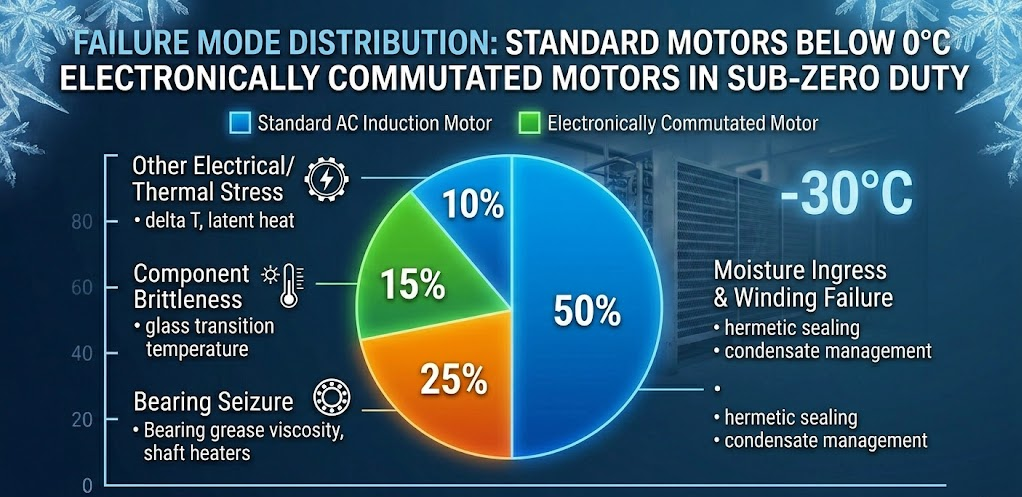
Operating mechanical and electronic equipment at cold-chain temperatures of -20°C or -40°C alters the fundamental behaviour of materials. Design engineers must account for three primary chokepoints.
Image 1: Failure Mode Pie Chart
Bearing Lubrication at Low Temperatures
Standard grease thickens and becomes viscous at freezing temperatures. It increases internal friction and puts immense strain on the motor shaft during startup. Research indicates that below -20°C, simple mineral base oils reach their pour point and cease to flow, potentially leading to metal-on-metal contact and bearing seizure. EC motors for these applications specify synthetic Polyalphaolefin (PAO) lubricants with high viscosity indices to ensure smooth rotation.
Moisture Ingress and Condensation
Temperature fluctuations are common during defrost cycles, creating a vacuum effect inside the motor housing. As the motor cools, it draws in moist air. When the motor restarts, this moisture condenses and then freezes into ice. Academic studies on the life extension of electrical motors highlight that moisture ingress is a leading cause of winding failure due to insulation tracking. High IP ratings and hermetic sealing are mandatory for sub-zero EC motors to prevent this breathing effect.
Managing Component Brittle Point
Many polymers reach a glass transition temperature where they become brittle. A standard fan blade might shatter if struck by ice pellets during a high-torque start. Engineers specify high-impact polymers that retain flexibility across extreme cold chain temperatures, preventing catastrophic mechanical failure.
Why EC Motors Excel in Refrigeration
Minimal Heat Dissipation
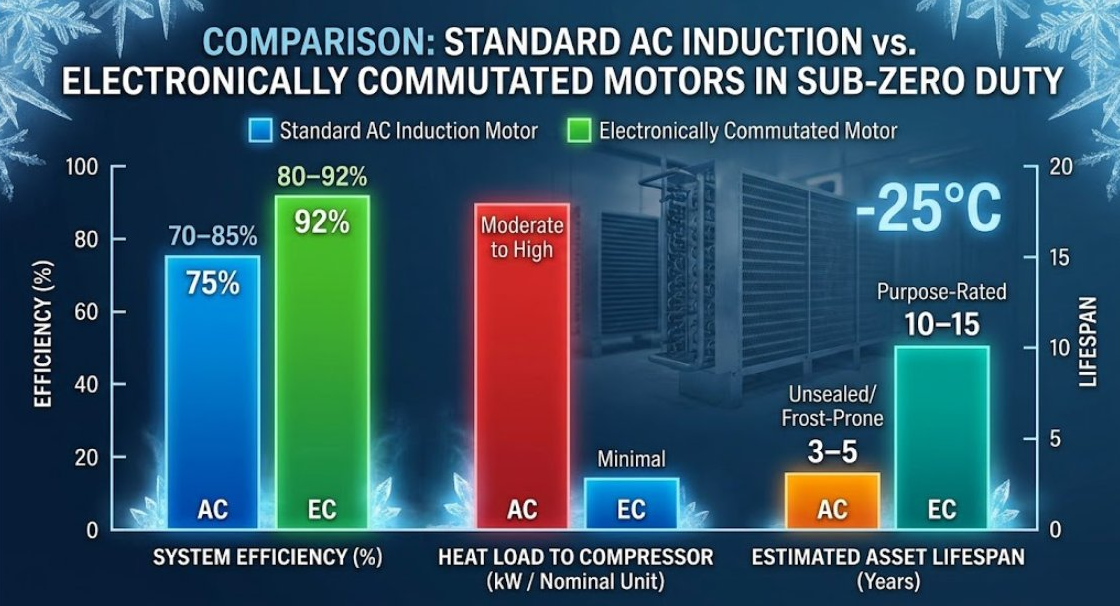
Because they utilise permanent magnets rather than induced fields, EC motors convert electrical energy into kinetic energy with minimal loss. While standard AC induction fans typically operate in the 70–85% efficiency band, EC-motor-driven fans often achieve 80–90% efficiency, with leading-edge designs reaching the low-90% range. By reducing the latent heat introduced into the room, the Delta T (temperature difference) across the evaporator coil remains stable.
Intelligent Speed Control
Refrigeration loads are dynamic. According to ASHRAE 90.1 energy standards, the ability to modulate speed is critical for energy conservation. EC motors allow for infinite speed adjustment (0–100%). Due to the fan affinity laws, running a fan at 80% speed can save nearly 50% of the energy compared to full-speed operation.
Critical Design Features for -30°C
- Shaft Heaters and Anti-Freeze Kits: Internal heaters prevent lubricants from congealing while the motor is stationary.
- Potting for Electronics: Onboard PCBs are potted in epoxy resin to protect against moisture and stabilise solder joints against thermal expansion.
- Drainage Plugs and Venting: Specialised weep holes allow condensate to drain away before it turns to ice.
How to Choose: Specification Quick-Guide
To ensure long-term reliability, facility managers should verify two critical parameters before retrofit or installation:
What minimum temperature rating should I look for in an EC motor for a -20°C cold room?
Always match the EC motor’s specified minimum operating temperature with the worst-case cabinet condition (including expected dew-point drops). For a -20°C room, a motor rated to at least -30°C or -40°C is required to maintain safety margins during deep-freeze cycles.
Which IP rating is required for EC motors in defrost-cycle environments?
A minimum rating of IP55 is required to block standard condensation, though IP66 or IP67 is highly recommended for evaporator environments subjected to heavy frost heave and wet defrost cycles.
Economic Impact on the Cold Chain
Energy is the largest operational expense in cold chain facilities. The DOE has recently updated motor efficiency standards, pushing the industry toward IE4 and IE5 efficiency levels. Upgrading to an EC motor reduces energy consumption across the entire refrigeration plant simply by reducing the parasitic heat load on the compressors.
The table below compares standard AC induction motors with EC-motor-driven fans under harsh, sub-zero cold-storage duty.
| Feature | Standard AC Induction Motor | Electronically Commutated Motor |
| Efficiency | 70% – 85% | 80% – 92% |
| Heat Output | Moderate to High | Minimal |
| Speed Control | Limited / Step Control | 0–100% Modulation |
| Lifespan at 0°C (Harsh Duty) | 3 – 5 Years (Unsealed / Frost-Prone) | 10 – 15 Years (Purpose-Rated) |
Image 2:
Frequently Asked Questions
Yes. However, the motor must be explicitly rated for such temperatures, utilising specialised arctic-grade lubricants and resilient sealing materials to prevent mechanical failure.
Total system savings typically range from 30% to 50%, with optimised refrigeration and AHU installations achieving up to 70% fan energy reduction when EC motors replace fixed-speed AC fans. It includes both the direct reduction in fan power and the secondary reduction in compressor load.
Cold environments actually improve semiconductor efficiency. The primary risk to electronics is moisture ingress. In harsh, frost-prone cold-storage environments, unsealed motors may only last 3–5 years, whereas purpose-rated EC-motor fans in properly managed systems commonly reach 10–15 years of service life.
Motors must overcome the resistance of thickened grease and potential frost buildup on the blades. EC motors provide high starting torque to “break” these bonds instantly.
Yes. Most are “drop-in” replacements that accept standard 0-10V, 4-20mA, or PWM control signals common in Building Management Systems (BMS).