
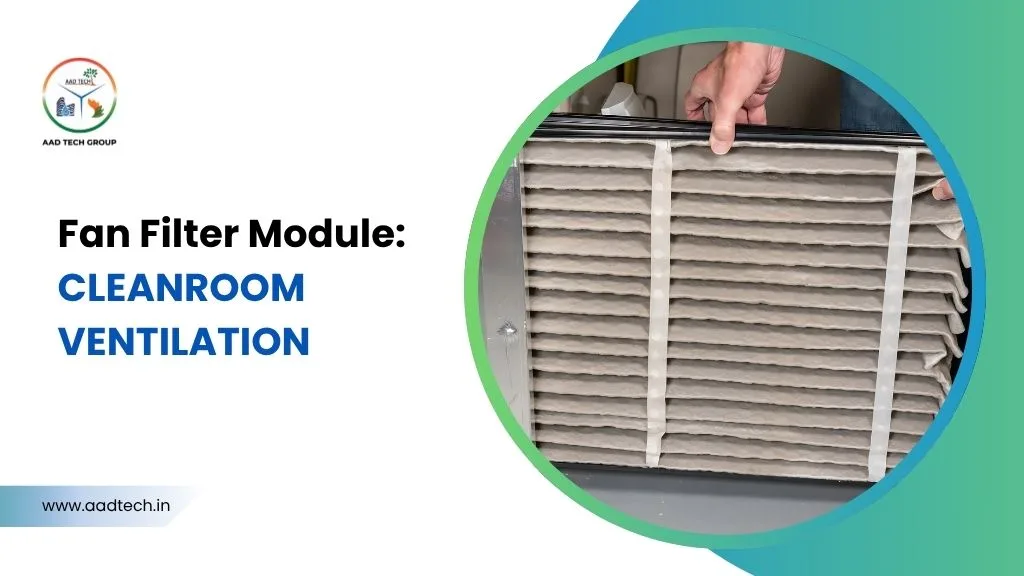
All cleanrooms have a non-negotiable need to preserve air quality. Regardless of application in pharmaceuticals, electronics production, biotech, or healthcare facilities, cleanrooms require a controlled environment where airborne particles are reduced to high levels of industry compliance. At the center of this system is a significant component, the Fan Filter Module (FFM).
Businesses such as Airpac Cleantech, a part of AAD Tech Group, are advancing the cleanroom technology through trustworthy fan filter solutions optimized for accurate airflow control, filtration performance, and energy efficiency. Having knowledge of how an FFM works and why it is necessary is the first step in designing a clean, contamination-free working environment.
What is a Fan Filter Module?
A Fan Filter Module is a self-supporting, ceiling-suspended unit that will deliver clean, filtered air to a controlled area. It integrates a fan and a high-efficiency particulate air (HEPA) or ultra-low penetration air (ULPA) filter into one unit.
The fan sucks in ambient air, which then moves through the filter, eliminating dust, microbes, and other impurities. The purified air is then dispersed uniformly into the cleanroom at a steady velocity, ensuring the desired level of cleanliness in accordance with ISO or GMP standards.
FFMs are modular in construction, which suits both new cleanroom installations and retrofitting existing facilities.
How Fan Filter Modules Improve Cleanroom Ventilation
A cleanroom’s effectiveness is defined by its ability to manage airflow and particulates. FFMs are pivotal in achieving this through:
- Delivering Uniform Airflow: An FFM provides a uniform laminar airflow, reducing turbulence that may result in particle recirculation.
- Removing Contaminants at the Point of Origin: High-quality HEPA or ULPA filters trap up to 99.999% of airborne particles, which ensures the air entering the cleanroom is contaminant-free.
- Facilitating Zonal Control: Several FFMs may be mounted throughout a cleanroom so certain areas can have higher levels of cleanliness for delicate operations.
- Supporting Positive Pressure Environments: FFMs create a marginally increased air pressure within the cleanroom over surrounding areas, keeping unfiltered air out.
Applications Throughout Industries
Fan Filter Modules are essential in industries where even submicroscopic contamination threatens product quality or safety. Typical uses include:
- Pharmaceutical Manufacturing: For sterile drug processing and packaging.
- Electronics & Semiconductor Production: Preventing sensitive components from static and dust.
- Food & Beverage Production: Maintaining cleanliness in packaging and preparation rooms.
- Hospitals & Labs: Sterile conditions within operating theatres, ICUs, and testing labs.
Energy Efficiency and Noise Reduction
Newer FFMs, like those manufactured by Airpac Cleantech, a part of AAD Tech Group, use EC (Electronically Commutated) fan technology, which provides excellent energy savings over AC fans. EC fans not only save power but are also quieter, an essential consideration in work environments where quieting the environment enhances comfort and productivity.
Critical Factors in Selecting a Fan Filter Module
The correct selection of the FFM for your cleanroom involves considering aspects like:
- Airflow Requirements: Based on cleanroom classification and process requirements.
- Filter Type & Efficiency: HEPA or ULPA depending on particle size control.
- Noise Level: Extremely important for operator comfort and workplace compliance.
- Energy Consumption: EC fans offer potential long-term cost savings.
- Ease of Maintenance: Modular designs make filter replacement and maintenance easier.
Aad Tech’s Role in Delivering Reliable Cleanroom Solutions
Airpac Cleantech, a part of AAD Tech Group, offers high-performance cleanroom fan filter solutions optimized to achieve global cleanroom standards while maintaining efficiency in operation. Designed with attention to precision engineering, low energy use, and long lifetimes, Airpac Cleantech, a part of AAD Tech Group, modules are optimized for applications in sectors where air purity directly affects quality and safety.
Their fan filter units seamlessly fit into a wide range of cleanroom configurations and provide scalable solutions for small-scale laboratory settings as well as large-scale industrial installations.
Conclusion
Cleanrooms are just as good as the ventilation system they have, and Fan Filter Modules form the backbone of that function. By providing a constant stream of clean air, they safeguard products, processes, and people from microscopic dangers.
Thanks to visionary companies like Airpac Cleantech, a part of AAD Tech Group, businesses can have cleanroom ventilation systems that not only satisfy compliance but also provide energy efficiency, minimal maintenance, and long-term operating value.