
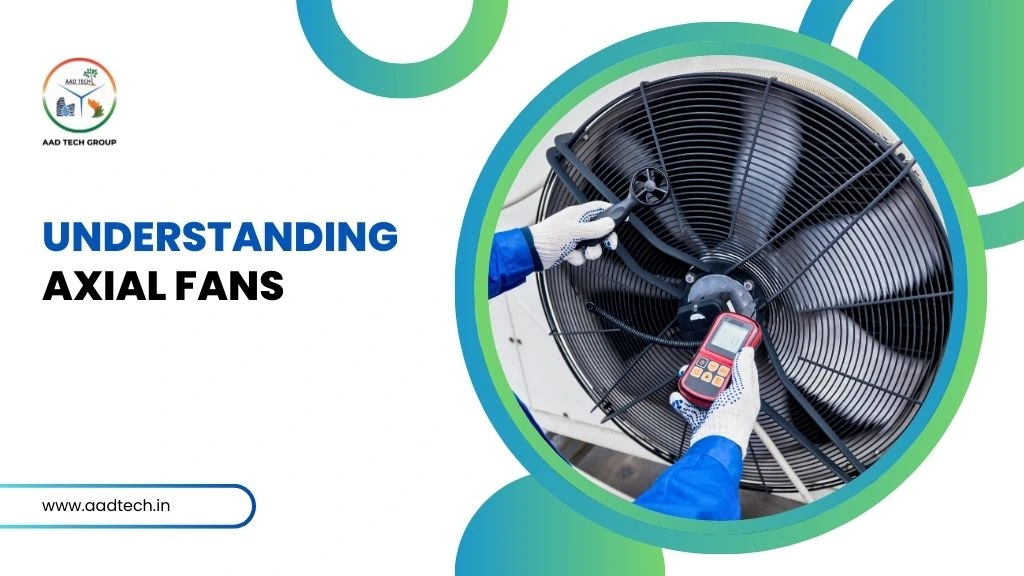
Axial fans are one of the most common air-moving devices in industrial and commercial environments. They move air along the axis of rotation—so air enters on one side of the hub and exits on the other in the same direction. This allows them to move large volumes of air with relatively low resistance, making them ideal for ventilation and cooling applications.
At Aad Tech, axial fans are included in our product portfolio alongside air-handling units, cooling towers and retrofit solutions. They form a key component for ventilation, cooling tower upgrades and air handling systems.
How Axial Fans Work
Axial fans pull air from one side and push it out the other in the same direction. This straight-through airflow design allows the fan to deliver:
High air volume,
Lower power consumption,
Compact installation, and
Flexible mounting options.
These characteristics make axial fans suitable for systems where airflow, space, and simplicity matter more than static pressure.
Learn more about EC technology and why it outperforms non-EC motors
Key Features of Axial Fans
When choosing an axial fan, some features are especially important:
- Blade design and pitch – Determines how much air the fan can move and at what speed.
- Motor and drive type – High-efficiency motors or EC motors and variable‐speed control help improve energy performance.
- Mounting flexibility – Axial fans can be wall mounted, duct mounted, rooftop mounted, or integrated into modular fan banks.
- Compact size – Because the air path is straight through, the fan typically requires less space than some duct fans or centrifugal fans.
- Ease of access and maintenance – Many axial fan modules are designed for quick removal or servicing, making maintenance simpler.
Common Applications of Axial Fans
Axial fans are used across a wide range of settings:
- Cooling towers – They are often used to pull air upward through fill media, especially in retrofit solutions that replace older fan systems with more efficient axial modules.
- Ventilation and exhaust systems – In factories, warehouses, large public spaces and HVAC systems, axial fans provide large-volume airflow for general ventilation, fresh air supply and exhaust.
- Air-handling units (AHUs) – In moderate-resistance duct systems, axial fans help move air through filters, coils and supply/exhaust circuits.
- Industrial equipment cooling – Machines, condensers and heat exchangers often use axial fans for direct airflow in compact spaces.
- Commercial buildings – Offices, hotels, hospitals, airports use axial fans for spaces requiring large airflow but not extremely high static pressure.
Why Use Axial Fans?
Axial fans offer several advantages:
- They handle large volumes of air more efficiently than many other types in appropriate applications.
- Their compact design allows installation in limited space, making them suitable for retrofits and upgrades.
- With modern motor and drive technology, axial fans can be highly energy-efficient.
- In modular systems, such as cooling-tower retrofits, multiple smaller axial fan modules offer redundancy, ease of maintenance and smoother operation.
At Aad Tech we incorporate these principles when supplying axial fan systems, particularly in cooling tower and ventilation upgrade projects.
Conclusion
Axial fans remain an essential element of air movement systems in industrial and commercial facilities. Their ability to deliver high airflow with relatively simple design makes them versatile and effective. Whether you’re upgrading ventilation, improving cooling towers or enhancing an AHU, selecting the right axial fan module matters.
At Aad Tech, we support clients with axial fan solutions designed for reliability, performance and energy efficiency. If you’re considering a ventilation or cooling upgrade, axial fans are a strong choice and understanding their features and applications helps you make the right decision.
Frequently Asked Questions
Generally not. Axial fans perform best where static pressure is moderate. Very high resistance systems may require other fan types.
Yes, many retrofits replace older fans with efficient axial fan modules to improve airflow, reduce energy and simplify maintenance.
Yes, particularly when paired with efficient motors or variable speed drives and matched to the correct application.
It depends on the environment; however, regular inspections of blades, motor bearings and mounting are recommended as part of routine maintenance.
Companies like Aad Tech provide axial fan modules, ventilation upgrades and cooling-tower retrofit services tailored to commercial and industrial requirements.