
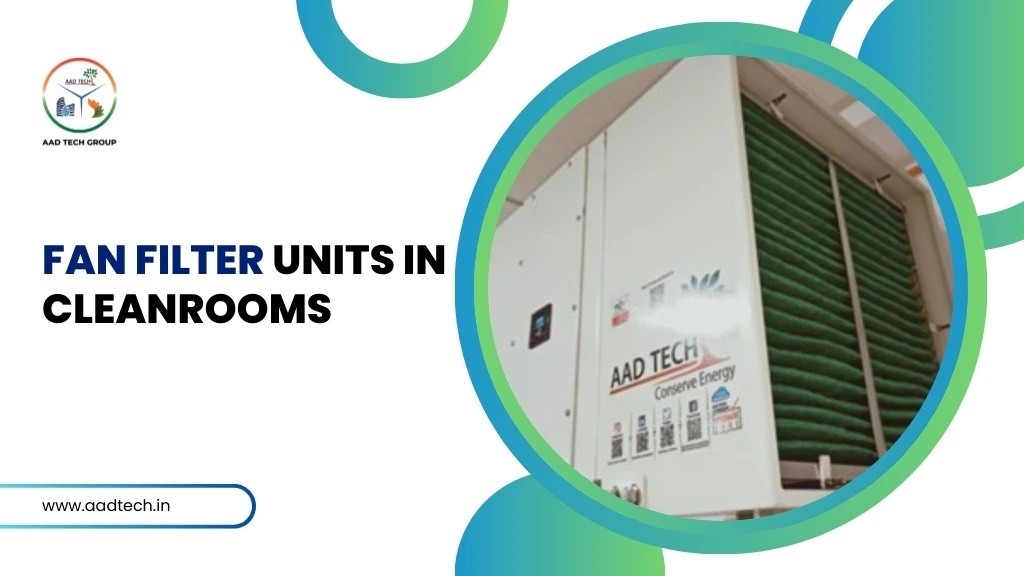
Cleanrooms depend on controlled airflow and high-efficiency filtration to keep sensitive processes free from airborne contamination. Whether used in pharmaceuticals, electronics, biotechnology or medical device manufacturing, the goal is always the same: maintain a stable, particle-free environment that meets strict standards.
One of the most effective ways to deliver clean, filtered air into these spaces is through a Cleanroom Fan Filter Unit (FFU). It is a compact, modular filtration system that combines a motorised fan and a high-efficiency filter inside a single housing. In this blog, we explain how FFUs work and why they are widely used in cleanroom design and retrofits.
What Is a Fan Filter Unit
A Fan Filter Unit is a self-contained piece of equipment that pulls in air from the plenum or surrounding space, filters it and pushes it into the cleanroom. Because the fan and filter are integrated into one unit, FFUs can be installed in a grid pattern across the cleanroom ceiling.
This approach helps maintain uniform airflow and makes it easier to scale up or reconfigure cleanrooms as requirements change.
How a Fan Filter Unit Works Inside a Cleanroom
Although FFUs come in different sizes and configurations, they follow the same basic operating sequence. Below is a simple explanation of how the air moves through the system.
1. Air Intake
The FFU pulls in ambient or recirculated air from the ceiling plenum. Some units may include a prefilter to remove larger dust particles before the main filtration stage.
2. Filtration Through HEPA or ULPA Filters
Once the air enters the unit, it passes through a high efficiency filter such as:
- HEPA which captures 99.97 percent of particles 0.3 microns and larger.
- ULPA which captures even smaller particles for more demanding cleanroom classes.
These filters remove dust, microorganisms, aerosols and other airborne contaminants.
3. Fan Driven Air Delivery
A motorized fan pushes the filtered air down into the cleanroom. Many modern FFUs use energy efficient motors that can adjust speed to maintain stable airflow rates.
4. Airflow Distribution Inside the Cleanroom
The clean air flows downward in a smooth and uniform pattern. This helps push contaminated air toward low wall returns or floor level exhaust points. The constant movement of filtered air keeps the environment clean and ensures the required air change rate for the cleanroom standard.
Learn more about how Fan Filter Units support cleanroom standards in our in-depth breakdown.
Benefits of Using FFUs in Cleanrooms
FFUs offer several advantages that make them suitable for cleanroom construction, expansion and retrofits.
Modular Design
FFUs can be added, removed or relocated easily, which helps when expanding production areas or upgrading cleanliness levels.
Uniform Airflow
Placing multiple FFUs across the ceiling grid creates even airflow distribution. This improves stability and helps maintain consistent environmental conditions.
Energy Savings
Modern FFUs use energy efficient motors that can adjust speed based on demand. This allows cleanrooms to cut unnecessary energy use during low load conditions.
Reduced Ductwork
Since each FFU is self powered, there is less reliance on large ducted HVAC systems. This results in simpler layouts and lower installation costs.
Ease of Maintenance
Filters can be replaced individually without shutting down the entire cleanroom. Technicians can service one unit at a time while others continue operating.
Where Fan Filter Units Are Commonly Used
FFUs are found in a wide range of industries that require particle-controlled environments. These include:
- Pharmaceutical and biopharmaceutical manufacturing
- Semiconductor and electronics production
- Optical and precision assembly
- Medical device manufacturing
- Research laboratories
- Food and beverage testing areas
They are suitable for both once-through and recirculating cleanroom designs.
Conclusion
Fan Filter Units provide a simple and effective solution for delivering clean air into controlled environments. Their ability to combine a fan and high-efficiency filtration into one compact module makes them ideal for cleanrooms that require flexibility, scalability and uniform airflow. Whether used in new construction or retrofit projects, FFUs help maintain reliable air cleanliness levels that support sensitive manufacturing and laboratory operations.At Aad Tech, we support cleanroom clients by providing reliable FFU-based solutions, helping them maintain stable air quality while keeping systems efficient, easy to service and adaptable for future expansion.
Frequently Asked Questions
Most units use HEPA filters and some use ULPA filters for higher cleanliness levels.
Yes. Their modular design makes them suitable for retrofit and expansion projects.
It depends on usage conditions. Many facilities replace HEPA filters every one to three years.
Yes. Many models use low power motors or EC motors to reduce energy consumption.
No. AHUs still provide temperature and humidity control. FFUs mainly handle final stage filtration and local airflow delivery.