
Buying an Air Handling Unit (AHU) requires massive capital investment. In India, many facility managers still treat an AHU as a simple metal box. This error costs companies lakhs of rupees. Poor design inflates your energy bills for the entire life of the plant. You must rigorously evaluate the internal engineering.
To find the best air handling unit manufacturers in India, ask these five critical questions. They will help you secure a system built for the extreme Indian climate. From the 85% relative humidity of a Mumbai monsoon to the heavy PM2.5 dust loads of a Delhi winter, your equipment must handle severe stress.
1. How does your design adapt to India’s diverse ambient conditions?
The air handling unit’s working principle seems simple on paper. The unit takes in ambient air, regulates temperature, controls humidity, filters dust, and distributes clean air. However, applying this principle in India poses a massive mechanical challenge.
European catalogue models often fail in India. They underestimate the high moisture loads on the coast. In cities like Chennai or Kolkata, an AHU works much harder to pull water out of the air than to drop the temperature. Conversely, in Northern India, extreme dry heat and dense dust require thick cooling coils and heavy pre-filtration.
Ask your manufacturer if they calculate their coil circuitry for your specific local climate. They must not simply supply an oversized unit to cover all bases. Oversizing causes rapid equipment cycling. This cycling ruins your power efficiency, breaks down compressors, and spikes your monthly utility costs.
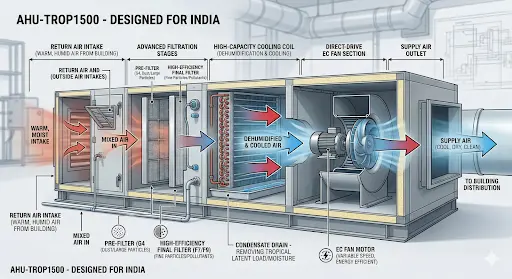
Figure 1:The internal working principle of a modern, energy-optimised Air Handling Unit designed to handle high static pressure and tropical humidity.
2. Do you offer application-specific types of air handling units, or just standard boxes?
Every commercial building must meet strict thermal and hygienic requirements. A retail mall in Bangalore does not need the air quality of a sterile injectable plant in Gujarat. When evaluating types of air handling units, verify that the manufacturer understands the exact technical benchmarks for your specific sector.
Do not accept a generic, one-size-fits-all box. Look for these specific builds:
- Hygienic AHUs (Healthcare and Pharma): These units must strictly comply with ISO 14644 standards. Look for 50mm or 60mm double-skin casing panels. They must feature coved internal corners to stop dangerous bacterial growth. They require multi-stage filtration setups, typically ending with H13 or H14 HEPA filters that deliver 99.97% efficiency against microscopic particles.
- Commercial and Modular Units: These designs focus on high airflow-to-footprint ratios. Ensure they feature integrated variable frequency drives (VFDs). They must allow for easy stacking in tight plant rooms, a common space issue in dense cities like Mumbai or Pune.
- Industrial Process AHUs: Manufacturing plants demand high static pressure. The AHU fan must often overcome internal pressures exceeding 150 mmwg to push air through long duct networks and heavy dust filters.
- Energy Recovery Ventilators (ERV): In highly humid climates, these units use treated exhaust air to pre-cool incoming fresh air. This smart thermal exchange reduces your total chiller load by up to 20%.
Choosing a manufacturer that treats these applications as distinct engineering challenges is vital. For a deeper technical dive, consider comparing different types of air handling units to find the configuration that best matches your facility layout.
3. Are you integrating Direct-Drive EC Fans, or relying on outdated belt-driven systems?
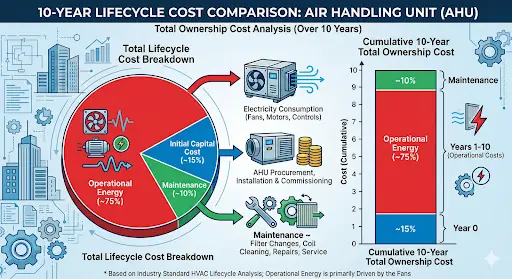
The fan acts as the absolute heart of the AHU. In India’s highly energy-sensitive market, the indispensable role of AHU fans dictates your operational budget. Traditional belt-driven AC fans suffer from severe mechanical flaws. Belt slippage alone causes a 5% to 10% loss in power transfer. Bearings wear out fast. The rubber belts also shed fine dust, creating a major contamination hazard for cleanroom environments.
Authoritative modern manufacturers have transitioned fully to Electronically Commutated (EC) fans. These advanced direct-drive systems offer massive performance upgrades over old technology:
- Superior Efficiency: EC fans use highly efficient DC motors with integrated AC power supplies. They cut massive amounts of wasted heat.
- Variable Speed Control: The integrated electronics enable the fan motor to match real-time building demand perfectly. You only pay for the exact airflow you need.
- Zero Belt Maintenance: Because they have no belts to tighten or pulleys to align, you eliminate all the expensive downtime associated with maintenance.
4. How do you address Thermal Bridging and Condensation in high-humidity zones?
In humid coastal climates, a sweating AHU is a common and dangerous sight. This external water pooling is not just a cosmetic flaw. It acts as a glaring warning sign of a cheap casing design. Suppose the AHU cabinet lacks a proper Thermal Break profile, internal cold transfers rapidly through the metal frame to the warm exterior. Engineers call this process thermal bridging.
This thermal bridging causes external condensation. The condensation creates three severe problems for your facility:
- Rapid Corrosion: Your expensive AHU housing degrades and rusts out in as little as three years.
- Microbial Growth: The constant wetness creates a perfect breeding ground for toxic mould and fungi near your air supply.
- Massive Energy Loss: Your costly cooling energy literally escapes through the thin metal walls of the unit.
You must insist on a casing design with certified Thermal Transmittance (T2/T1) and Thermal Bridging (TB2/TB1) ratings. A high-performance thermal break unit traps the cold air inside the box and keeps the exterior panels completely dry.
5. Can you validate your energy efficiency against recognised standards?
A manufacturer’s sales pitch holds zero value without hard data backing it. In the competitive Indian market, you must demand strict performance validation. Ask the manufacturer to run their internal selection software. Ensure this software strictly aligns with global Eurovent or AHRI standards.
Ask them to hand over a detailed technical submittal. This technical document must clearly list the Specific Fan Power (SFP) and the exact pressure drops across all cooling coils and filter banks.
Before you finalise any major capital purchase, cross-reference their maintenance and performance claims. Use trusted industry guidelines. Check their data against the ISHRAE AHU Selection Guide or the U.S. Department of Energy (NREL) official checklists. This critical review step ensures your final unit meets strict global standards for airflow delivery and long-term energy conservation.
Standard AHU vs High-Performance AHU Specs in India
| Feature | Standard Spec | Recommended Indian Spec | Impact |
| Fan Type | Belt-Driven AC Motor | Direct-Drive EC Fan | Saves 30% on bills<sup>[AMCA 210]</sup>. |
| Casing Profile | Standard GI | Thermal Break (TB2/TB1) | Stops rust and sweating |
| Filtration | Basic G4 Pre-filter | Multi-stage (G4+F9+HEPA) | Protects coils, ensures IAQ. |
| Motor Efficiency | IE2 or Lower | IE5 (EC Integrated) | Part-load savings dominate. |
Frequently Asked Questions
An AHU acts as a building’s lung, filtering and cooling ambient air before distributing it via high-pressure fans.
Key types include Hygienic (Pharma), Modular (Commercial), Heavy-Duty (Industrial), and ERVs for coastal humidity.
EC fans use direct-drive DC motors with built-in speed control to eliminate belt-slip and cut energy waste by 30%.