
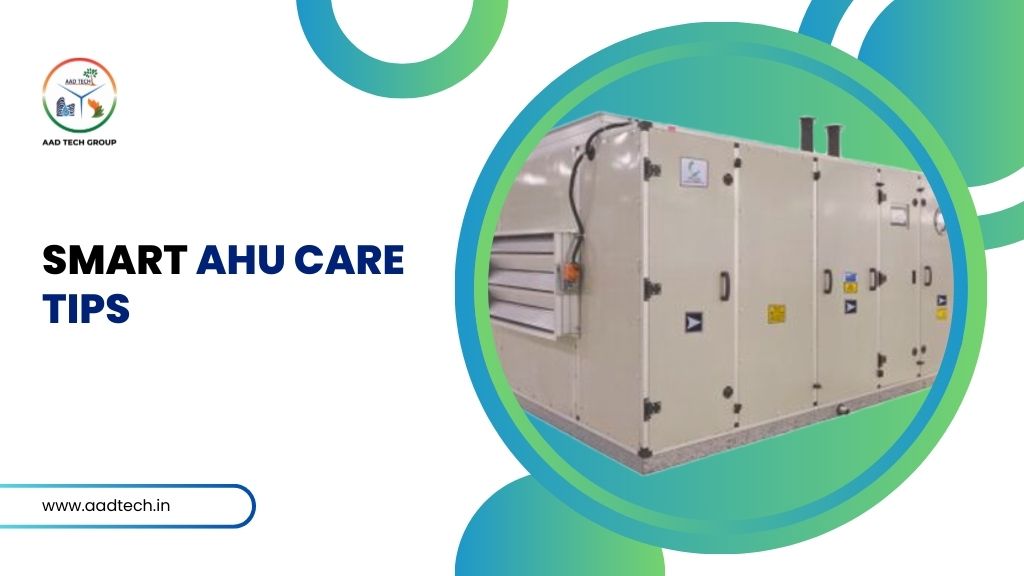
Air Handling Units (AHUs) are essential for maintaining proper ventilation, airflow, and indoor environmental quality. Regardless of the building type or the AHU’s specific configuration, consistent maintenance is necessary to ensure reliability, hygiene, and energy-efficient operation.
Below are universal AHU maintenance best practices applicable to all AHU designs, including modern beltless or EC fan–based systems.
1. Inspect and Replace Air Filters Regularly
Filters are the primary barrier against dust and airborne contaminants. As they load with particles, airflow decreases and the system becomes less efficient.
Best practices:
- Inspect filters periodically, depending on dust levels and operational hours.
- Replace or clean filters when recommended pressure-drop limits are reached.
- Maintain a logbook to track filter life and pressure-drop trends.
Clean filters support good air quality and reduce stress on downstream components. At AAD Tech, we configure a Magnehelic gauge on filter that communicates with the BMS if the filter is choked and needs cleaning. This process enhances air flow and efficiency of fan saving energy and future maintenance costs.
2. Clean and Maintain Coils
Cooling and heating coils can accumulate dust, moisture films, and microbial growth, reducing heat transfer effectiveness.
Maintenance steps include:
- Cleaning coil surfaces with approved methods.
- Checking temperature differentials across coils.
- Inspecting for fin blockage, corrosion, or dirt accumulation.
- Ensuring coil control valves and actuators operate correctly.
Clean coils help maintain stable temperatures and consistent airflow.
3. Verify Airflow Pathways and Damper Operation
Stable airflow is essential for consistent ventilation and system performance.
Recommended checks:
- Inspect outside air, return air, and exhaust/mixing dampers for smooth movement.
- Test actuators and linkages for accuracy.
- Look for air leakage around damper frames and blades.
- Measure static pressure to confirm airflow integrity.
Well-functioning dampers help maintain proper ventilation rates and system balance.
4. Check AHU Casing, Panels, and Insulation
The structural integrity of the AHU directly affects energy efficiency and hygiene.
Routine tasks:
- Inspect access doors for proper sealing.
- Check panel joints and gaskets for wear or leakage.
- Evaluate internal insulation for cleanliness and secure attachment.
- Address corrosion, cracks, or loose components immediately.
A well-sealed AHU prevents infiltration, moisture issues, and energy loss.
5. Maintain Drain Pans and Condensate Systems
Moisture accumulation inside AHUs can lead to microbial growth and operational disruptions.
Key actions:
- Clean drain pans to remove algae, sludge, or sediment.
- Ensure condensate drain lines have proper slope and are unobstructed.
- Flush traps and drain lines periodically.
- Inspect for signs of pooling water or slow drainage.
Proper condensate management prevents leaks, odors, and hygiene concerns.
6. Test and Calibrate Sensors & Control Systems
AHUs rely on sensors and automated controls to regulate environmental conditions.
Essential maintenance actions:
- Calibrate temperature, humidity, differential pressure, and CO₂ sensors regularly.
- Review control algorithms and setpoints in the building or local control system.
- Validate that dampers, control valves, and monitoring devices respond correctly.
- Confirm that alarms and safety interlocks function as intended.
Accurate sensors and well-calibrated controls ensure stable, efficient operation.
7. Conduct Periodic Deep Cleaning and Annual Performance Reviews
Beyond routine checks, deeper inspections help identify and correct hidden issues.
Annual AHU evaluations typically include:
- Thorough internal cleaning of the unit.
- Inspection of all sensors, actuators, and control components.
- Review of airflow and pressure values across major sections.
- Assessment of outdoor air intake conditions.
- Analysis of operational logs and energy performance trends.
A structured annual audit helps maintain long-term AHU reliability.
Conclusion
Reliable AHU Retrofit operation depends on:
- Routine inspections
- Filter and coil upkeep
- Airflow and damper verification
- Drainage system maintenance
- Sensor calibration
- Regular deep cleaning and system reviews
These steps help maintain ventilation quality, reduce energy consumption, and prevent unplanned downtime.
At AAD Tech, we help facilities modernise older AHUs by replacing conventional belt-driven systems with EC fan–based retrofit solutions, and by integrating IoT-enabled controllers and sensors for predictive and preventive maintenance. This significantly reduces manual servicing needs and long-term maintenance costs.
Learn more about how static pressure impacts HVAC efficiency
Frequently Asked Questions
Filter inspections should be done at intervals based on dust load typically every 2 to 8 weeks. Replacement should follow the recommended pressure-drop limit.
Dirty coils reduce heat transfer efficiency and restrict airflow, leading to higher energy consumption and inconsistent temperature control.
Common causes include clogged filters, damper malfunction, duct leakage, or blockages in airflow pathways.
At least once a year, or more frequently in critical or sensitive environments.
Yes. EC fan–based retrofits eliminate belts and reduce moving parts. Combined with IoT monitoring, they enable predictive maintenance and lower servicing frequency.