
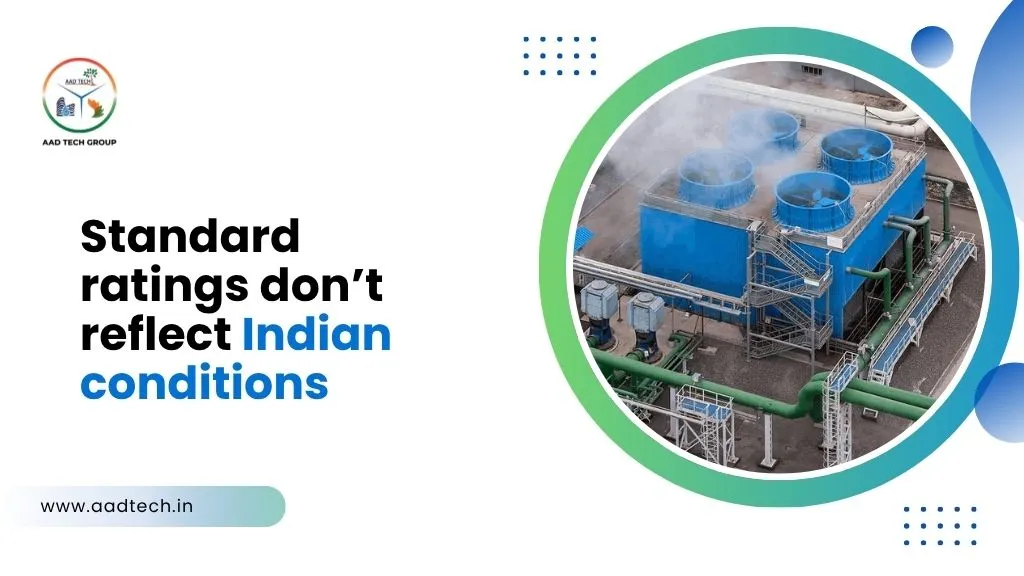
It is a familiar dread for facility managers across India. As May approaches and temperatures in the Gujarat chemical belts push 45°C, or the humidity in Chennai crosses 80%, the plant’s cooling tower (the very one the catalogue promised would deliver 500 TR) suddenly cannot keep up. The result? Escalating energy bills, reduced production output, and, too often, catastrophic chiller trips.
The problem isn’t the machinery; it is the mathematics. Global standard ratings for cooling towers are often calculated using milder Western wet-bulb temperatures (WBT), typically based on CTI (Cooling Technology Institute) or ASHRAE 90.1 standards, ranging from 23.9°C to 26.7°C. Relying on these nominal figures during an Indian summer is a gamble. Understanding the factors affecting cooling tower performance in India requires looking at a thermodynamic floor that is significantly higher than international benchmarks.
The Wet-Bulb Reality: India’s Thermodynamic Floor
A cooling tower’s operation hinges entirely on evaporative cooling. While the ambient dry-bulb temperature (the standard thermometer reading) is what we feel, the cooling tower only cares about the Wet-Bulb Temperature (WBT). The WBT represents the theoretical limit: the absolute lowest temperature water can reach through evaporation.
In India, this limit is moving. While a Western tower is designed for a 24°C WBT, Indian peaks in Mumbai, Chennai, or Kolkata frequently hit 28–32°C WBT. Soaring temperatures create a non-linear drop in efficiency. We define Cooling Tower Effectiveness ($\epsilon$) as:
$$\epsilon = \frac{T_{in} – T_{out}}{T_{in} – T_{wb}} \times 100\%$$
As the $T_{wb}$ rises during a humid monsoon or a scorching inland summer, the denominator in this equation shrinks. If the tower isn’t oversized or optimised to compensate, the $T_{out}$ (cold water temperature) must rise. Field studies from the International Research Journal of Engineering and Technology (IRJET) show that efficiency can plummet from 70% in winter to as low as 52% in peak summer.
The Math That Actually Matters: Approach and Range
To accurately assess your plant’s health, you must move past catalogue ratings and focus on the Cooling Tower Approach. The approach is the difference between the cold-water temperature leaving the tower and the ambient wet-bulb temperature ($T_{out} – T_{wb}$).
In a perfect world, a tower might have a design approach of 3–4°C. However, the Indian summer forces this approach to widen to 6–8°C. It isn’t just a technicality; it is an economic drain. Per the “3% Rule,” for every 1°C increase in the cold-water temperature supplied to the condenser, a water-cooled chiller’s power consumption increases by approximately 3%.
The Performance Gap: Design vs Indian Summer Reality
Condition Design WBT (°C) Summer WBT (°C) Efficiency Drop Chiller Power Penalty
Ideal (CTI/ASHRAE) 26.7 26.7 Baseline (70%) 0%
Hot-Dry (Delhi/Ahmedabad) 24.0 25.6 -10% to -15% +10%
Humid (Mumbai/Kolkata) 24.0 28.5 -20% to -25% +15% to +20%
Monsoon (Chennai) 24.0 30.0 -30% or more +25% to +30%
Summer-Specific Mechanical Failures
The harsh thermodynamics are compounded by physical stressors unique to the Indian subcontinent. When the dry-bulb hits 45°C, three hidden cooling tower problems emerge:
1. The Scaling Double Whammy
In hot-dry zones like Rajasthan or North Gujarat, high evaporation rates concentrate minerals rapidly. Indian borewell water typically contains 1,000–5,000 ppm of Total Dissolved Solids (TDS). As water evaporates, calcium and magnesium scale foul the filters. Traditional film fills, while efficient when clean, provide thousands of tiny grooves for scale to take hold, choking airflow and widening the approach. For these conditions, splash packing is often a more resilient choice.
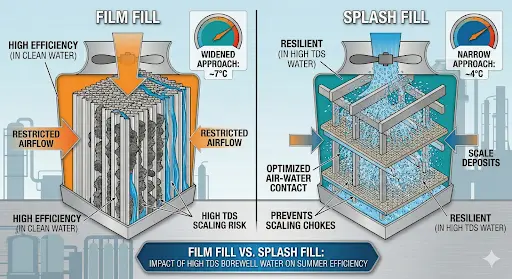
Source: AadTech Engineering Design/ CTI Standard 201 Comparison.
2. Fan Fatigue and Belt-Slip
Conventional cooling towers rely on standard AC motors and belt-driven fans. At summer load below 100%, belt slip can reduce fan speed by 5–10%. Because of the fan laws, a small drop in RPM results in a significant drop in airflow. If the air-to-water ratio falls during a heatwave, the tower cannot reject the required BTUs, leading to a high-pressure trip on the chiller.
3. Dust and Ambient Heat
The “Loo” winds of North India carry heavy dust loads. This dust mixes with the scale on wet fills, creating a “cement” that is nearly impossible to clean without damaging the PVC. Furthermore, standard motors often struggle with 45°C ambient temperatures, leading to winding failures precisely when you need cooling most.
The Retrofit Solution: AadTech’s Answer to the Indian Reality
Surviving an Indian summer does not require a new tower; it requires retrofitting the existing unit to handle local stressors.
Upgrade to EC Fans
Direct-drive EC (Electronically Commutated) fans are the single most effective upgrade for summer performance. Unlike belt-driven fans, EC fans eliminate transmission loss. They provide higher static pressure to overcome the resistance of even slightly fouled fills, maintaining the cooling tower approach even under the worst conditions.
Optimise Fill Selection
Don’t use European fill standards for Indian water. AadTech audits often recommend switching to high-clog-resistant or splash fills in regions with high-TDS water. It ensures that the 4–6 Cycles of Concentration (CoC) recommended by BIS IS 8188 don’t lead to a choked tower.
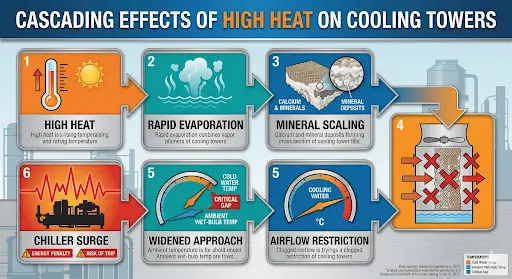
Source: AadTech Engineering Field Data.
Executive Summary: The Summer Efficiency Roadmap
- The Problem: International ratings assume a WBT of 24–26°C; the Indian reality is 28–32°C.
- The Cost: A 1°C increase in cold-water temperature = 3% more chiller power.
- The Indicator: Monitor your Approach. If it exceeds 5°C, your tower is failing your plant.
- The Solution: Retrofit with EC Fans to restore airflow and choose fills based on TDS levels, not just catalogue efficiency.
Takeaway: Moving Beyond the Nameplate
A “500 TR” cooling tower is not always a 500 TR cooling tower. Performance is a variable of the local environment. To protect your bottom line, you must engineer for the worst-case Indian wet-bulb, not a lab-tested Western standard. By investing in EC technology and robust water management, you can turn your cooling tower from a liability into a high-performance asset.
Frequently Asked Questions
High wet-bulb temperatures (28–32°C), coastal humidity, and high-TDS scaling from groundwater are the primary drivers.
Range is $T_{in} – T_{out}$ (Hot vs Cold). Approach is $T_{out} – T_{wb}$ (Cold vs Ambient Wet-Bulb).
Rising WBT caps the air’s moisture capacity, limiting heat rejection and forcing the cold-water temperature floor higher.
Yes; they eliminate belt-slip and maintain high static pressure through fouled fills, cutting chiller power by ~15%.