
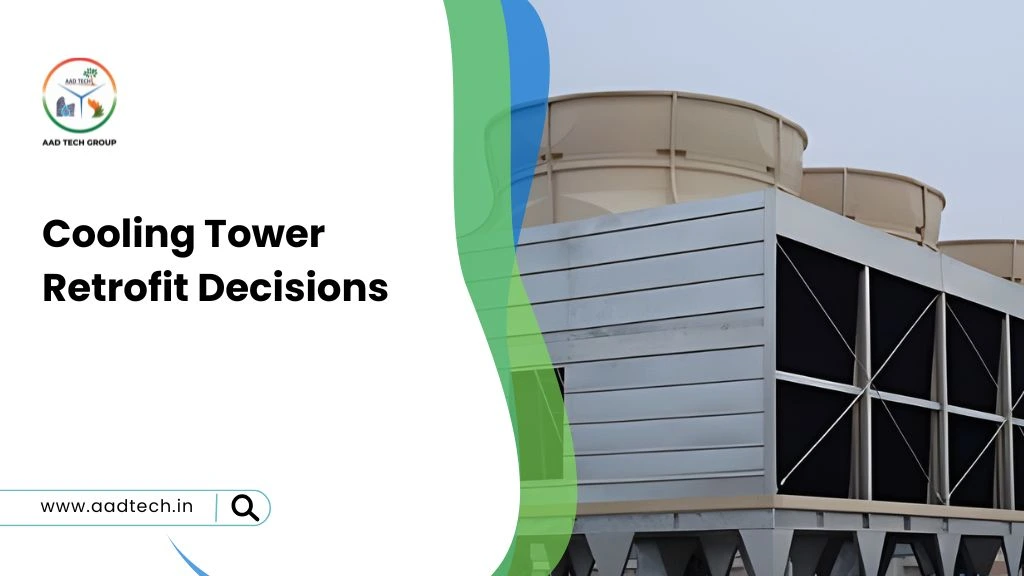
Every cooling tower eventually sends small signals. A new vibration appears. Outlet temperatures creep up. Energy use quietly climbs. At some point, someone asks the real question: Is this just a worn part, or is the system trying to tell us something more?
That question sits at the heart of retrofit decisions. Replacing components can restore stability and efficiency when the system fundamentals remain healthy. When done blindly, it often hides deeper design or operational issues instead of fixing them.
Why Do Cooling Tower Retrofits Getting Popular?
Many cooling towers operating today were installed when energy costs were lower, and production demands were lighter. Over time, loads increase, operating hours expand, and efficiency expectations change. Older systems begin to show strain even if they are still mechanically intact.
Improving energy efficiency of cooling tower systems through targeted upgrades allows facilities to modernise performance without the cost and disruption of full replacement. However, successful retrofits depend on choosing the right improvements rather than reacting to the loudest failure.
When Should You Replace Cooling Components?
Before approving a replacement, it helps to pause and ask a simple question. Is this component limiting the system’s ability to perform today, or is it only showing visible wear while deeper constraints remain hidden? When performance continues to drift despite routine maintenance, the system is often signalling the need for more thoughtful evaluation.
Replacement makes sense when the component itself has become the bottleneck for cooling tower performance and operational stability.
When Fans Create Vibration or Uneven Airflow
Fans drive the heat rejection process. As blades wear, bearings age, and alignment drifts, airflow becomes inconsistent and vibration increases. These changes affect temperature control and increase mechanical stress across the system.
Replacing aging fans often restores balanced airflow, reduces noise, and improves part-load efficiency. In many cases, this delivers measurable gains in cooling tower performance, especially under variable operating conditions.
When Motors and Drives Waste Energy
Older motors and drives often operate at lower efficiency and limited speed flexibility. This forces fans to run harder than necessary, even when cooling demand is low.
Upgrading motors and adding modern speed control allows airflow to match real load conditions. This supports better energy efficiency of cooling tower operation while lowering electrical losses and thermal stress.
When Fill Media Loses Heat Transfer Efficiency
Fill media creates the surface area needed for heat exchange between air and water. Over time, scale buildup, biological growth, and material aging reduce this effectiveness.
When outlet water temperatures drift upward despite adequate airflow, degraded fill is often the underlying cause. Replacing compromised fill restores thermal performance without altering the tower structure.
When Controls Limit System Visibility
Legacy control systems often provide minimal insight into system behaviour. Operators may lack visibility into airflow stability, fan loading, or environmental changes.
Modern monitoring and automation enable trend tracking, early fault detection, and optimisation rather than reactive maintenance.
Discover our blog on how cooling towers support energy efficiency in manufacturing plants.
Instances Where Component Replacement Isn’t the Right Fix
Not every performance issue can be solved through part replacement. In some cases, underlying constraints limit what any upgrade can realistically achieve. Recognising these situations early avoids repeated investment in changes that deliver only marginal improvement.
Structural Degradation Starts Happening in the Tower Body
If the basin, casing, or support framework shows corrosion, leakage, or material fatigue, mechanical upgrades alone cannot restore long-term reliability. Structural deterioration compromises safety, alignment, and water containment, making component replacement a short-term mitigation rather than a durable solution.
When Design Capacity No Longer Matches Operating Load
Some cooling towers were originally sized for lower thermal loads than they now carry. As process demand increases, replacing fans or motors may improve airflow marginally but cannot overcome fundamental capacity limitations. Persistent temperature instability after upgrades often signals this mismatch.
When Chronic Water Quality Issues and Fouling Persist
Ongoing scaling or biological fouling rapidly degrades new components if treatment practices remain unchanged. Without stabilising water chemistry and hygiene control, repeated replacement becomes cyclical rather than corrective.
How to Make Smarter Retrofit-related Decisions?
Retrofit-related decisions rely on data rather than assumptions. Reviewing temperature approach, energy trends, vibration behaviour, and maintenance history helps determine whether targeted upgrades will genuinely improve cooling tower performance or simply delay deeper system changes.
A system-level perspective protects long-term value and operational stability.
Conclusion
Cooling tower retrofits create value when they address the true performance limitation rather than the most visible symptom. Strategic replacement improves reliability and efficiency when the structure and capacity remain sound.
At Aad Tech, we evaluate systems based on real operating behaviour, helping facilities make retrofit decisions that strengthen long-term performance without unnecessary disruption.
Frequently Asked Questions
A retrofit upgrades selected components to improve efficiency and reliability without replacing the entire tower.
Fans, motors, fill media, drift eliminators, and control systems.
Yes, targeted upgrades often reduce power consumption and stabilise output.
When structural damage, capacity limits, or water quality issues persist.
By tracking temperature approach, energy use, vibration trends, and maintenance data.
Most component upgrades can be phased to minimise disruption.