
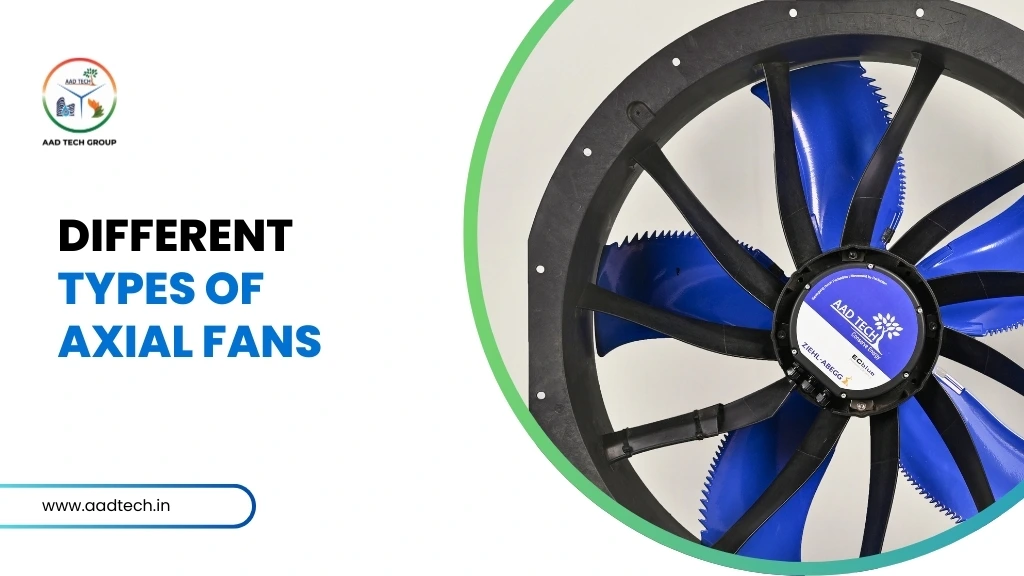
The axial fan is one of the most widely used airflow devices in ventilation and cooling systems. Its design moves air along the axis of rotation, creating a smooth and directed pattern suited to industrial lines, commercial buildings, cleanrooms, and large utility areas. Engineers compare the many types of axial fans available because each model shifts air in a distinct way, and this affects pressure, temperature control, and overall system efficiency.
Industrial ventilation has grown steadily over the last decade, supported by rising demand for energy-aware infrastructure. The global fan and blower sector had an approximate valuation of $7.2 billion in 2025.
Selecting the correct axial fan is therefore more than a mechanical choice. It determines how well the environment remains stable and how long the system remains efficient.
Quick Overview: Types of Axial Fans and Their Uses
| Axial Fan Type | Key Feature | Primary Use |
| Tube Axial | Cylindrical, directed airflow | Ducted ventilation and narrow passages |
| Vane Axial | Guide vanes for pressure control | Process ventilation and fume extraction |
| Propeller Axial | Simple, open-blade form | Free-air cooling and broad spaces |
| Bifurcated Axial | Protected motor layout | Hot or corrosive air streams |
| Reversible Axial | Dual-direction operation | Tunnels, mines, and smoke management |
| EC Axial | Electronically commutated motor | Energy-sensitive HVAC and cleanrooms |
Tube Axial Fans: Directed Flow Through Defined Paths
Tube axial fans are one of the most widely used types of axial fans in everyday ventilation systems. Their cylindrical housing creates a narrow, guided path for air. The axial fan inside rotates with a steady force, keeping the flow aligned within the tube. This helps maintain uniform movement even when the duct length increases or bends slightly.
These fans respond well to situations where moderate pressure is required but space is limited. Paint booths, warehouses, parking areas, fire-exit corridors, and long ventilation shafts use tube axial units for this reason. Their simple form also makes them easier to mount on walls, frames, or suspended structures.
Because the airflow remains concentrated, system losses stay low. This gives the tube axial model a practical balance between installation cost and daily performance.
When engineers assess the types of axial fans for compact layouts, tube axial options often stand at the top of the list.
Vane Axial Fans: High Pressure with Controlled Direction
Vane axial fans are built for higher pressure. Behind the rotating blades, stationary guide vanes straighten the air before it exits the housing. The result is a stronger, more concentrated airflow and reduced turbulence. This makes the axial fan suitable for heavy-duty industrial environments that run continuously.
You will find vane axial units in fume extraction lines, process ventilation systems, filtration rooms, and industrial zones where air quality or temperature must be held within narrow limits. Because the vanes correct the natural swirl created by the impeller, the system gains efficiency without needing larger motors.
In practical terms, a vane axial fan helps maintain airflow consistency even when the static pressure fluctuates. This stability becomes important in long duct networks or production lines that run for extended periods.
Among all types of axial fans, the vane axial model is preferred when precision and higher pressure matter more than simple volume movement.
Propeller Axial Fans: Open-Air Movement for Wide Spaces
The propeller design is the simplest among the types of axial fans. The blades rotate freely without duct walls, allowing the axial fan to move a high volume of air with minimal resistance. The flow spreads outward naturally, making the fan suitable for large, open areas rather than confined ones.
This type is common in agricultural buildings, workshops, halls, equipment rooms, and outdoor condenser units. Because the pressure requirement is low, the fan does not need to overcome heavy static resistance. It provides strong airflow while keeping power consumption reasonable.
Propeller fans are also valued for rapid heat removal. In many industrial settings, their broad coverage helps equipment cool faster, which supports both safety and operational stability. When engineers rank types of axial fans for open-space cooling, the propeller axial fan is usually placed first.
Bifurcated Axial Fans: Built for Heat, Dust, and Corrosion
A bifurcated fan protects its motor by keeping it outside the airflow path. The air passes through two side channels that bypass the motor chamber. This allows the axial fan to handle high-temperature streams, grease-laden vapours, or corrosive fumes that would ordinarily damage electrical components.
Because of this design, bifurcated axial fans are used in commercial kitchens, chemical plants, furnace exhausts, and industrial discharge lines. Their construction supports high reliability even in environments that experience intermittent temperature spikes or strong contaminants.
The actual airflow remains smooth, and the fan body channel remains fully functional while the motor stays insulated. When selecting types of axial fans for harsh or unpredictable environments, the bifurcated option becomes essential rather than optional.
Reversible Axial Fans: Two Directions, One Installation
Reversible axial fans are designed to operate in both directions without mechanical repositioning. Their blade geometry allows airflow to shift from supply to exhaust instantly. This dual-purpose ability makes the axial fan highly suitable for tunnels, mines, emergency ventilation systems, and areas where smoke or dust must be cleared quickly.
Urban tunnels rely on reversible fans to control smoke movement during emergencies. Mining operations also use them to guide fresh air into shafts and extract fumes when needed.
The value of this design lies in the response time. Changing direction at once avoids delays that could compromise safety. Among all types of axial fans, reversible units play the most important role in emergency airflow planning.
Learn more about axial fan types, features, and applications in our detailed axial fan guide.
EC Axial Fans: Energy-Efficient Choices for Modern Systems
EC axial fans use electronically commutated motors. These motors operate with higher efficiency than traditional counterparts and allow precise speed control. For industries that monitor energy usage closely, this axial fan is a valuable choice.
EC fans are used in cleanrooms, data centres, HVAC units, laboratories, and pharmaceutical environments. Their quiet operation, variable control, and low power draw align with the shift toward smarter infrastructure.
Studies show that EC motors can reduce energy consumption by 30 to 50 per cent compared to standard motors. When comparing all types of axial fans, EC models offer the strongest long-term efficiency advantage.
Conclusion
The wide range of types of axial fans allows engineers to design ventilation systems that match both operational and environmental needs. Each axial fan listed here serves a distinct purpose, whether it is managing high pressure, cooling broad rooms, resisting heat, or improving energy performance. When a system uses the correct type, airflow remains consistent and long-term efficiency improves.
Aad Tech supports these goals through reliable axial solutions for industrial and commercial settings. For planned upgrades or new projects, Aad Tech can guide you toward the fan that fits your system best.
Frequently Asked Questions
The primary types include tube axial, vane axial, propeller, bifurcated, reversible, and EC models. Each one is designed for a specific airflow need, ranging from simple ventilation to controlled, high-pressure applications.
They are widely used in industrial plants, HVAC systems, cooling assemblies, and large ventilation networks. Their ability to move air in a straight, steady path makes them suitable for both open spaces and structured ductwork.
A vane axial fan is selected when a system needs higher pressure without losing airflow stability. Its guide vanes straighten the air, allowing the fan to deliver more controlled and efficient performance.
They use electronically commutated motors that regulate speed with precision. This smart control reduces energy waste and keeps airflow output closely matched to real-time system demand.
It is suitable when the air stream is hot, greasy, or chemically harsh enough to damage a standard motor. The motor is placed outside the airflow path, allowing the fan to operate safely in demanding environments.