
If your Air Handling Unit (AHU) consumes excessive power while delivering weak airflow, the centrifugal fan curve indicates a structural issue. Ignoring these graphical warnings leads to pressure-cascade collapses, humidity spikes, and costly GMP audit failures. Most facility managers overlook these signs until a motor burns out or cleanroom validation fails during a critical production cycle. Understanding the relationship between the fan’s capability and the system’s demand is the only way to ensure operational continuity.
I. The Core Diagnostic: Reading the Curve
A centrifugal fan curve is a graphical representation of a fan’s performance, plotting Static Pressure ($P_s$) against Airflow Volume ($Q$). Every fan model has a unique signature determined by its impeller geometry and housing design. However, the fan does not operate in a vacuum. To find your true operating point, you must overlay the System Resistance Line (the mathematical representation of the friction caused by ducts, coils, and filters) onto the fan’s performance data.
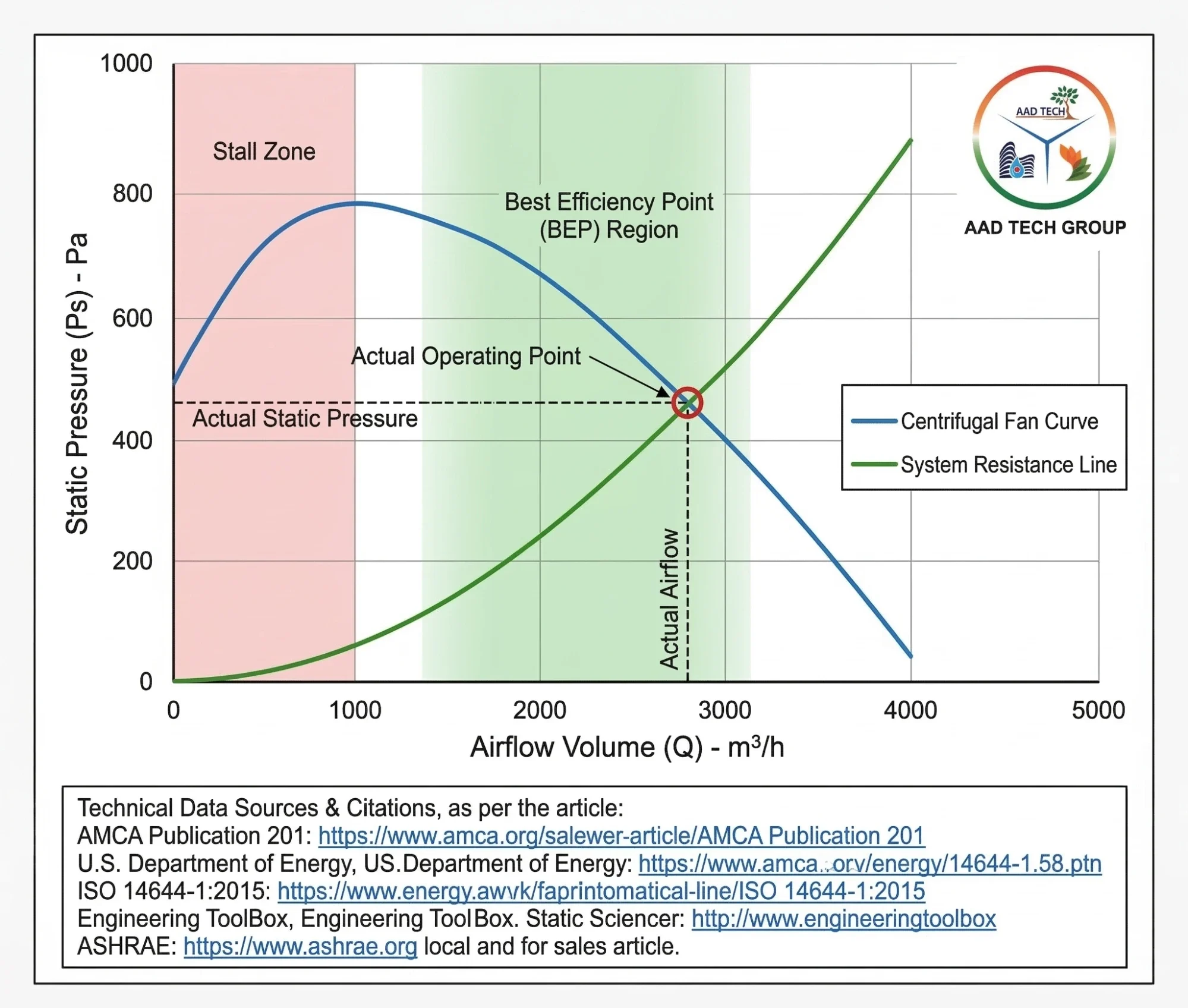
Where these two lines intersect is your reality. Any deviation from this intersection indicates a mechanical flaw, a design error, or an environmental change. If your AHU operates away from the Best Efficiency Point (BEP), you are burning money to generate heat and vibration rather than air movement.
II. 5 Red Flags You Cannot Ignore
1. Operating in the “Stall Zone” (Aerodynamic Instability)
When your operating point sits to the left of the curve’s peak pressure, the fan enters the stall zone or surge limit. In this region, the air can no longer follow the contour of the fan blades. It thus creates a pocket of turbulent, stagnant air, resulting in violent vibrations and low-frequency thumping noises.
The Compliance Risk: In high-precision environments like pharmaceutical labs, operating theatres and isolation wards, data centres and server farms, or semiconductor and microelectronics fabrication units, this turbulence disrupts laminar flow and creates pressure pulses. These pulses damage sensitive HEPA filter seals over time, leading to bypass leakage and failed particle counts. If your BMS shows fluctuating static pressure despite a constant fan speed, you are likely stalling.
2. The Steep Efficiency Drop-Off
Legacy AC centrifugal fans have a narrow sweet spot. As you move toward the far right of the fan performance curve, the efficiency collapses. It usually occurs when a system has insufficient resistance, perhaps due to missing filters or oversized ductwork.
The Economic Risk: In this runaway state, the motor draws maximum current (Amps) but produces very little useful static pressure. You pay for peak electricity while the motor runs dangerously hot. Excess heat transfer into the airstream also increases the load on your cooling coils, creating a double-penalty for energy consumption.
3. Hunting and RPM Fluctuation
Modern AHUs often use Variable Frequency Drives (VFDs) to maintain setpoints. However, if your control panel shows erratic RPM changes (constantly jumping up and down), the fan is “hunting.” The occurrence is that the fan is poorly matched to the system resistance, causing the controller to struggle to find a stable intersection on the centrifugal fan curve.
The Mechanical Risk: Constant over-correction leads to premature bearing wear and places immense stress on the motor windings. In controlled environments, bio-containment suites, sterile processing departments or critical pressure zones, hunting disrupts the delicate pressure balance between rooms, triggering alarms and halting production.
4. Excessive System Effect Factor (SEF)
Standard performance curves are measured in laboratory environments with straight, unobstructed inlets and outlets. In the real world, AHU cabinets are often cramped. If an inlet is too close to a wall or an outlet has a sharp 90-degree elbow, you encounter the system effect.
5. Failed Filter Loading Compensation
As HEPA and pre-filters load with dust, the system resistance curve shifts steeply to the left. A flat centrifugal curve cannot handle this shift; as resistance increases, airflow volume ($Q$) drops rapidly.
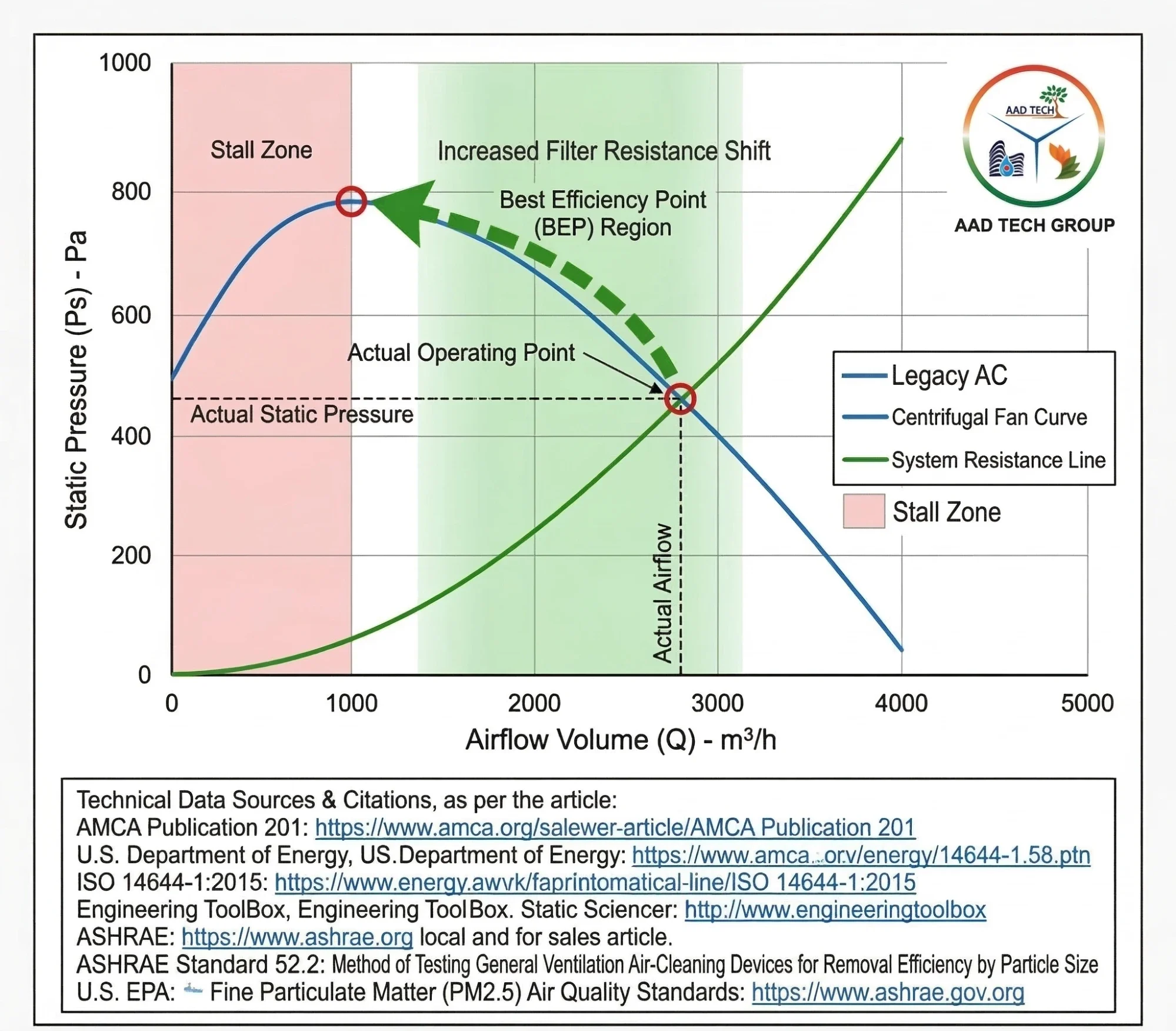
The Safety Risk: When the Air Changes Per Hour (ACH) falls below the ISO 14644-1 legal limits, the environment becomes unsafe for sterile manufacturing. While legacy fans require manual VFD intervention to speed up, modern IE5 EC fans’ high efficiency enables constant-volume mode. The fan’s internal logic senses the filter load and automatically scales the RPM to climb the curve and maintain the required airflow.
III. Comparison: Performance Evolution
The transition from traditional AC induction motors to IE5-rated Electronically Commutated (EC) fans represents a paradigm shift in HVAC reliability.
| Performance Feature | Legacy AC Centrifugal Fan | IE5 EC Fan Technology |
| Efficiency at Part-Load | Efficiency collapses below 65% | Maintains over 90% efficiency |
| Response to Clogged Filters | Airflow volume collapses | Automatic RPM adjustment to maintain $Q$ |
| Noise Profile | High vibration in “Stall Zone” | Pulse-width modulation (Quiet operation) |
| Control Logic | External VFD and sensors required | Integrated digital intelligence and PID |
Sources: IEC 60034-30-2, EC vs. AC Performance Data, Part-Load Efficiency Analysis and constant volume logic
Table 1: Technical superiority of IE5 EC fans over traditional AC centrifugal curves.
IV. The Aad Tech Edge: Beyond the Graph
Don’t let a flatlined curve compromise your facility’s safety or your company’s bottom line. Most troubleshooting in the HVAC industry involves simply turning up the speed, which often pushes the fan further into an inefficient or unstable zone.
Aad Tech Group specialises in IE5 EC retrofits that transform failing AHUs into high-efficiency assets. We don’t just look at the fan; we analyse the entire system geometry to eliminate system effect losses. Our engineering team interprets your specific data to prevent downtime before a breakdown occurs. By moving to an EC Fan Array or a single IE5 upgrade, you gain a control curve that adapts to your facility’s needs in real-time.
Frequently Asked Questions
The fan curve stays constant, but system conditions (dirty filters, leaks, wear) shift performance.
Static = resistance handling; Total = resistance + air velocity. Static is key for AHUs.
They don’t electronics adjust speed automatically to maintain airflow.
Lower density (heat/humidity) reduces pressure output correction factors are needed.
No, stall is blade-level failure; surge is full airflow reversal.