India’s push for Net Zero by 2070 places immense pressure on the built environment. According to the Bureau of Energy Efficiency (BEE), HVAC systems account for approximately 40% of energy consumption in commercial buildings. Standard induction motors are no longer sufficient. To meet LEED, BREEAM, or GRIHA standards, engineers must look at the heart of the air handling unit. EC fans (Electronically Commutated) are the most effective tool to slash carbon footprints today.
Efficiency Beyond the Standard: IE5 and PFC
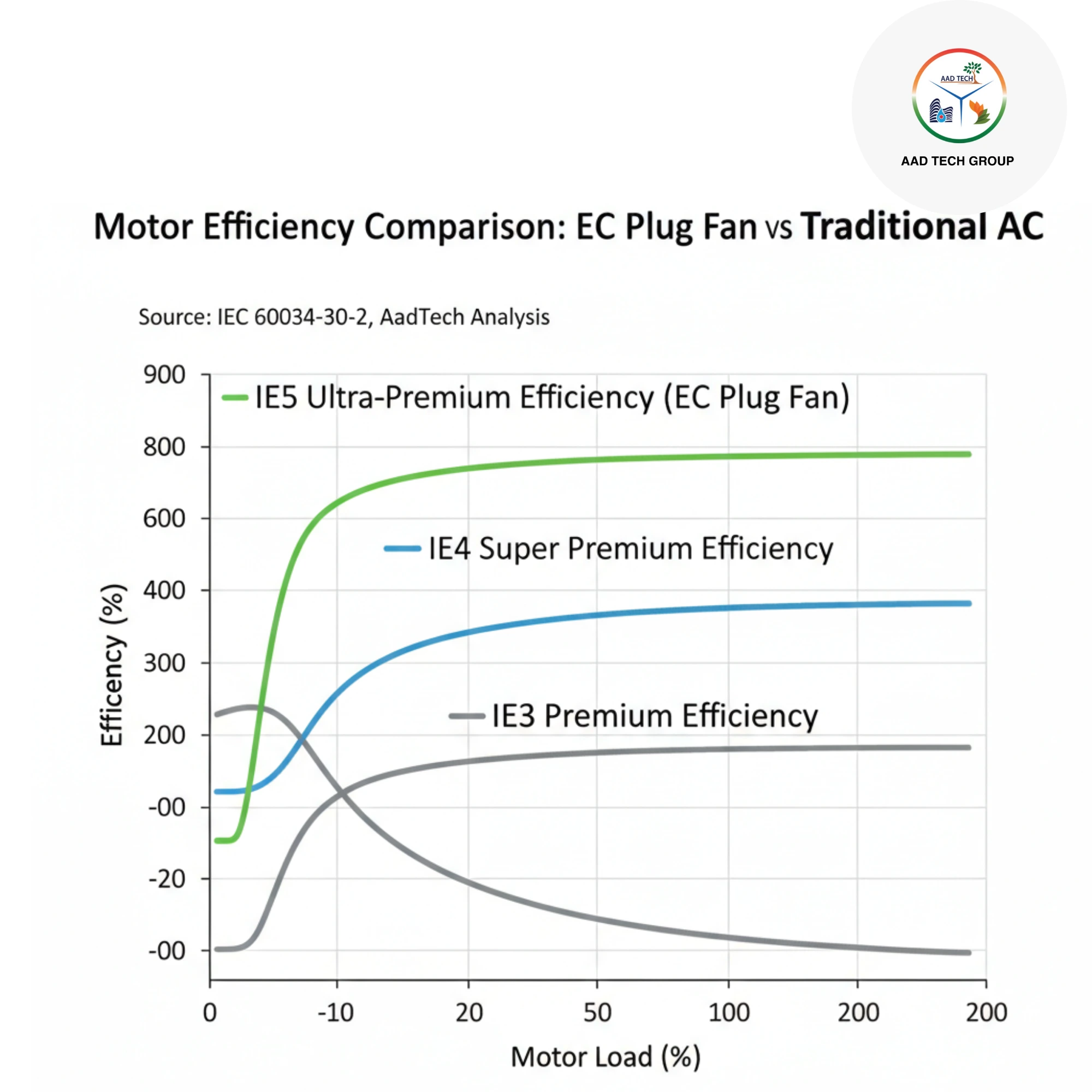
Most industrial motors struggle to meet IE3 or IE4 efficiency levels. EC fans leapfrog these benchmarks. They often provide IE5 “Ultra-Premium” efficiency standards as defined by IEC 60034-30-2. Unlike AC motors that lose energy to heat and friction, EC motors use permanent magnets. The advantage? It eliminates rotor copper loss.
Aad Tech India integrates Active Power Factor Correction (PFC) into these fans. This technology cleans “dirty power” within the building grid. It reduces harmonic distortion and lessens the electrical strain on the entire facility. By adhering to ISO 12759-3:2019 standards for fan efficiency and aligning with the Energy Conservation Building Code (ECBC), these units ensure every watt of power translates into airflow.
The Physics of Power: Variable Speed Control
The colossal waste in a traditional HVAC system is “throttling.” Running a fan at full speed and using dampers to restrict air is like driving a car with the accelerator and brake pressed at once.
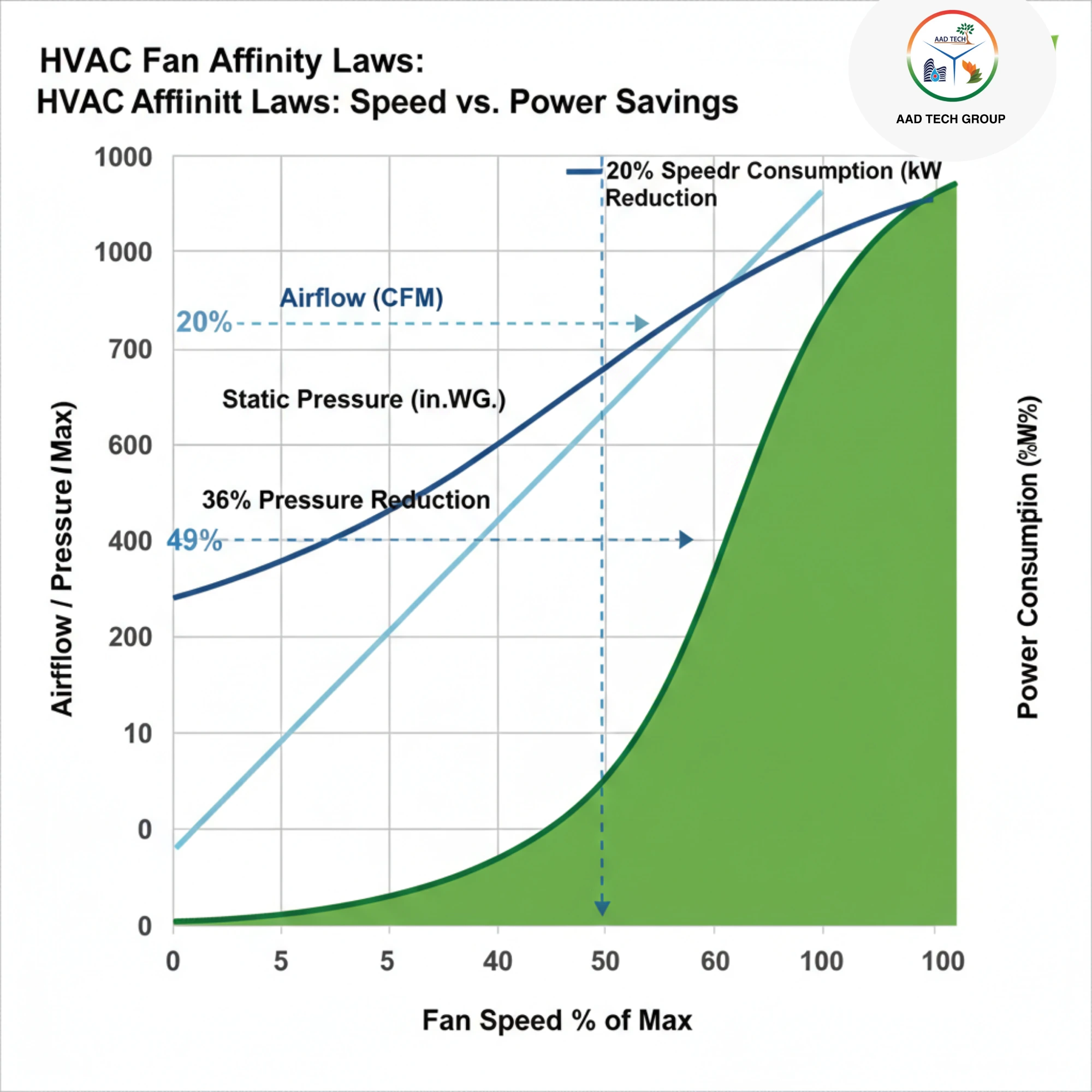
EC fans use integrated speed control to match real-time building demand. The fan relies on the Fan Affinity Laws.
- Reducing fan speed by 20% can cut power consumption by nearly 50%.
- Integrated electronics allow for seamless communication with Building Management Systems (BMS).
- The fan ramps up or down instantly in response to occupancy or indoor air quality.
For a deeper look at how this technology transforms maintenance, read about 8 Reasons EC Fan Arrays Are the Future of HVAC Retrofits.
Lowering Embodied Carbon through Design
Sustainability starts before the fan even turns on. Traditional belt-driven fans require massive steel frames, pulleys, and heavy belts. These materials carry high “embodied carbon,” the emissions generated during their mining and manufacture.
AadTech’s EC Centrifugal Fans are compact and direct-drive. They eliminate the need for heavy transmission components. This reduction in raw metal lowers the carbon footprint of the manufacturing process. Because they are lighter, engineers can design smaller Air Handling Units (AHUs). It thus reduces the structural steel required for the building’s mechanical floors, supporting the latest GRIHA Criterion 8 for Energy Efficiency.
Aad Tech India’s Vision for a Greener India
Aad Tech is not just a manufacturer; we are partners in India’s energy transition. We help industries move away from energy-hungry induction motors. By switching to intelligent EC technology, facilities can achieve international green building ratings more quickly. We provide the hardware that turns “Green Building” goals into measurable energy savings, directly supporting the National Mission for Enhanced Energy Efficiency (NMEEE).
Explore our guide: To understand the core technology behind these savings on EC Motor Fundamentals and Benefits.
Retrofit Impact: The 2026 Benchmarks
Based on the current 2026 India grid emission factor (approx. 0.79 kg CO₂/kWh), the environmental impact of a single-unit upgrade is significant.
| Metric | Traditional AC Fan | AadTech EC Plug Fan |
| Efficiency Class | IE2 – IE3 | IE5 |
| Speed Control | External VFD needed | Integrated / Digital |
| Transmission Loss | 5% to 12% (Belts) | 0% (Direct Drive) |
| Maintenance | High (Belt/Bearing wear) | Ultra-Low (Brushless) |
| Annual CO₂ Savings | Baseline | ~3.8 – 4.1 Tonnes per 5.5kW unit |
Frequently Asked Questions
EC fans directly impact the Energy and Atmosphere (EA) category in LEED and Criterion 8 in GRIHA. By keeping up with IE5 efficiency standards and utilising integrated speed control, they lower the building’s Energy Performance Index (EPI).
Yes. Aad Tech’s EC fans feature integrated electronics. They support standard communication protocols such as Modbus-RTU and 0-10V analogue signals for seamless interfacing with legacy BMS systems.
An IE5-rated EC motor maintains its peak efficiency even when running at 40% or 60% speed. In contrast, AC motors experience a sharp efficiency drop at part load. Over a year, this results in significantly lower cumulative kWh consumption.
Aad Tech often recommends a Fan Array (multiple smaller EC fans) to provide N+1 redundancy. If one fan fails, the remaining fans automatically increase their speed to maintain the required airflow, ensuring the building remains operational.
Given high commercial electricity tariffs, most retrofits see a full Return on Investment within 18 to 24 months when factoring in energy savings and the total elimination of belt and pulley maintenance.