

Selecting between air handling unit manufacturers is often reduced to a price-per-CFM calculation. However, for engineers and facility managers, the true cost of an AHU is hidden in its mechanical construction and long-term operational efficiency.
This checklist goes beyond the datasheet to help you evaluate the structural integrity and thermodynamic performance of your next unit, specifically optimised for high-demand environments such as India’s coastal and industrial hubs.
1. Casing Construction and Thermal Bridging
The AHU casing is the thermal barrier between your conditioned air and the ambient environment. In high-humidity climates like Mumbai or Chennai, poor construction practices lead to sweating and significant energy loss.
- Thermal Transmittance (U-Value): Look for manufacturers offering T2 or T1 classes. It measures the insulation’s ability to prevent heat gain.
- Thermal Bridging (Kb): This measures heat transfer through the frame. A high-quality manufacturer uses thermal breaks (TB1 or TB2), non-conductive barriers that prevent the outer frame from reaching the dew point. According to Eurovent Recommendation 6/18, this is critical for preventing mould and structural corrosion.
- Panel Insulation: Demand 50mm or 75mm injected polyurethane (PUF). Unlike 25mm fibreglass, injected PUF provides superior structural rigidity and a higher R-value that won’t degrade over time.
Image 1: Anatomy of a Thermal Break (TB1) Frame
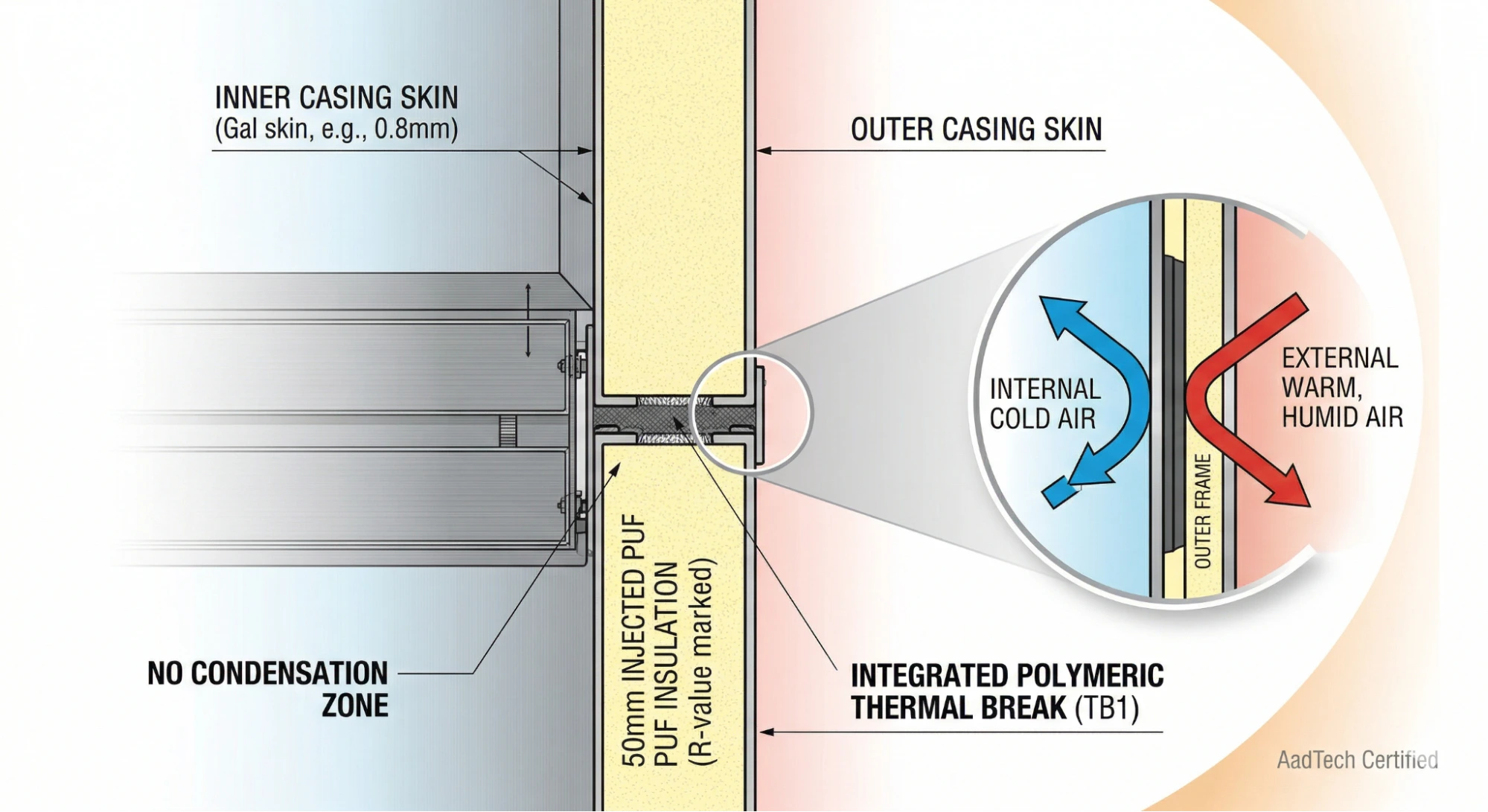
Source: AadTech Internal Engineering Laboratory (2024).
2. Mechanical Strength and Leakage Classes
A flimsy casing bows under high static pressure, leading to air bypass.
- Casing Strength (Class D1): Ensure the unit is rated for minimal deflection (Class D1) under pressures of ±1000 Pa, as specified by EN 1886.
- Air Leakage (Class L1 per EN 1886): Even a 2% leakage rate can spike energy bills by 15%. While Class L2 is common, Class L1 is the gold standard. Insist on verified leakage data to ensure your conditioned air actually reaches the ductwork.
3. Fan and Motor Integration: The IE5 EC Advantage
The motor is the heart of the AHU’s energy consumption. Transitioning to IE5 Electronically Commutated (EC) technology (which meets the highest IEC 60034-30-2 efficiency classes) is the single most effective way to reduce OpEx. It is a cornerstone of modern AHU decarbonisation strategies.
- Direct Drive vs Belt Drive: Modern manufacturers have moved away from belt-driven fans, which lose 2–5% efficiency to friction and create belt dust that contaminates filters.
- Fan Wall (Array) Technology: Rather than one large fan, an EC Fan Array provides N+1 redundancy. If one motor fails, the others ramp up to maintain CFM, ensuring zero downtime for critical facilities.
- Explore More: For a deeper look at high-efficiency components, browse our technical motor and fan archives.
Image 2: The Redundancy Advantage
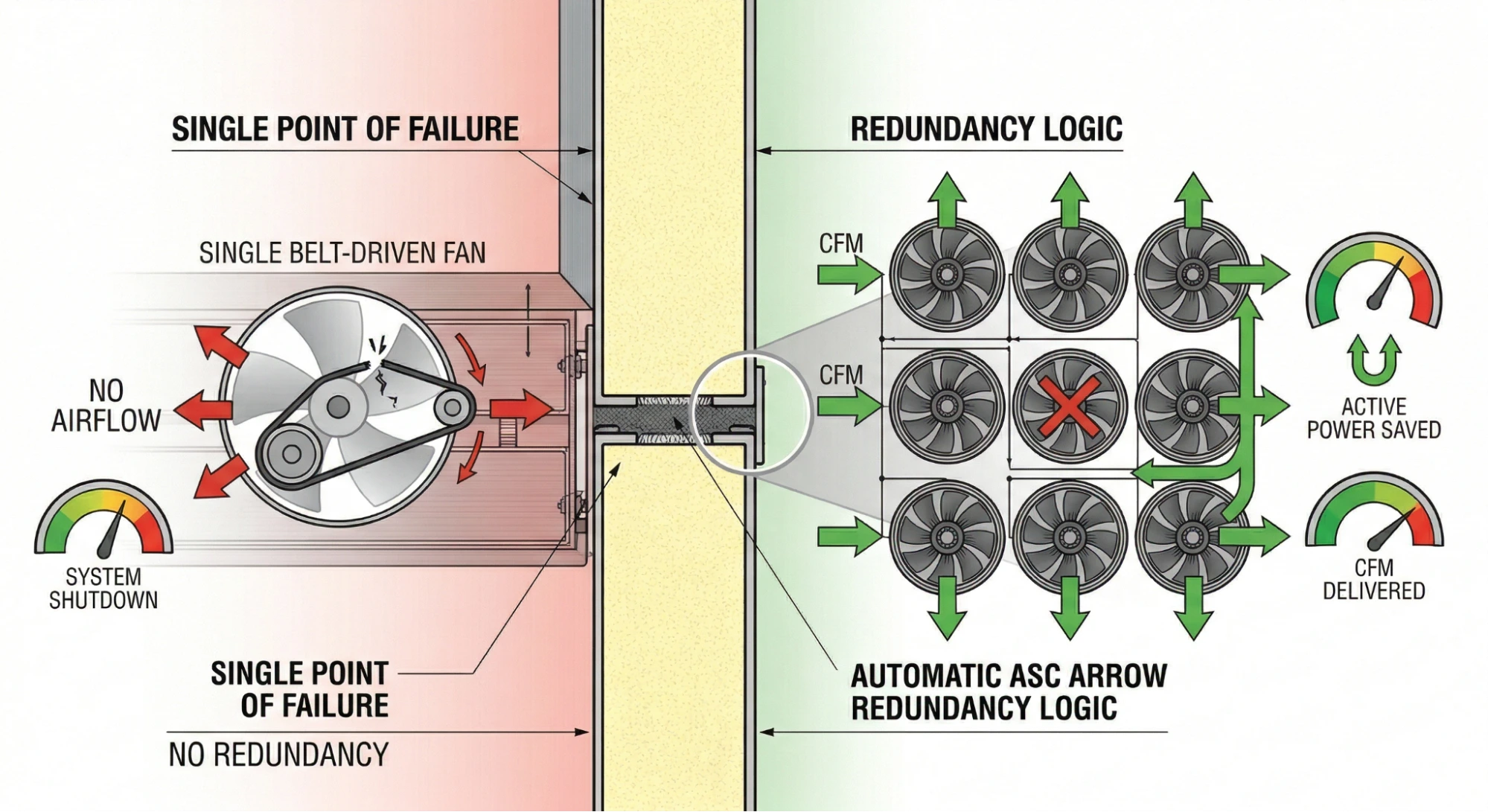
Source: AadTech Redundancy Protocol (2024).
4. Coil Performance and Material Grade
- Fin Material: Use hydrophilic-coated aluminium fins to prevent water carry-over in humid monsoon conditions.
- Face Velocity: ASHRAE Standard 62.1 guidelines suggest keeping face velocity below 500 FPM (2.5 m/s) to prevent moisture from being pulled into the supply stream.
5. Maintenance and Access
- Access Doors: Must be equipped with thermal-break frames and pressure-relief latches.
- Filter Integrity: Look for high-integrity, gasket-sealed frames; high-efficiency filters (formerly Class F9) should now comply with ISO 16890 filtration standards, specifically targeting the $ePM_1 \geq 80\%$ category to ensure the removal of sub-micron urban pollutants.
Comparison Matrix: The AadTech Difference
| Feature | Industry Standard | AadTech Spec | Business Impact |
| Casing Leakage (EN 1886) | Class L2 | Class L1 | 10–15% energy savings. |
| Thermal Bridging | TB3 | TB1 / TB2 | Zero mold/condensation risk. |
| Motor Efficiency | AC + VFD | IE5 EC Motor | 30%+ energy savings. |
| Fan Configuration | Single Belt-Drive | Redundant EC Array | Zero single-point failure. |
| Insulation | 25mm Fiberglass | 50mm Injected PUF | Superior R-value & acoustics. |
In high-humidity regions, if the frame isn’t thermally broken, the outer surface temperature drops below the dew point. It causes external sweating, leading to rust and mould growth in the mechanical room.
In a standard AHU, a single motor failure shuts down the system. In an AadTech Fan Array, multiple fans share the load. If one fails, the others increase speed to maintain airflow.
L1 is significantly more airtight than L2. In cleanrooms or hospitals, L1 is essential to prevent unconditioned, unfiltered air from leaking into the supply stream.
PUF is injected under high pressure, filling every void. It provides better insulation and adds structural strength, whereas fibreglass can sag and absorb moisture over time.
Use differential pressure (DP) gauges. For example, replace a filter when it moves from 250 Pa (initial/clean) to 500 Pa (final/dirty) to ensure energy efficiency isn’t compromised by a clogged system.