
Your HVAC system silently loses peak performance. Over time, the gap between nameplate efficiency and operational reality widens significantly. Facility managers face a tough choice: invest in a surgical retrofit or face high costs for cooling tower replacement. This decision dictates your site’s energy revolution for the next decade.
Modern industrial operations demand high reliability and a low carbon footprint. Ageing assets often struggle to meet these strict requirements. Navigating the choice between refurbishment and replacement requires a deep understanding of thermodynamics. You must balance immediate capital expenditure against long-term operational costs and HVAC retrofit ROI.
The Anatomy of Decay
Ageing units suffer from physical and thermal degradation. AHU casings corrode, leading to air bypass and significant energy waste. Internal insulation often breaks down, contaminating the air stream with particulates. These issues compromise indoor air quality and increase fan workloads. When air escapes through degraded seals, your sensible cooling capacity drops. It forces the system to work overtime.
Cooling towers face fill media calcification, which restricts vital airflow. Water distribution nozzles clog, creating dry spots on the fill. These failures force the fans to run longer to maintain temperatures. Mechanical components, such as gearboxes, also suffer from constant vibration fatigue. If left unchecked, the fouling factor increases the motor brake horsepower (BHP) required. Scale buildup acts as an invisible tax on your budget. Just 1mm of scale on a heat exchanger increases energy use by 10%. These efficiency losses eventually force every facility to reach a financial crossroads. Stagnant water in fouled towers also increases the risk of biological growth. The result is a safety hazard that requires immediate technical intervention.
Figure 1: High Scaling Blocks Essential Airflow
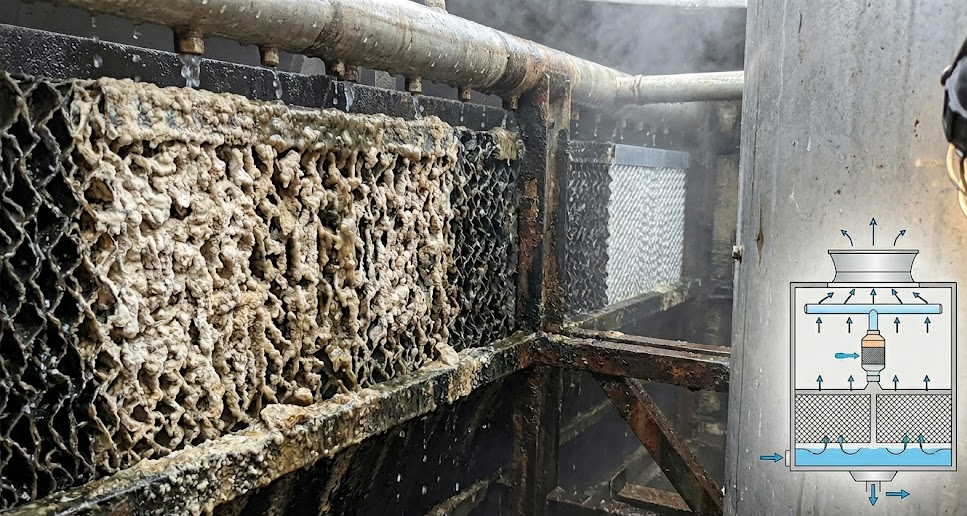
Source: AadTech Industrial Cooling Tower Maintenance
Retrofitting: The Surgical Update
Engineers often choose retrofitting to avoid the high cost of replacing a cooling tower. Upgrading to IE5 EC fans delivers the highest immediate impact. These fans eliminate belts and pulleys, instantly reducing maintenance hours. The direct-drive design removes friction losses common in traditional belt-driven systems. EC fan retrofitting is the low-hanging fruit for decarbonisation goals.
Coil re-sleeving also restores thermal capacity without disturbing existing ductwork. Technicians can replace old, pitted coils with high-efficiency copper alternatives. This process restores the pressure drop to original specifications. It allows the entire system to breathe easier while consuming less electricity. Modern coils often provide a better thermal gradient than older models.
Follow the 50% Rule for your budget. If a retrofit costs more than half the cost of a new unit, choose replacement. Learn more about the benefits of AHU refurbishment to save capital. Many facilities find that targeted upgrades provide 90% of the performance of new equipment. This approach preserves the existing structural steel and piping infrastructure.
Figure 2: IE5 EC Fan Array Installation (The Redundancy Boost)
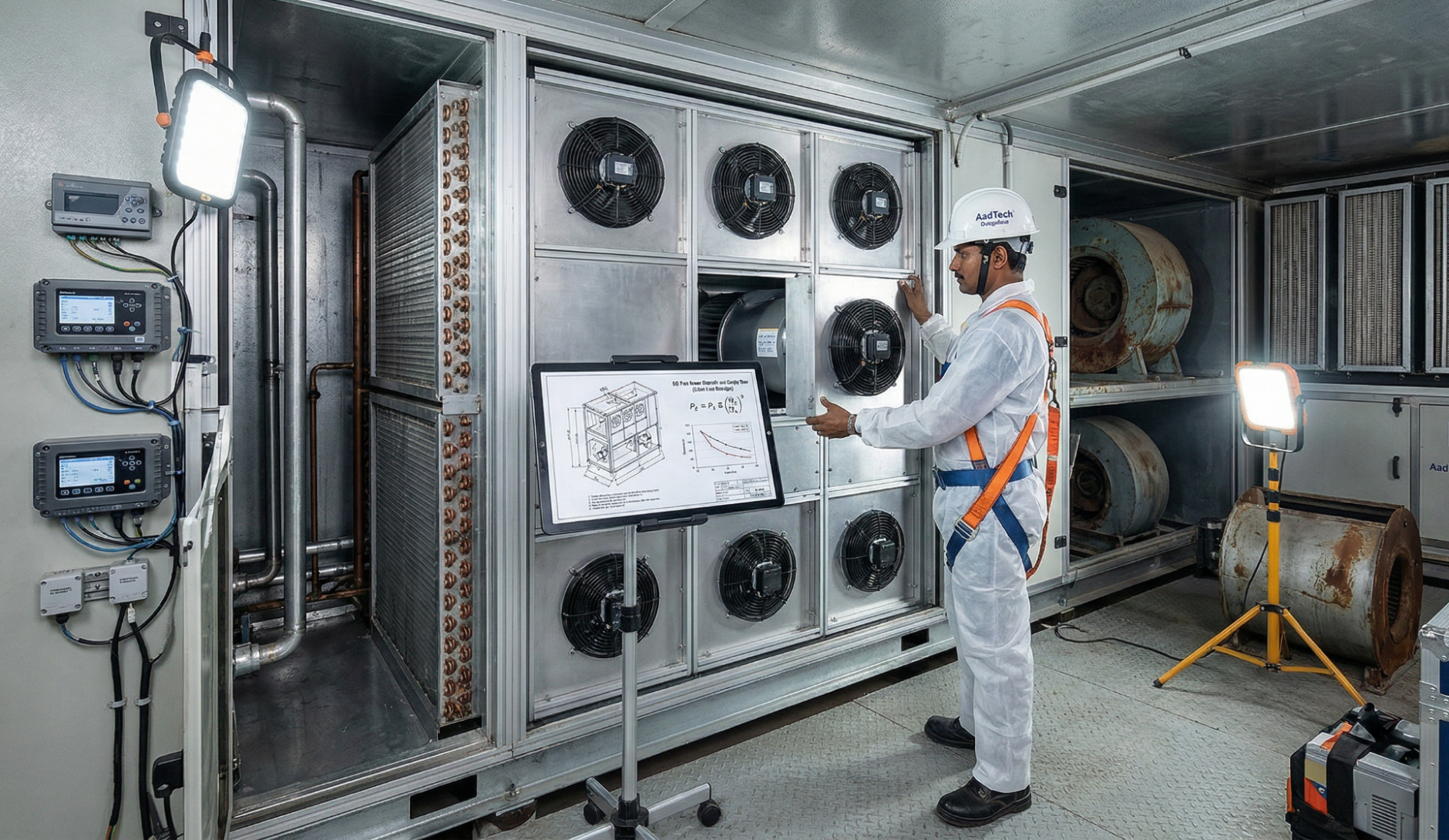
Source: AadTech, IE5 Fanwall & VFD Integration
Full Replacement: When to Pull the Plug
Sometimes, a retrofit merely masks terminal issues. You must replace the unit if the casing hits Leakage Class L3. Putting new components in a rusted shell wastes your investment. Structural integrity is the foundation of any successful HVAC operation. If the framework cannot support new coils, the AHU’s life expectancy has ended.
Modern units offer a 30% smaller footprint for the same CFM. It allows for better space optimisation in crowded plant rooms. You can use the extra floor space for other critical machinery. Newer designs also feature improved access hatches for easier future maintenance. The benefit is that it reduces labour costs for every subsequent inspection. New systems also facilitate the transition to low-GWP refrigerants. It future-proofs your facility against tightening environmental regulations. Older systems often rely on phased-out gases that become increasingly expensive. A full replacement ensures your site remains compliant with green building standards. It also allows for the installation of high-efficiency drift eliminators.
Financial Modelling
Total Cost of Ownership (TCO) reveals the true winner. A full replacement has a high upfront price but lowers long-term OpEx. Retrofits offer a faster payback period, typically within two to four years. You must look at the 10-year horizon to make an informed choice.
| Metric | Retrofit Strategy | Full Replacement |
| Upfront Capital | 20–60% of new unit | 100% + Installation |
| Energy Savings | 15–25% Improvement | 30–50% Improvement |
| Asset Life | Extends 10–15 Years | New 25-Year Cycle |
| Downtime | 2–3 Days | 1–2 Weeks |
Consider the Avoided Maintenance Cost in your calculations. New equipment eliminates the constant repairs associated with ageing assets. Proper retrofitting balances these costs effectively for most industrial sites. It allows you to upgrade the heart while keeping the skeleton.
Maximise Your Asset Life
Don’t guess the remaining life of your critical assets. A professional audit identifies the specific failure points in your system. We measure airflow, motor efficiency, and thermal transfer rates. This data drives a logical decision rather than an emotional one.
Let AadTech perform a thermodynamic audit to calculate your exact ROI. We help you navigate the complexities of HVAC lifecycle management with precision. Our team evaluates your specific site constraints and energy goals. We provide a clear roadmap for either a surgical retrofit or a total system overhaul.
An EC fan retrofitting project typically delivers an HVAC retrofit ROI within 18 to 36 months. You calculate this by comparing the motor brake horsepower (BHP) of old motors to that of IE5 EC motors. Factor in the elimination of belt maintenance and the energy saved through VFD integration.
The standard AHU life expectancy is 20 to 25 years, according to the CIBSE Guide M. However, poor water chemistry impact can shorten this to 15 years. If the casing remains airtight, a refurbishment can extend this lifecycle by another 15 years.
The base cost of replacing the cooling tower covers the unit, but installation adds variables. You must budget for cranes, structural reinforcements, and updated drift eliminators. Retrofitting internal components often costs only 30% of a full replacement.
A high fouling factor prevents effective heat transfer. When the fill media clogs, your heat rejection efficiency plummets. It thus forces the system to increase its speed to compensate for the loss of the thermal gradient.
Yes, you can enhance sensible cooling by replacing old coils with high-density alternatives. This surgical retrofit restores the pressure drop and improves heat exchange rates. When combined with modern filtration, a refurbished AHU achieves 95% efficiency.