
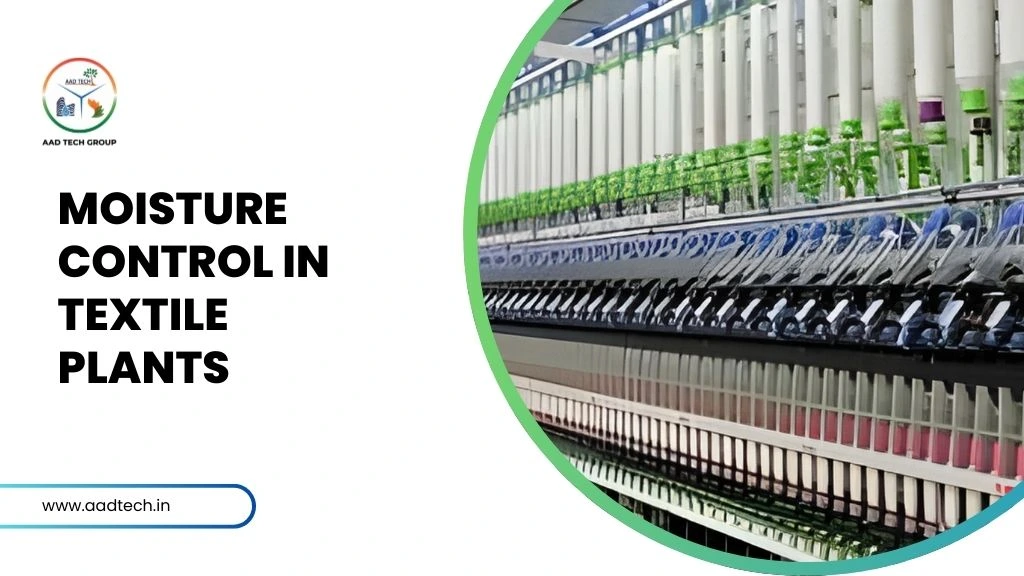
Walk into any textile plant, and you can almost feel the air before you see the machines. Sometimes it feels dry and brittle. Other times it feels heavy and damp. That invisible layer of moisture plays a much bigger role than many people realise, and sooner or later every plant manager finds themselves asking the same question: why does humidity seem to affect everything from yarn quality to machine behaviour?
In textile production, moisture is not a side variable. It directly influences fibre strength, static buildup, fabric consistency, and even production speed. When moisture drifts outside the ideal range, defects increase, breakdowns become more frequent, and energy costs quietly rise.
How Small Moisture Shifts Create Big Production Problems?
Low Humidity and Its Hidden Impact
Low humidity creates static electricity, fibre brittleness, and frequent yarn breakage. Operators often notice increased stoppages and dust accumulation without immediately connecting them to dry air conditions.
Dry environments also attract lint to sensors and rollers, affecting machine accuracy and long-term reliability.
High Humidity and Process Instability
Excess moisture causes fibres to absorb water unevenly, leading to variations in fabric weight and texture. Mould risk rises in storage zones, and corrosion becomes more likely on exposed metal parts.
Seasonal humidity spikes often explain sudden quality fluctuations even when machine settings remain unchanged.
Why Do Textiles Need a Narrow Moisture Band?
Textile fibres respond sharply to environmental changes. Even slight humidity shifts can affect tensile strength, friction levels, and dimensional stability.
Because outdoor conditions and machine heat fluctuate constantly, moisture control must be dynamic rather than static.
Airflow Strategy Shapes Moisture Stability
Humidity control depends heavily on how evenly air moves across the production floor. Poor airflow creates invisible pockets of dry or damp air that quietly disrupt consistency.
This is where system design becomes critical rather than simply adding more capacity.
Choosing the Right Fan Configuration
How a Plug Fan AHU Supports Air Movement?
A plug fan AHU integrates the fan directly into the air handling unit without a scroll housing, allowing flexible layout and compact installation. These systems work well where modular design and space efficiency are important.
Plug fan AHUs are commonly used for general ventilation and circulation in textile environments.
Plug Fans vs EC Fans in Moisture-Control Zones
When comparing plug fans vs EC fans, the difference becomes visible in control accuracy and energy behaviour. EC fans offer smoother speed modulation and faster response to changing airflow demands, supporting more stable humidity control.
Plug fans can perform reliably, but their efficiency and responsiveness depend more on external control systems.
Learn about where centrifugal fans deliver stable pressure and airflow
Why Stability Outperforms Target Numbers?
Maintaining stable humidity matters more than hitting a single numeric target. Frequent fluctuations stress fibres and disrupt process consistency even when averages appear acceptable.
Stable airflow supports stable moisture distribution across the plant.
Operational Gains From Controlled Moisture
Effective moisture control delivers measurable improvements:
- Reduced yarn breakage and downtime
- Improved fabric uniformity
- Cleaner machines with lower dust buildup
- Predictable production speeds
- Better working comfort
These improvements compound over time across quality and maintenance performance.
Conclusion
Moisture control in textile plants directly influences product quality, machine health, and operational reliability. When airflow and humidity drift out of balance, problems accumulate quietly before becoming visible on the production line.
Evaluating airflow strategies, including EC fans and the correct application of an AHU, helps plants achieve more consistent environmental control.
Thus, we design airflow and moisture management systems that respond to real production conditions rather than assumptions. By focusing on stability, efficiency, and long-term reliability, we help textile plants maintain the environmental consistency that quality manufacturing demands.
Frequently Asked Questions
Moisture directly affects fibre strength, static buildup, and fabric consistency, which impacts overall product quality and machine performance.
Low humidity increases static electricity, yarn breakage, dust accumulation, and machine stoppages.
A plug fan AHU allows flexible airflow design and compact installation while supporting steady air circulation across production zones.
EC fans provide more precise speed control and faster response, helping maintain stable airflow and moisture levels.
Yes, uneven air distribution creates moisture pockets that lead to inconsistent fibre behaviour and quality variations.
Yes, stable humidity reduces dust buildup, corrosion, and mechanical stress, lowering long-term maintenance needs.