
Is your HVAC system a ticking time bomb for a Batch Failure? One tiny belt slip or a black dust leak could cost you your entire manufacturing licence. Discover why the industry’s elite are ditching traditional AC fans for the IE5 Compliance Fortress, and how to audit your AHU for 100% GMP validation before the next inspector walks in.
I. The High Stakes of Cleanroom Compliance
In pharma manufacturing, the Air Handling Unit (AHU) acts as your first line of defence. In a pharmaceutical cleanroom, the margin for error stays at zero. One tiny breach leads to cross-contamination and massive recalls.
An industrial air handling unit for pharma must prioritise ISO 14644-1 standards and comply withEU GMP Annex 1. These laws demand more than just cold air; they demand precise pressure control and flawless filtration. Choosing the right AHU manufacturing company is a vital step for your Contamination Control Strategy (CCS).
II. Anatomy of a Compliance-Ready System
Modern AHUs eliminate dead zones where microbes grow.
- Housing and Sterile Build: Top manufacturers use double-skin panels with antimicrobial coatings and coved internal corners to ensure sanitising agents reach every spot.
- Graded Filtration: A sequential defence, Primary (G4/F7) protects the system, while Terminal (H14 HEPA/U15 ULPA) ensures 99.995% efficiency.
- Thermal-Bridge-Free Design: This stops condensation, preventing moisture-related germs from forming.
III. Numerical Analysis: EC Fans vs AC Systems
The shift from AC to EC removes mechanical variables that threaten validation.
- Eliminating Mechanical Creep: Direct-drive EC fans connect the motor directly to the impeller, eliminating belts that can slip or stretch. It thus maintains the precise pressure cascades required by Annex 1.
- Removing “Black Dust”: Zero belts mean zero rubber particulate shedding, protecting your expensive HEPA filters.
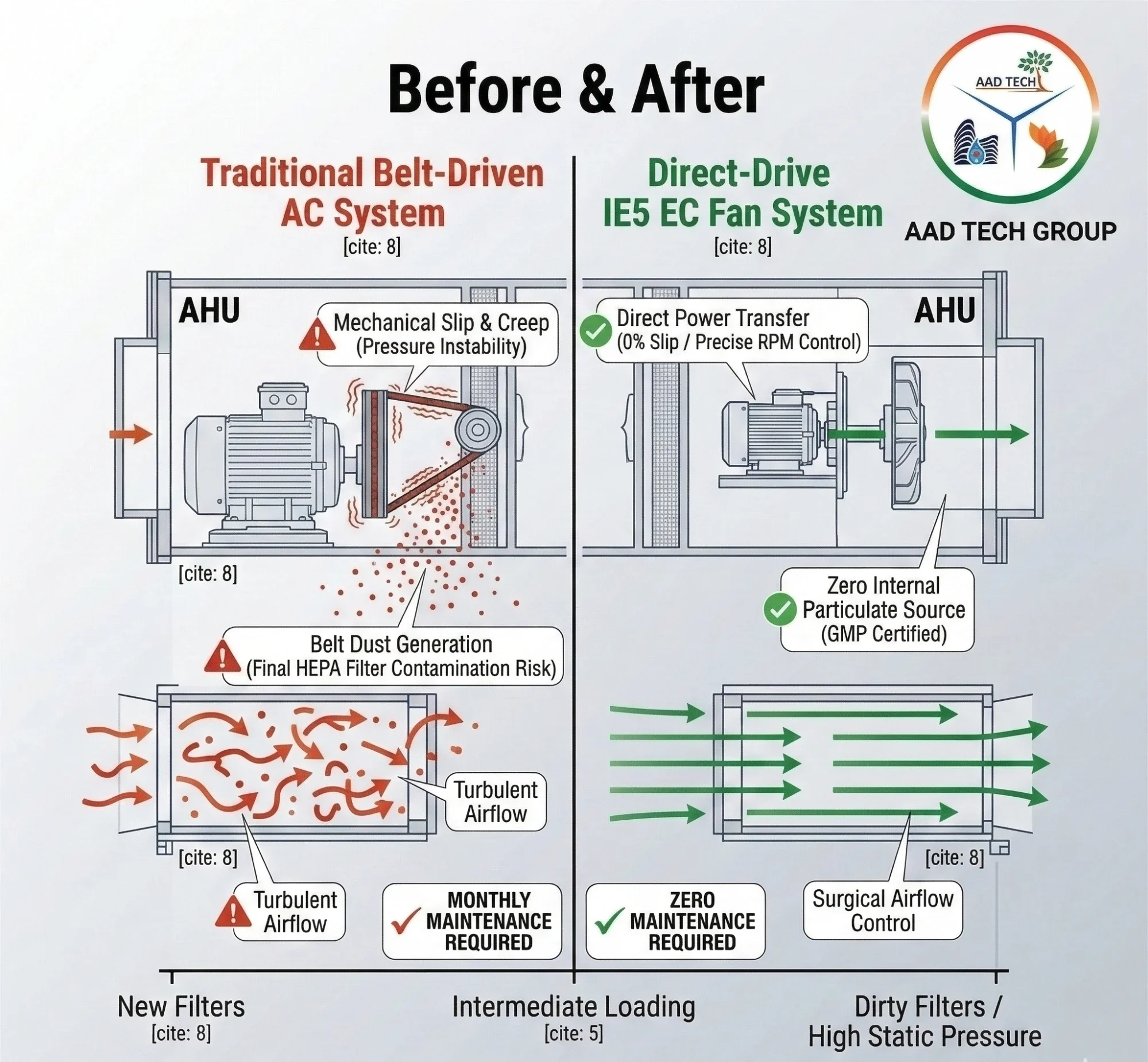
- Surgical Control: IE5-rated EC motors offer 0.1% control precision, responding instantly to pressure changes (e.g., door openings) without the “hunting” effect of traditional VFDs.
IV. The Pre-Specification Checklist: Critical Evaluation Metrics
Before you specify an AHU, evaluate these eight core metrics to ensure the system can pass a full validation lifecycle (DQ/IQ/OQ/PQ):
| Feature | Traditional Belt-Driven AC | Direct-Drive IE5 EC (Compliance-Ready) | Regulatory Impact / Why It Matters |
| Motor Efficiency | IE2 – IE3 (80–88%) | IE5 (>95%) | Reduces heat load on cooling coils; lowers energy OpEx. |
| Airflow Precision | Limited / Step-based | Surgical (0.1% accuracy) | Critical for Laminar Flow (0.45 m/s) in Grade A zones. |
| Particulate Risk | High (Belt Dust) | Zero (No Wear Parts) | Eliminates internal “Black Dust” per ISO 14644-1. |
| Pressure Stability | Variable (Belt Slip) | Constant (Direct-Drive) | Maintains the 10–15 Pa pressure cascade between zones. |
| Recovery Time | Slow VFD Response | Instantaneous | Ensures Recovery <20 mins per ISO 14644-3. |
| Redundancy | Single Point of Failure | N+1 Fan Array | Prevents total cleanroom collapse during motor maintenance. |
| Footprint | 100% (Baseline) | 40–50% smaller | Increases available space for technical mezzanines. |
| Maintenance | Monthly (Tensioning) | Zero (Maintenance-Free) | Reduces risk of technician-induced contamination. |
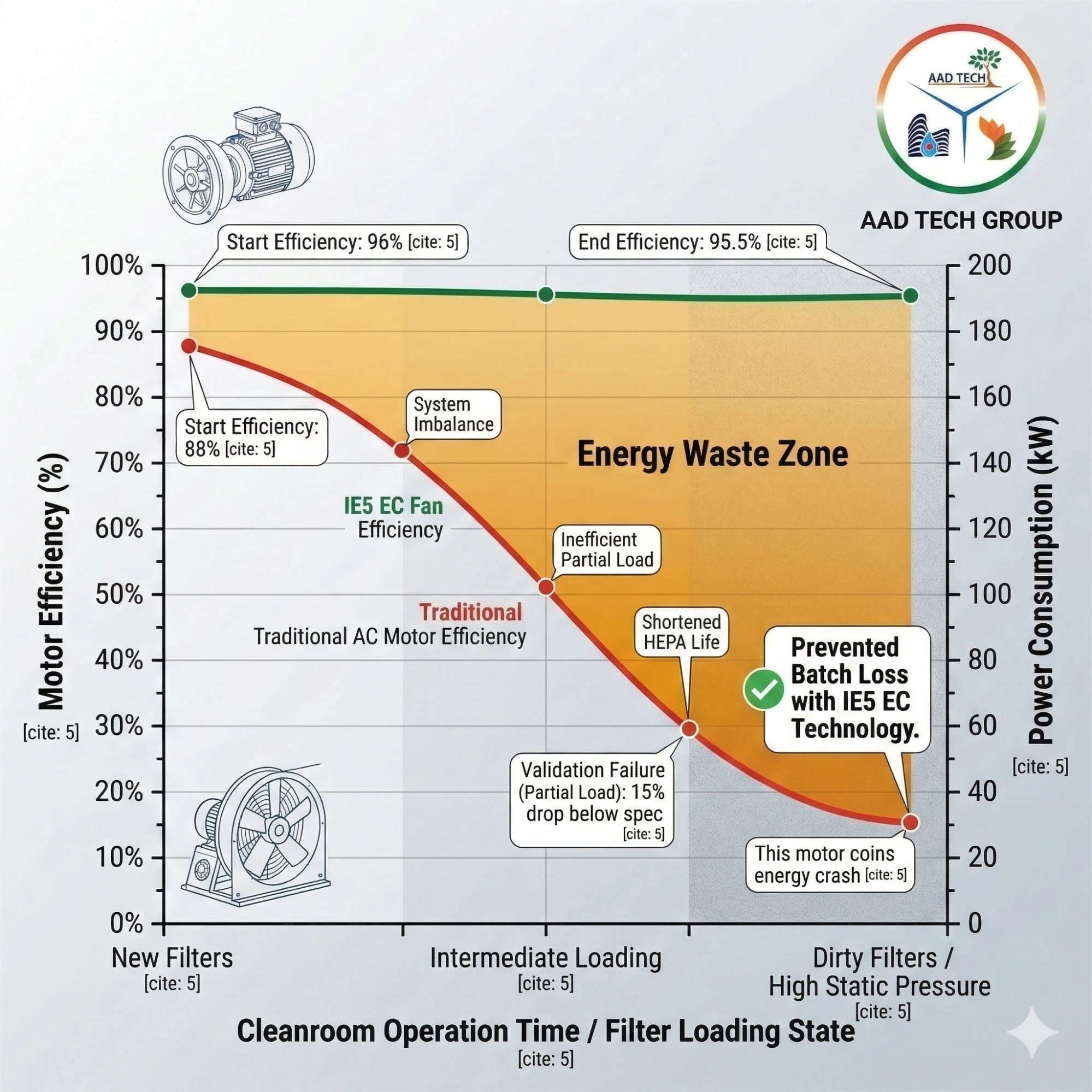
V. Data: Efficiency and Pressure Drops
VI. Future-Proofing with Top Manufacturers
Energy costs and “Dirty Power” regulations in India continue to rise. Our systems utilise IE5-rated EC fans to cut carbon footprints by 25% while ensuring HEPA safety. By aligning your hardware with ISPE Good Practice Guides, you future-proof your facility against stricter audits.
Frequently Asked Questions
IE5 motors cut energy loss by ~40%, reduce heat output, and improve efficiency—especially in 24/7 pharma operations.
They eliminate belts, preventing black dust contamination and protecting HEPA filters.
It’s the time taken to restore cleanroom standards after contamination—typically under 20 minutes for Grade A/B zones.
EC fans adjust speed precisely to maintain consistent airflow (0.45 m/s ±20%), even as filters load.
It ensures continuous operation, if one fan fails, others compensate, avoiding system downtime.