
I. Introduction: The High-Stakes Indian Climate
Designing an HVAC system for a temperate, inland environment is fundamentally different from engineering one for the Indian subcontinent. India presents a unique, dual-threat climate envelope: punishing monsoon moisture that frequently pushes relative humidity past 90%, combined with aggressive, chloride-laden coastal air in industrial hubs such as Mumbai, Chennai, and Gujarat.
A standard commercial air handler deployed in these zones will rapidly succumb to surface condensation, filter fouling, and accelerated galvanic corrosion. For facility managers, identifying the best AHU manufacturers in India is not merely about achieving design cooling loads; it is a critical strategy for asset longevity and minimising Total Cost of Ownership (TCO). High-performance industrial air handling unit manufacturers treat India’s climate as a mandatory engineering baseline, designing robust systems capable of surviving decades of salt spray and latent heat stress.
II. Engineering for the Monsoon: Mastering Humidity Management
Latent Load Handling
During the Indian monsoon, the primary engineering challenge shifts from sensible heat (temperature) to massive latent heat (moisture). If an AHU is not specifically sized for this, the facility will experience high humidity, leading to product degradation and severe mould growth.
Top-tier manufacturers engineer their cooling coils specifically for high latent heat loads. The moisture removal capacity required can be modelled mathematically by calculating the latent heat load ($Q_l$), where the mass flow rate of air ($\dot{m}$), the latent heat of vaporisation ($h_{fg}$), and the change in humidity ratio ($\Delta w$) dictate the energy required:
$$Q_l=\dot{m}\cdot h_{fg}\cdot \Delta w$$
To handle this load, coils in monsoon-ready AHUs are designed with more rows (often 6 to 8) and optimised fin spacing to ensure maximum contact time and prevent moisture carryover into the air stream.
Advanced Dehumidification Tech
Over-cooling the air to strip moisture is highly energy-intensive. Instead, the top 10 AHU manufacturers in India integrate active humidity management systems. It includes desiccant wheels that chemically adsorb moisture, and “monsoon reheat” cycles that carefully warm the over-chilled, dry air back to a comfortable supply temperature without reintroducing water.
Upgraded Filtration and Sterilisation
Damp, humid months turn standard air filters into breeding grounds for microbial growth. To combat this, industrial units feature moisture-resistant synthetic filter media. Additionally, manufacturers install Ultraviolet Germicidal Irradiation (UVGI) lamps downstream of the cooling coil to continuously sterilise the drain pan and coil surface, preventing bio-fouling.
III. The Coastal Defence: Superior Corrosion Protection
In coastal zones, salt-laden air acts as a relentless catalyst for oxidation. Standard materials break down rapidly, leading to refrigerant leaks and catastrophic structural failures. Protecting the AHU requires a comprehensive metallurgical defence strategy.
[Image 1: Infographic – Coastal vs Inland AHU Specification Comparison]
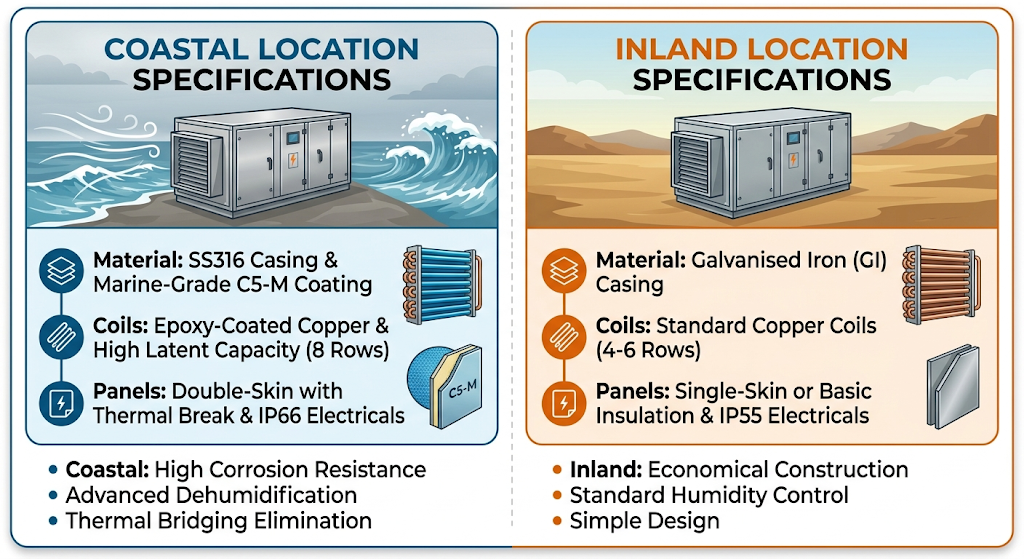
Material Selection Comparison
| Material Specification | Typical Use Case | Corrosion Resistance |
| Galvanised Iron (GI) | Inland, dry zones. | Low. Highly prone to rust in humid/coastal areas. |
| Aluzinc | Moderate coastal proximity. | Medium. Aluminium-zinc coating provides a sacrificial barrier. |
| Stainless Steel (SS304/SS316) | Direct coastal and industrial zones. | High. SS316 offers extreme resistance to chloride-induced pitting. |
Rigorous Coating Standards
For the delicate heat exchangers, bare aluminium or copper will corrode within months in coastal environments. Premium industrial units utilise coils with pre-coated fins (often referred to as blue or gold fins), which are treated with epoxy or phenolic coatings. Furthermore, the external casing and frame must adhere to strict international durability standards, frequently utilising marine-grade coatings certified to C5-M corrosion class to withstand continuous exposure to salt air.
IV. Structural Integrity: Double-Skin Panels & Thermal Breaks
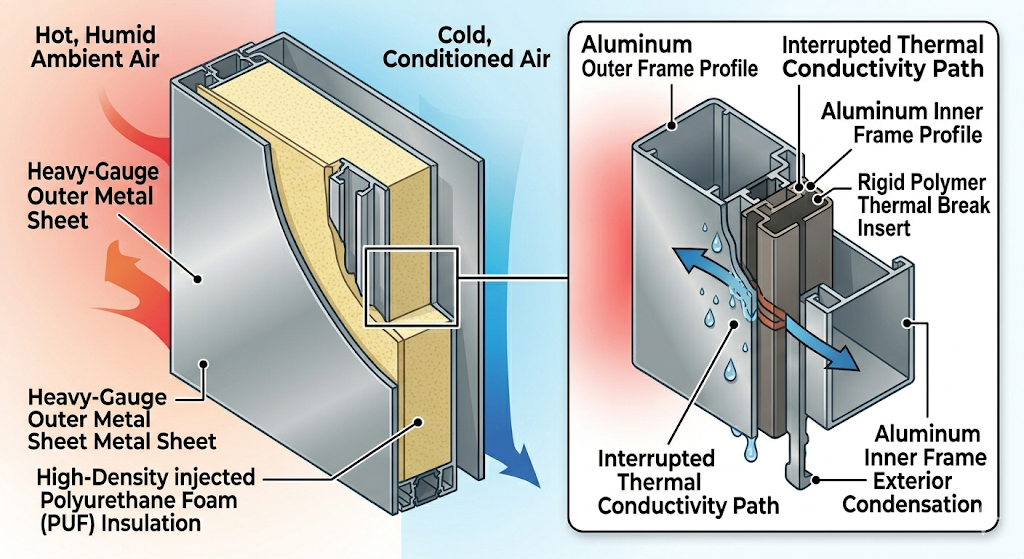
When cold, conditioned air inside the AHU interacts with the hot, humid Indian summer air outside the unit, it causes the exterior casing to sweat. This surface condensation pools around the unit, creating slipping hazards and accelerating external rust.
[Image 2: Diagram – Cross-Section of a Thermal Break Profile]
Eliminating Thermal Bridging
To prevent exterior sweating, top manufacturers utilise double-skin panels. These panels consist of an inner and an outer metal layer with high-density polyurethane foam (PUF) injected between them. Crucially, the internal frame is constructed from thermal-break profiles. These extruded profiles feature a rigid, non-conductive polymer insert that physically separates the inner cold metal from the outer warm metal, preventing the transfer of heat.
Weatherproof Electrical Systems
Moisture management extends to the AHU’s electrical components and rotating parts. In rain-exposed or persistently humid environments, electrical panels and fan motors must be hermetically protected. Manufacturers specify motors with IP55 or IP66 ratings, ensuring that driving rain, high-pressure washdowns, and pervasive humidity cannot penetrate the electrical housings and cause short circuits.
V. Selecting the Best: What to Look For
When procuring an industrial AHU for an Indian facility, evaluating the manufacturer’s specific capabilities is paramount. Facility and MEP managers should use this fundamental checklist:
- Monsoon-and-coastal-ready options: Confirm the manufacturer offers specific monsoon-mode or coastal-grade AHU packages with coated coils, double-skin panels, and C5-M-rated coatings.
- International Certifications: Verify that the manufacturer holds credentials from recognised bodies such as Eurovent, AHRI, or AMCA, which ensure the unit’s thermal and aerodynamic performance matches its marketed specifications.
- Testing Capabilities: Ensure the manufacturer has the capacity to conduct rigorous factory-level testing, including salt-spray testing for casing durability and casing leakage tests to verify air-tightness.
- Regional After-Sales Support: The most resilient AHU still requires maintenance. Choose a manufacturer with a dense service network and rapid-response teams located near your specific industrial belt.
Frequently Asked Questions
Inland AHUs are typically designed to manage sensible heat using standard materials such as galvanised iron (GI) and basic aluminium coils. Coastal AHUs are built for extreme humidity and salt spray, utilising stainless steel (SS304/316), heavy-duty C5-M marine coatings, epoxy-coated coils, and high-capacity dehumidification systems.
Sweating (condensation) occurs when the hot, humid exterior air hits the cold metal casing of the AHU. It is a common issue during the Indian monsoon. Manufacturers prevent this by using double-skin insulated panels and thermal-break profiles that prevent the cold internal temperature from reaching the outer casing.
A thermal break is a non-conductive material (usually a rigid polymer or polyamide strip) installed within the aluminium framing of the AHU. It literally breaks the metal-to-metal contact, preventing thermal energy (coldness) from conducting from the inside of the unit to the outside panel.
C5-M (defined under ISO 12944) is an international standard rating for environments with very high corrosivity, specifically coastal areas with high salinity. Paints and coatings rated C5-M are heavily formulated to withstand continuous exposure to salt spray and aggressive industrial atmospheres without degrading.
Galvanised steel relies on a thin zinc coating to prevent rust. In highly humid, salty environments like coastal India, chlorides rapidly corrode this zinc layer. Once the bare steel is exposed, it rusts very quickly, leading to structural failures and air leaks. Stainless steel or Aluzinc is highly preferred for these regions.