
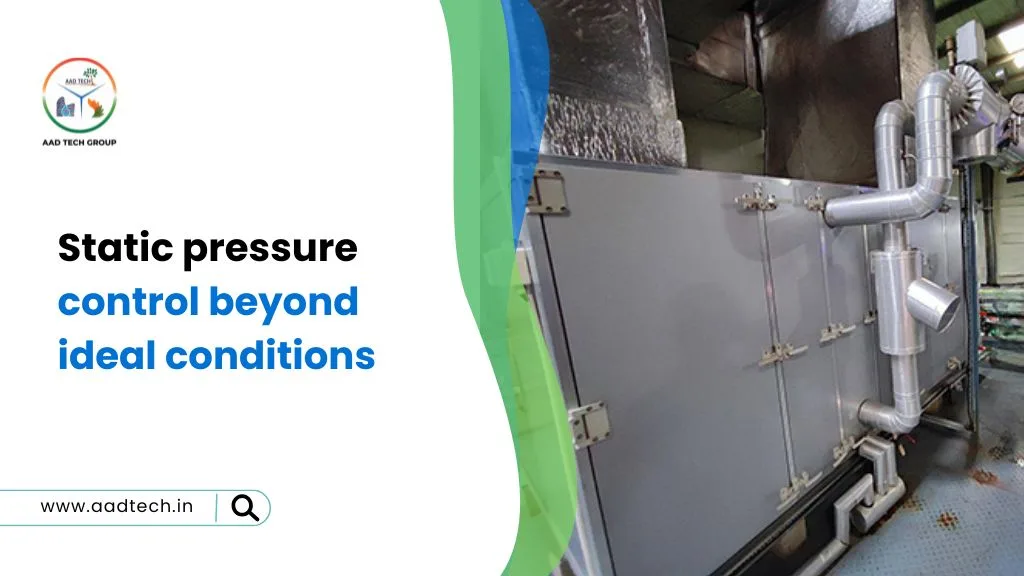
Static Pressure Reset (SPR) is an intelligent HVAC control strategy that dynamically adjusts an Air Handling Unit’s duct pressure in response to real-time zone demand. Instead of maintaining a wasteful constant pressure, the system lowers the setpoint until at least one VAV damper is nearly wide open. By reducing the resistance AHU fans must overcome, Aadtech’s EC retrofit solutions can slash power consumption by 40% to 70%, transforming ageing assets into IE5-compliant, smart AHUs.
1. The Physics of Resistance: Why We Over-Pressurise
In a standard commercial HVAC system, the AHU static pressure is the force required to circulate air through filters, coils, and complex duct runs. Most Indian and UK facilities operate on a fixed setpoint, typically between 375–625 Pa (1.5–2.5 in. w.g.).
The inefficiency is staggering: these systems are essentially redlined to meet peak loads that only occur 10% of the year. It is like driving a car at 100 km/h while constantly riding the brakes. You reach the destination, but at the cost of massive energy waste and mechanical wear.
The Power of the Cube Law
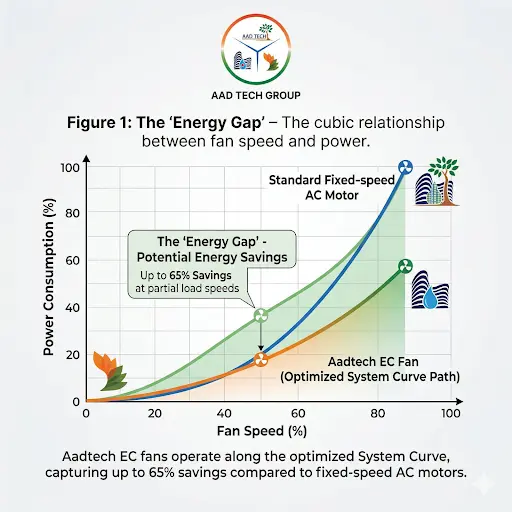
The Fan Affinity Laws govern the mathematics of AHU fans:
$$P_2 = P_1 \times \left(\frac{N_2}{N_1}\right)^3$$
Where $P$ is power and $N$ is speed (RPM).
Mathematically, reducing fan speed to 80% reduces power consumption by ~50%. While traditional AC motors lose efficiency at part-load, Aadtech’s IE5-efficiency EC fans maintain peak performance across the entire modulation range, turning theoretical math into actual bankable savings.
2. Strategies for Modulation: Trim-and-Respond
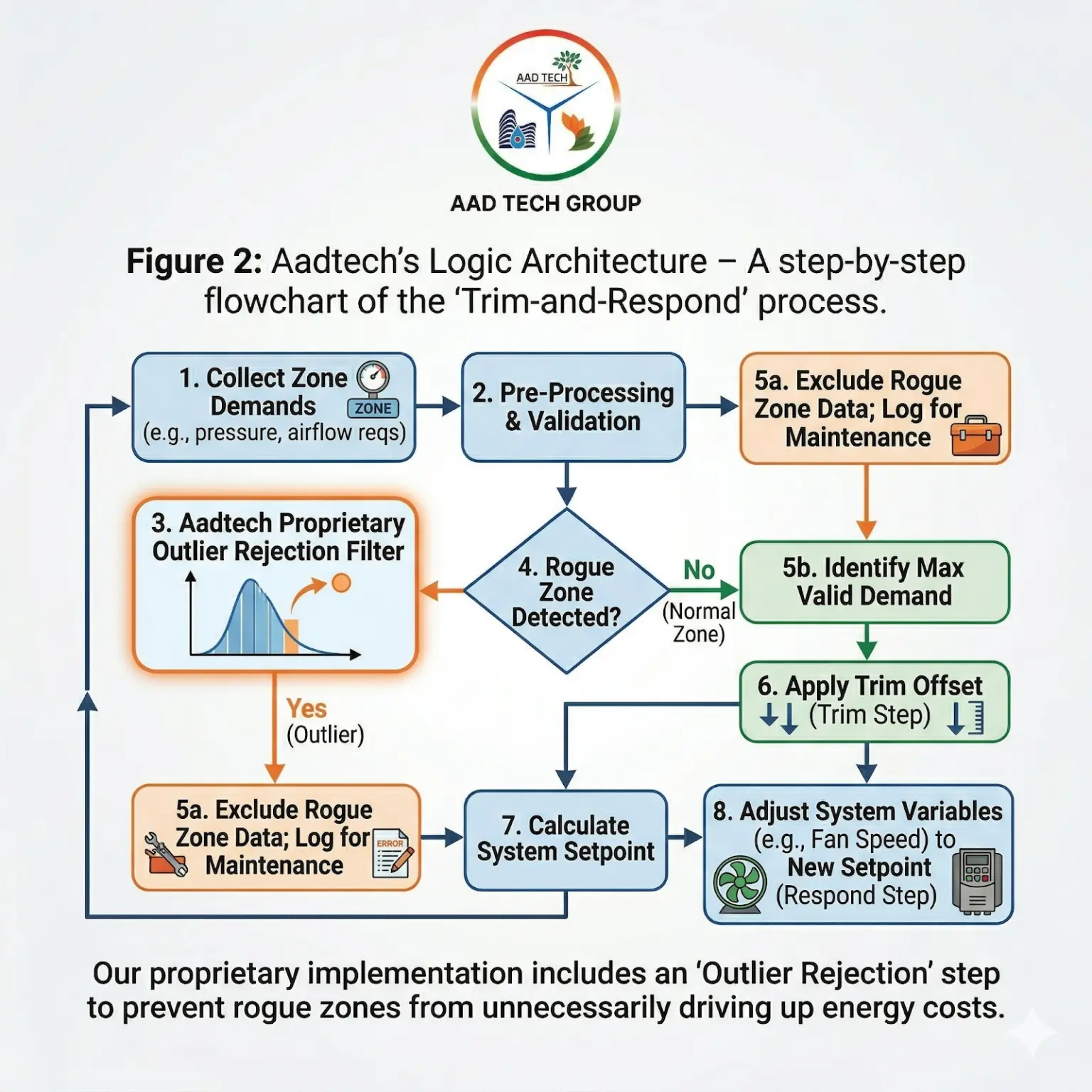
To move away from fixed setpoints, Aadtech implements the Trim-and-Respond algorithm, a gold standard recognised by ASHRAE 90.1.
- The Trim: The BMS periodically trims (lowers) the static pressure setpoint.
- The Respond: If a VAV box signals it is 90% open but still under-cooled, it generates a request.
- The Balance: The system increases pressure only when a threshold of requests is met, ensuring the hungriest zone is satisfied without over-pressurising the rest of the building.
3. The On-Site Reality: Why Theoretical Savings Vanish
Even the best algorithms fail without expert field tuning. At Aadtech, our 15+ years of experience in 25,000+ EC installations have identified three critical reality gaps:
The Rogue Zone (The Efficiency Killer)
A single faulty VAV box (with a stuck actuator or a sensor placed near a heat source) will stay 100% open and request more pressure indefinitely. It thus forces the AHU to ramp up for the entire facility to satisfy only one outlier.
- Aadtech Solution: Our smart controllers use logic that ignores outliers ($>2\sigma$ from the median damper position), flagging them for maintenance via IoT dashboards rather than wasting energy.
Sensor Placement & Hunting
If the duct pressure sensor is too close to the discharge, it creates a noisy signal. If it’s too far, the signal lag causes the VFD to hunt, oscillating wildly. This unstable operation destroys motors and disrupts comfort.
- The Fix: We position sensors at 2/3 of the longest duct run and implement a 25 Pa (0.1 in. w.g.) hysteresis to ensure smooth, stable modulation.
SPR for High-Humidity Climates (India/UK Focus)
In high-humidity regions like parts of India or London, aggressive pressure resets can reduce air velocity through the cooling coil too much, impacting dehumidification. Aadtech’s integration ensures that static pressure never drops below the threshold required to maintain latent heat removal, balancing energy with air quality.
4. Hardware Integrity: The Aadtech EC Advantage
Software cannot fix a mechanical failure. Legacy belt-driven fans suffer from slip losses, belt dust, and high maintenance.
- Direct-Drive Precision: Aadtech retrofits replace belts and pulleys with direct-drive EC fans (Ziehl-Abegg technology).
- IE5 Efficiency: Our motors exceed IE5 standards, ensuring that when the reset logic calls for 30% speed, the motor isn’t burning off energy as heat.
- Zero Maintenance: No greasing, no belt alignment, and a 10+ year lifespan.
5. Engineering Checklist: Is Your AHU Ready?
Before enabling a reset strategy, verify these Expert-Level parameters:
- VAV Calibration: Verify 95% damper accuracy via a BACnet loop test.
- Duct Integrity: Ensure no major leaks are stealing the pressure intended for terminal zones.
- Redundancy: Use an EC Fan Array (FanWall) so the system remains operational even if one fan fails
6. Frequently Asked Questions
Retrofits deliver 40–60% energy savings (up to 70% in pharma sites).
No; CO2/humidity sensors ensure full WHO/USFDA compliance.
EC fans are direct-drive and maintain >90% efficiency at part-load.
Most projects achieve full ROI within 1.5 to 2.5 years.
Yes; ASHRAE 90.1 and ECBC require it for multi-zone VAV systems.