
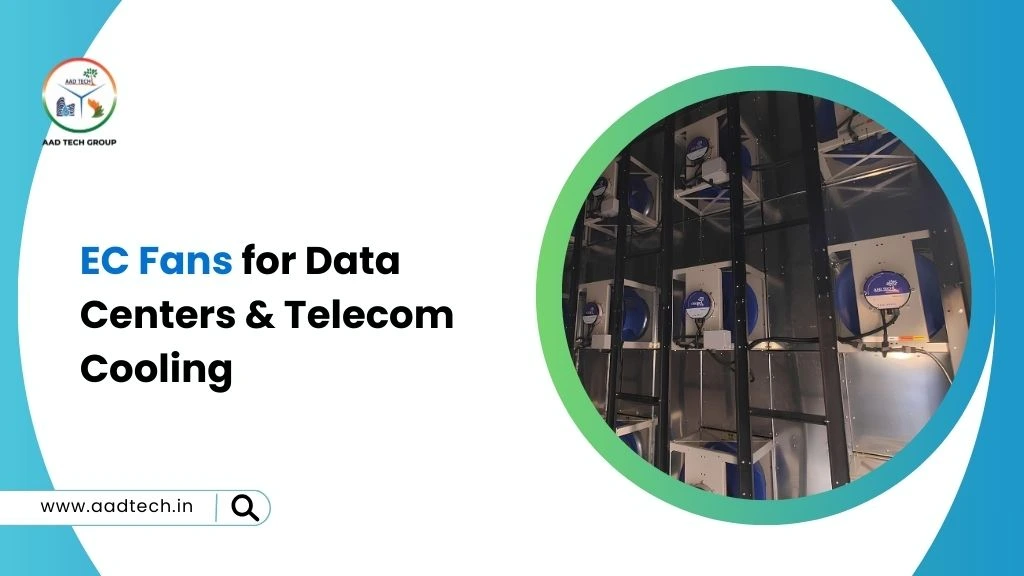
In today’s hyperconnected world, data centers and telecom networks quietly power almost everything we do, and somewhere between a video call and a cloud backup, you may find yourself wondering where all that heat actually goes. Every stream, every transaction, every computation generates electrical activity, and when operators pause mid-operation to ask themselves how much longer traditional cooling can keep up without affecting performance or energy budgets, the answer increasingly points toward EC technology.
AtAad Tech, we see EC fans for data centers not as just another component added to a cooling system, but as a clear shift in how airflow, efficiency, and long-term reliability are approached in high-load environments. As thermal demands rise, the way air is moved matters more than ever.
What Are EC Fans and Why Do They Matter?
EC stands for electronically commutated, and while the term may sound technical, the idea behind it is surprisingly practical. EC fans combine the strengths of AC and DC motors using integrated electronics, and when you stop to think about it, why would a fan need to run at a fixed speed when cooling demand is constantly changing?
Unlike traditional AC fans that operate without real-time adjustment, EC fans regulate speed and airflow based on actual thermal conditions. This allows cooling output to respond to demand rather than assumptions, which naturally reduces wasted energy and improves overall system behaviour. Because of this intelligent control, EC fans for data centers deliver higher efficiency, longer service life, and airflow precision that matches how modern facilities really operate, which is variable, dynamic, and sensitive to load shifts.
Discover how EC fans improve airflow in public environments
How EC Fans Change the Cooling Equation?
Energy Use That Adapts to Demand
EC fans stand apart because they adjust speed based on real cooling needs, not fixed assumptions. This can reduce power consumption by 30 to 50 percent, which matters when cooling accounts for a large share of total facility energy use.
Built for Stability and Long Service Life
With fewer mechanical parts and a brushless motor design, EC fans generate less heat and experience lower wear. The result is quieter operation, reduced vibration, and more reliable performance in sensitive environments.
A Smarter Foundation for Future Cooling
These combined benefits are why EC fans are no longer seen as simple upgrades. They are now considered the base of cooling systems designed to handle future demands.
Real Change in Data Centers and Telecom Facilities
Cooling challenges in data centers and telecom sites are rarely static. Loads rise and fall with user behaviour, rack densities change as equipment evolves, and telecom infrastructure must perform reliably across different climates. Traditional fans, limited by fixed-speed behaviour, struggle to adapt in real time, and this often leads operators to ask why cooling feels mismatched to actual conditions.
Facilities that move toward EC fans for data centers often see immediate, measurable benefits. Large cloud operators report notable reductions in cooling energy costs after retrofitting server aisles with EC axial fans, while telecom sites using EC centrifugal fans experience better uptime and lower operational expenses even in harsh outdoor environments. These outcomes reflect a broader shift in thinking, where cooling responds to real heat loads rather than theoretical peak conditions.
Why Variable Speed Becomes a Turning Point?
A traditional fan running at full speed when only half the load exists is inefficient, and once you picture that scenario across hundreds or thousands of fans, the energy loss becomes impossible to ignore. Many operators reach a point where they ask why cooling systems still behave as if conditions never change.
EC fans solve this by matching output to real-time conditions. This responsiveness reduces unnecessary energy use, limits wear on components, and keeps temperatures closer to optimal operating ranges. The result is not only lower energy bills, but also a reduced environmental footprint, which has become a serious consideration for sustainable data center and telecom operations.
The Benefits You Notice After the Switch
Beyond efficiency metrics, EC fans bring improvements that become apparent only after they are in place. Lower noise levels create safer and more comfortable working conditions for technicians, while reduced vibration helps protect sensitive equipment over long operational cycles. More precise airflow control also improves thermal stability, since cooling no longer relies on simple on or off behaviour.
Together, these elements create a cooling layer that adapts quietly in the background, responding to demand instead of operating by default.
Supporting Sustainability and Smarter Operations
Most data centers today operate with clear sustainability goals, and cooling efficiency plays a major role in meeting them. Because EC fans for data centers reduce energy consumption and support low-carbon strategies, they are increasingly used to improve Power Usage Effectiveness and reduce long-term emissions.
These fans also integrate well with modern building management systems and IoT-based monitoring, which allows operators to track performance, predict maintenance needs, and fine-tune cooling strategies over time. When insight replaces guesswork, cooling becomes easier to manage and more reliable to operate.
Conclusion: Cooling That Evolves With Demand
As digital traffic continues to grow and reliability expectations rise, many facilities find themselves asking how uptime can be protected without pushing energy consumption or risking thermal failure. For an increasing number of operators, the answer lies in smarter airflow rather than bigger systems.
At Aad Tech, we see EC fans for data centers as a direct response to how cooling needs are changing. They offer efficiency, adaptability, longer service life, quieter operation, and alignment with sustainability goals, all while supporting the realities of modern infrastructure.For organisations planning for longevity, operational efficiency, and future scalability, EC fans are no longer optional additions. They are quickly becoming the default choice for cooling strategies built to handle what comes next.
Frequently Asked Questions
EC fans adjust airflow dynamically based on heat load, reducing wasted energy and improving cooling performance.
Yes, many facilities see cooling energy reductions of 30–50% after switching to EC fan systems.
Yes, they produce less noise due to smoother, brushless operation.
Their precise airflow and lower thermal stress contribute to more stable operating temperatures, which can extend equipment life.
Yes, they work well in both indoor server halls and outdoor telecom shelters, adapting to variable loads and environmental conditions.