
For decades, the “Efficiency Revolution” in commercial buildings focused on what we could see: LED lighting, high-performance glass, and smart thermostats. Yet, the largest energy consumer in any HVAC system remained hidden in plain sight.
The traditional AC induction motor, the workhorse of the 20th century, has reached its physical limit. While lighting has transitioned from filament to fibre optics, most HVAC units still rely on 19th-century magnetic principles.
Electronically commutated (EC) technology represents the “digital revolution” of the mechanical world. It isn’t just a marginal improvement; it is a fundamental shift in physics.
1. The Physics of the “Efficiency Gap”
To understand the superiority of EC motors, we must examine how they handle magnetic fields.
The Problem with AC: The “Slip” Tax
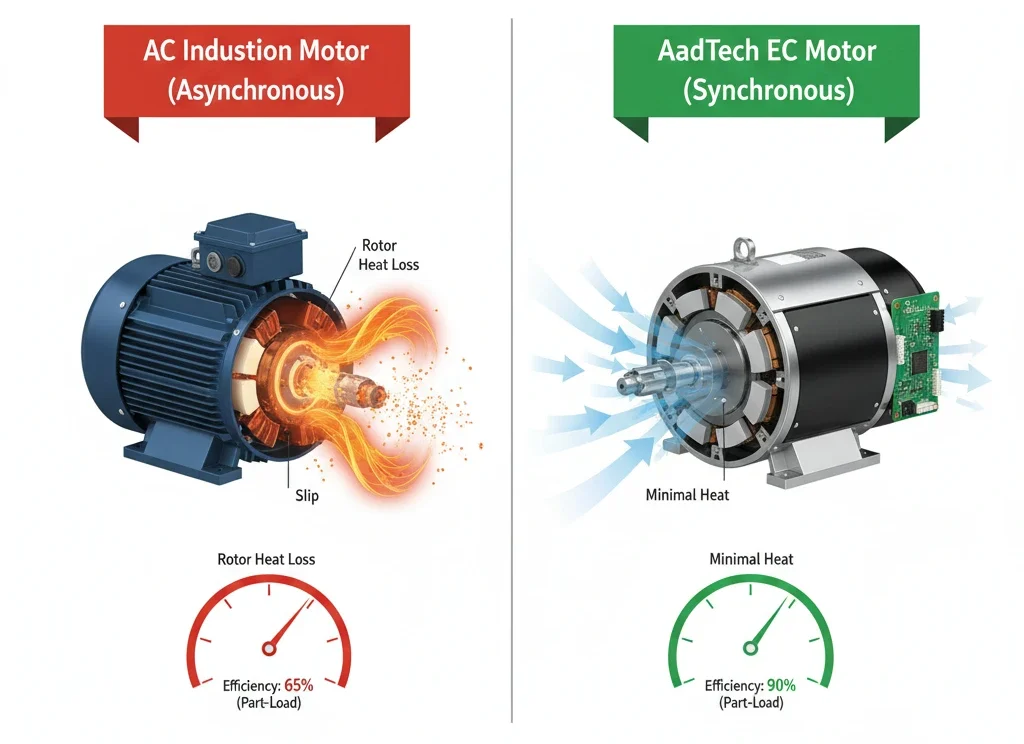
Traditional Alternating Current (AC) induction motors are asynchronous. To create motion, the stator must “induce” a magnetic field in the rotor using copper windings. This process requires constant energy and creates “slip,” a lag between the magnetic field’s speed and the rotor’s speed. This lag is pure energy waste dissipated as heat.
The EC Solution: Permanent Magnetism
EC motors utilise Permanent Magnets on the rotor. Because the rotor is already magnetised, the motor doesn’t need to “waste” electricity creating a magnetic field.
2. Thermal Management and Lifespan
In the world of HVAC, heat is the enemy of efficiency. Because traditional motors lose so much energy to “slip,” they run hot. This creates a negative feedback loop in your AHU:
- Direct Loss: Energy intended for motion is lost as thermal waste.
- Secondary Load: The HVAC system must then work harder to remove the heat that the motor itself just injected into the airstream.
The EC Advantage:
Because EC motors are 30% to 50% more efficient at the point of use, they produce significantly less waste heat. This cooler operation has a massive impact on Bearing Life. High temperatures degrade lubricants; by running cooler, EC motors extend the life of their internal components, reducing mechanical failures and maintenance downtime in demanding climates.
3. Integrated Intelligence: The “Smart” Motor
Perhaps the greatest advantage of EC technology is its onboard electronics. In a traditional setup, you need an external Variable Frequency Drive (VFD) to control speed. A VFD adds bulk, complexity, and its own set of energy losses.
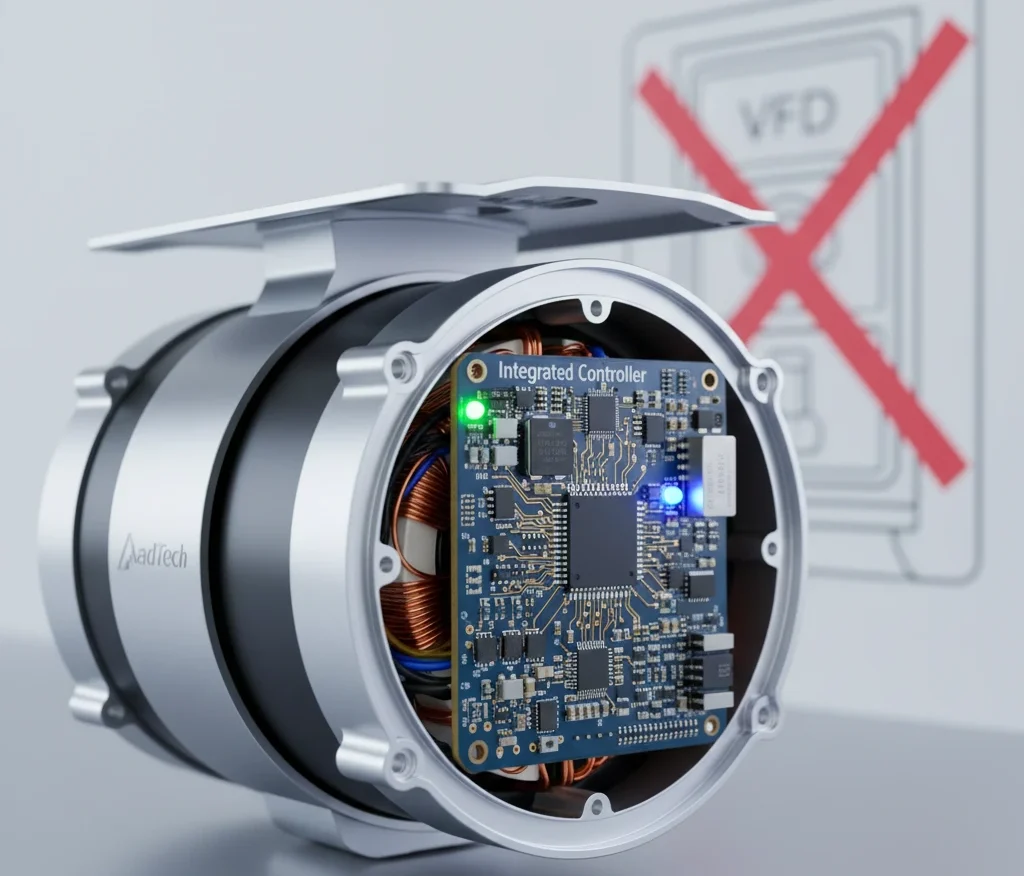
An EC motor acts as its own VFD. The integrated controller continuously monitors the load and adjusts the power input in real-time.
- Precision Torque: Unlike AC motors, which often stall or overheat when slowed down, EC motors maintain high torque even at ultra-low speeds.
- Plug-and-Play: No need for complex external wiring or cooling for a separate VFD cabinet.
- Predictive Maintenance: The onboard “brain” can communicate performance data, enabling IoT connectivity and early warning signs before a failure.
4. The Aad Tech Edge: Future-Proofing Your Hardware
At Aad Tech India, we provide “future-proof” hardware. Switching to EC motors isn’t just an energy play; it’s a digital upgrade. By moving to synchronous, permanent magnet technology, you aren’t just saving on this month’s utility bill; you are investing in a system capable of predictive maintenance and seamless IoT connectivity.
Technical Comparison: At a Glance
| Feature | AC Induction Motor | AadTech EC Motor |
| Magnetism | Induced (Energy intensive) | Permanent (Zero-loss) |
| Efficiency Standard | Typically IE2 / IE3 | IE5 (Ultra-Premium) |
| Speed Control | Requires External VFD | Integrated Electronics |
| Heat Output | High | Low |
| Maintenance | Frequent (Bearing stress) | Minimal (Cooler operation) |
Frequently Asked Questions
Essentially, yes. An EC motor is a brushless DC motor with built-in electronics that allow it to run on AC power. It combines the efficiency of DC with the easy connectivity of the AC grid.
Induction motors use electricity to create a magnetic field in the rotor, which generates heat. EC motors use permanent magnets, so no electricity is wasted on the rotor, resulting in much lower thermal loss.
No. One of the primary benefits of EC technology is that the speed control electronics are integrated directly into the motor housing, eliminating the need for an external VFD.
While results vary by application, most facilities see energy reductions of 30% to 50% compared to standard AC motors, especially in systems with variable demand.
Yes. EC motors are often more compact than the AC motors they replace, making them ideal for retrofitting into existing Air Handling Units to improve efficiency without a complete system replacement.