
In industrial refrigeration and HVAC systems, the cooling tower is often the most overlooked component (until the chiller trips on high-pressure alarms). The financial penalty of neglect is immediate and severe: a mere 1°C increase in cooling water temperature can spike a chiller’s energy consumption by 2–3%.
To master cooling tower troubleshooting, one must look beyond obvious mechanical failures and focus on the fundamental thermodynamic metric: Approach Temperature.
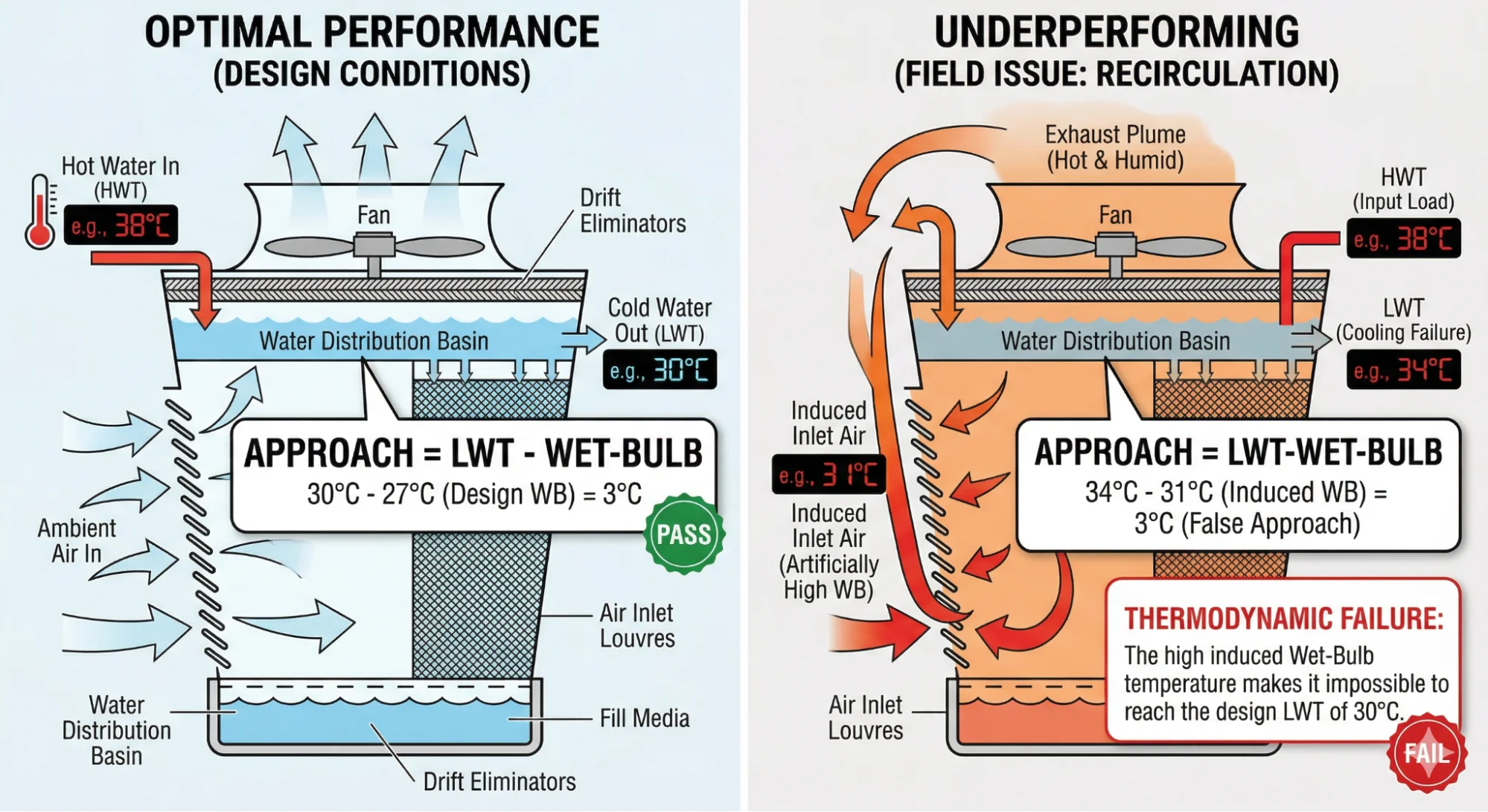
The Approach Temperature Formula
| $$\text{Approach} = \text{Cold Water Temperature (LWT)} – \text{Ambient Wet-Bulb Temperature}$$ |
An ideal approach typically sits between 2.5°C and 4°C. If your approach is widening, your system is bleeding money. Here are the 7 root causes of cooling tower underperformance.
1. Fouled or Degraded Fill Media
The fill media is the heart of heat transfer. In Indian industrial zones, ambient dust and high-TDS water frequently conspire to clog fill flutes with a mixture of silt, scale, and biofilm. The result is channelling, where water bypasses clogged sections and flows in thick streams, destroying the air-water contact time.
When thermal performance degrades, selecting the right replacement is critical; standard options often fail under local water conditions. For a deeper dive into selecting the right media for high-fouling environments, see our guide to cooling tower fill selection in India.
2. Blocked Spray Nozzles and Poor Water Distribution
Efficient cooling requires the fill to be 100% wetted. When nozzles clog due to inadequate cooling water treatment, dry spots form. Because dry air takes the path of least resistance, it rushes through these dry zones where no evaporation occurs. This bypass air does no work, causing the approach temperature to spike even though the fan is running at full speed.
3. Fan and Motor Degradation (The Airflow Deficit)
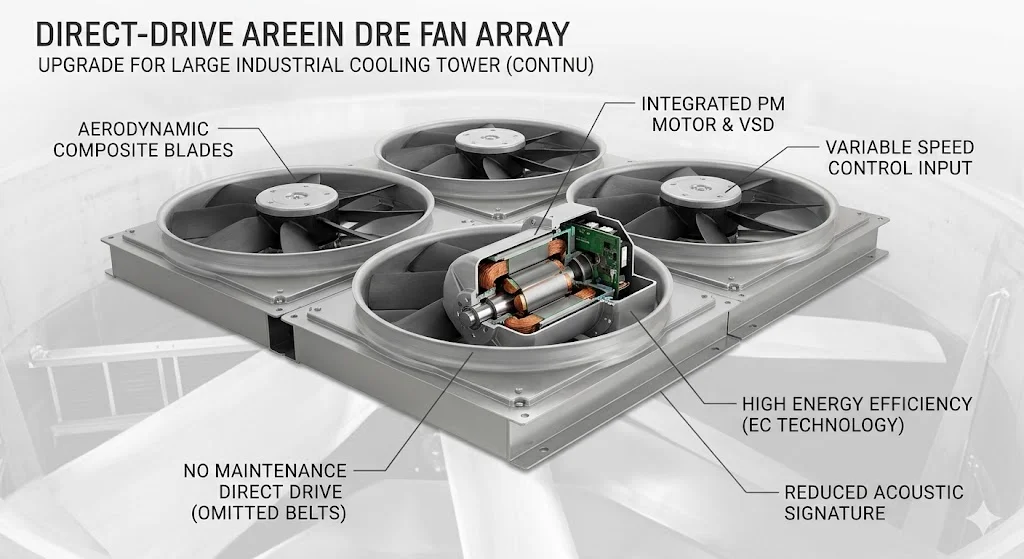
At AadTech, we frequently find that thermal issues are actually airflow issues. Traditional belt-driven axial fans are prone to belt slip, incorrect blade pitch, and bearing wear, all of which reduce the total CFM (Cubic Feet per Minute).
Source: Approach-Based Cooling Tower Control for Energy Efficiency
Transitioning to modern direct-drive EC fans eliminates transmission losses and allows for precise speed control, ensuring the tower maintains the correct air-to-water ratio even as ambient conditions fluctuate.
4. Severe Scale and Corrosion
In regions like Bengaluru or Gujarat, groundwater contains high concentrations of calcium and magnesium. Without a robust blowdown strategy, scale buildup acts as an insulator on the internal heat exchange surfaces. A layer of scale just 0.5mm thick can reduce heat transfer efficiency by double digits. Maintaining water chemistry in accordance with CTI (Cooling Technology Institute) standards is non-negotiable for long-term ROI.
5. Clogged Drift Eliminators and Air Inlet Louvres
Aerodynamics play a critical role in tower health.
- Inlet Louvres: If blocked by debris or scale, they starve the fan of air.
- Drift Eliminators: When these become fouled or misaligned, they increase the static pressure drop across the tower.
It chokes the fan and reduces airflow. Regular drift eliminator maintenance is essential to prevent excessive water loss and protect fan longevity.
6. Recirculation and Interference
Site layout is a common invisible cause of underperformance.
- Recirculation: This occurs when a tower’s own hot, humid exhaust air is pulled back into its air intakes.
- Interference: This happens when adjacent towers feed hot air into the intakes.
Both scenarios artificially raise the ambient wet-bulb temperature. It is also why many facilities struggle during peak heat; you can learn more about why standard ratings fail in Indian summers and how to mitigate these site-specific risks.
7. Excessive Heat Load Beyond Design Capacity
Sometimes, the tower is not failing. It is simply outgrown. If a facility has added new production machinery or upgraded chillers without auditing the cooling tower’s capacity, the underperformance is actually due to exceeding the original thermal design parameters. A professional thermal audit can determine whether your current infrastructure can handle your expanded load.
Cooling Tower Troubleshooting Matrix
| Symptom | Root Cause | Diagnostic Action |
| High Approach | Fouled Fill/Airflow | Fill inspection, fan |
| Dry Spots | Clogged Nozzles | Basin wetting check |
| Water Loss | Drift Eliminators | Gap/brittleness visual |
| Vibration | Fan Imbalance | Analysis, belt tension |
| High Energy | Scale/Overload | Chemistry test, load audit |
Frequently Asked Question
Typically, an approach of 2.5°C to 4°C is considered efficient. For precise benchmarking, consult the CTI thermal testing guidelines.
Efficiency is checked by measuring the Cooling Range (Inlet Temp – Outlet Temp) and the Approach, then comparing these values against the manufacturer’s design curve for the current ambient wet-bulb temperature.
Air and water cannot mix effectively. Water channels through limited openings, drastically reducing the evaporative surface area. It results in higher water temperatures returning to the chiller, increasing energy costs and risk of system trips.