
Modern cold storage warehouses operate on incredibly thin profit margins. Massive electricity bills destroy that profitability every single month. Facility managers face immense pressure from corporate boards to cut operational costs. However, they cannot risk a single thermal excursion. One equipment failure can ruin millions of rupees worth of sensitive inventory.
You must find the exact balance between aggressive energy efficiency and flawless thermal compliance. Achieving this requires precision engineering, not guesswork.
The Hidden Parasitic Loads in Cold Chain Logistics
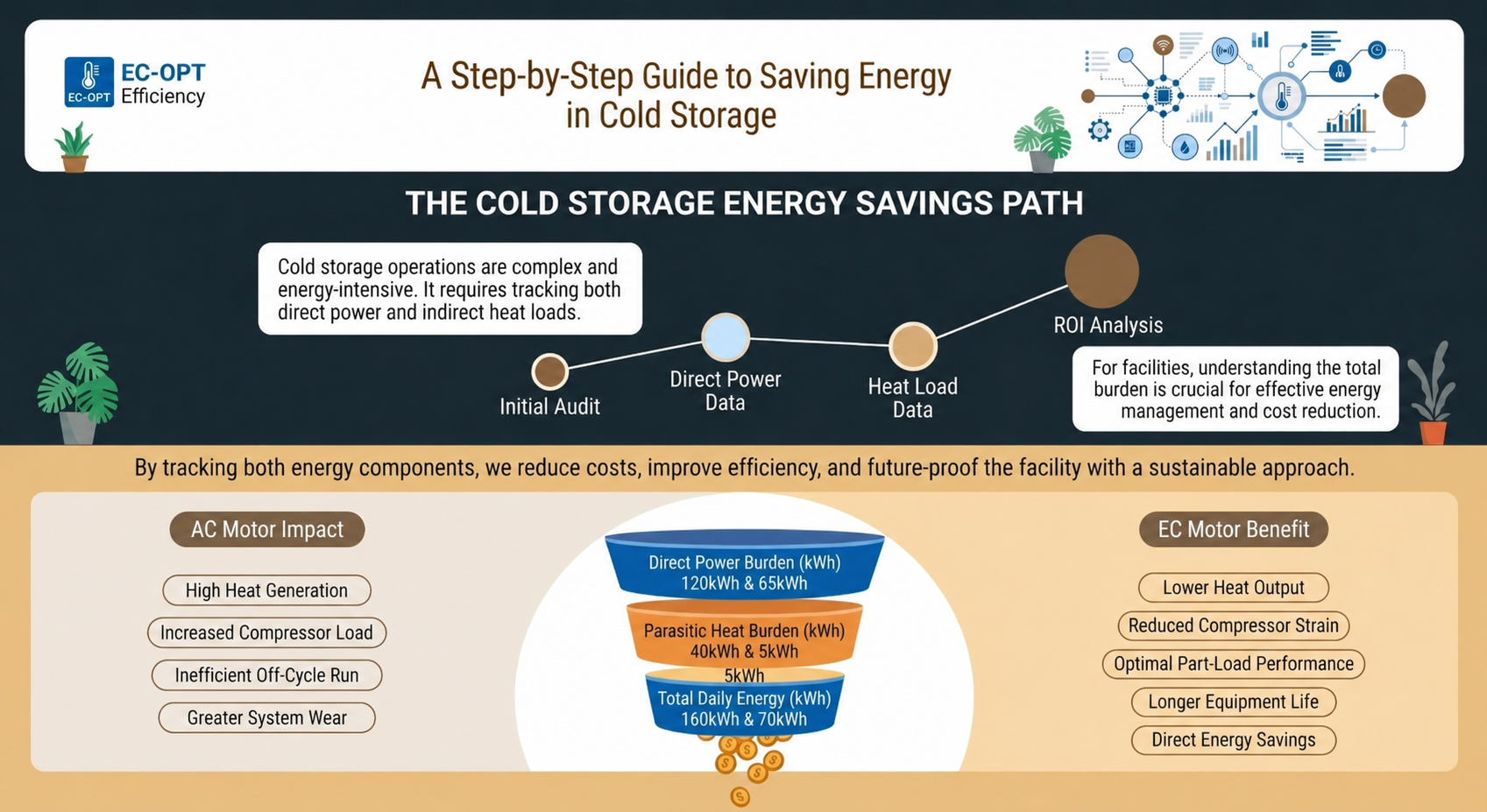
Many supply chain directors ignore the physical phenomena occurring within their own cold rooms. Legacy AC (Alternating Current) belt-driven fans create massive thermal issues. These outdated motors run constantly at maximum speed. They do not just move air; they physically generate mechanical heat inside your sub-zero space.
Engineers call this self-generated heat a parasitic load. Your refrigeration compressors must work overtime simply to remove the heat your own fans produce. This destructive cycle inflates your electricity bill exponentially. According to the U.S. Department of Energy (DOE), inefficient industrial motor systems account for massive electrical waste, much of it expelled as heat.
Facility managers working in cold chain logistics cannot achieve peak efficiency until they eliminate this self-generated heat. Our engineering team recently conducted a detailed analysis of EC Motors in Sub-Zero Cold Storage, focusing on the physics of sub-zero thermal challenges.
Targeting the Air Handling Unit: The EC Fan Upgrade
The fastest way to eliminate parasitic heat is an energy-saving retrofit. This surgical intervention targets the exact source of the electrical waste: the air handling unit (AHU). Our technicians replace inefficient belt-driven AC blowers with highly advanced Electronically Commutated (EC) fans.
Conventional AC motors typically achieve only 85% efficiency. In contrast, EC motors operate at 93%-95% efficiency. They generate virtually zero excess motor heat. Furthermore, an EC fan system eliminates the mechanical friction losses caused by old belts and pulleys totally. You instantly remove copper losses and slip losses from your daily energy equation.
Maintenance teams also gain massive advantages. EC fans do not require constant belt tensioning. The system utilises high-quality sealed bearings. It means bearing maintenance drops to absolute zero.
By incorporating built-in variable-speed drives, the EC system delivers the exact airflow required by the room. The affinity laws of physics state that reducing a fan’s speed by just 20% cuts its energy consumption by nearly 50%. It creates immediate, verifiable financial returns. Research published by university engineering departments frequently highlights that Variable Frequency Drives (VFDs) provide the highest return on investment for industrial HVAC upgrades.
Securing Strict Cold Chain Temperature Compliance
Protecting sensitive pharmaceutical or food payloads remains your ultimate priority. Facility managers face strict auditing standards. You cannot sacrifice regulatory compliance for a lower power bill. Modern EC retrofits solve this problem entirely.
These advanced systems use intelligent sensors. The sensors communicate instantly with the air handling unit. The smart controller dynamically modulates the fan speed based on real-time room data.
Instead of old AC fans slamming on at full power and then shutting off entirely, EC fans provide smooth, continuous airflow adjustment. This precise control eliminates the massive temperature swings typical of legacy systems. You secure an unyielding, rock-solid cold chain temperature across the entire storage floor. The system distributes chilled air evenly, eliminating stagnant warm pockets. Your payload remains perfectly stable. Ultimately, you execute your corporate sustainability programmes without ever risking product spoilage.
Energy Saving Retrofit vs Complete System Overhaul
Many operations directors mistakenly believe they must halt their entire facility and buy entirely new equipment to cut power bills. But that’s a costly error. If your existing AHU casing remains structurally sound, you do not need a complete teardown. You simply need to upgrade the internal mechanics. We outline this crucial financial decision in our Retrofit vs Replace Guide.
An energy-saving retrofit transforms a legacy metal box into a modern, high-performance machine. Our industrial engineers design the new fan array to fit exactly into your existing footprint. The installation requires minimal operational downtime. Facility managers usually recover their capital investment within 24 months. Meanwhile, the new EC fans deliver a lifespan exceeding ten years.
However, extreme environments sometimes cause severe metal degradation. If your casing shows massive structural failure or heavy rust, patching it would be a waste of money. In these severe cases, our engineers will design a completely custom AHU, built specifically for harsh industrial conditions.
Stop Leaking Profits
Do not let parasitic heat loads drain your operational budget. Secure your cold chain and cut your power bills at the same time. Contact AADTECH’s industrial engineers today. Book an energy audit to assess your current power draw and discover your precise savings potential.
Frequently Asked Questions
A: An energy-saving retrofit involves upgrading the internal components of an existing HVAC system. Engineers install Electronically Commutated (EC) fans, variable frequency drives, and smart sensors inside your current casing. This process avoids replacing the entire structural unit. It slashes electrical consumption while extending equipment lifespan.
A: Retrofitted Air Handling Units use smart sensors to monitor the thermal load constantly. Instead of simply turning on and off at random, the system adjusts the fan speed in real time. The mechanism ensures the cold chain temperature remains perfectly stable without any dangerous thermal spikes.
A: Legacy AC fan motors run continuously at full speed. They generate significant mechanical friction and heat. This heat creates a parasitic load inside the cold room. Your refrigeration compressors must work much harder and consume vastly more electricity just to remove the heat caused by your own fans.
A: No. Industrial engineers plan energy-saving retrofits to minimise downtime. Technicians swap out individual components, such as fan arrays and control panels, in carefully staged steps. The process allows your facility to maintain operational continuity and protect all stored inventory during the upgrade.
A: You should choose a retrofit if your existing AHU casing and coils remain structurally sound. A retrofit replaces the power-hungry parts. However, if the metal casing is severely degraded or rusted, you must install a completely new system to maintain structural integrity.