
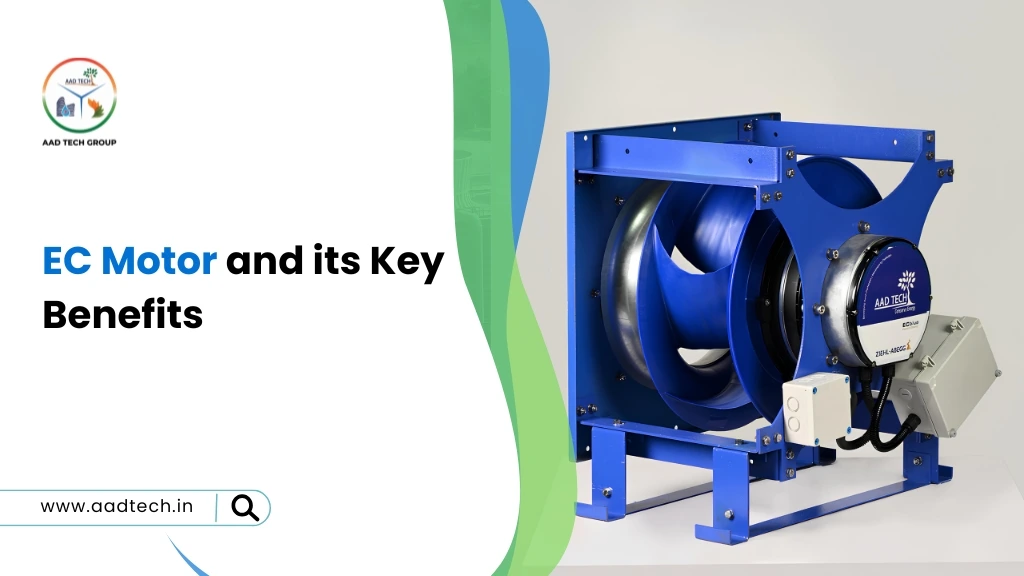
As energy costs rise and demands for efficient ventilation grow, the choice of fan motor becomes critical. Among modern motor technologies, the EC motor (Electronically Commutated motor) stands out for delivering high efficiency, precise control, and long-term reliability.
At Aad Tech, we recommend EC-motor fans, whether centrifugal or axial, when retrofitting air-handling units (AHUs), cooling towers, or ventilation systems. Below, we explain how EC motors work and why they are increasingly becoming the standard for modern HVAC and ventilation systems.
What Is an EC Motor
An EC motor is essentially a brushless permanent-magnet motor with built-in electronics that convert an AC supply into a precisely controlled DC output. This design uses a permanent-magnet rotor and an electronic commutation circuit, instead of the traditional AC induction motor approach, which relies on electrical excitation of rotor windings.
Because the motor handles commutation electronically, EC motors offer smoother operation, better control over speed, and greater overall efficiency compared to conventional AC motors.
Key Advantages of EC Motor Fans
1. High Energy Efficiency
EC motors generally consume less energy than traditional motors. Because the rotor uses permanent magnets rather than requiring current for magnetic excitation, energy losses are reduced. This contributes to significant power savings, especially at partial load.
Many users report energy savings in the range of 30% to 50% when switching from standard AC-motor fans to EC motor fans, especially in variable-speed applications.
2. Variable Speed & Precise Control
EC motors come with built-in electronic control, often accepting 0–10 V or similar control signals. This enables fine-grained speed control without the need for external variable-frequency drives (VFDs).
Adjusting fan speed to match real ventilation demand reduces wasted energy and allows more precise air flow and pressure control, which is especially valuable in AHUs, cleanrooms, and variable-load HVAC systems.
3. Lower Noise and Vibration
Because EC motors operate smoothly and efficiently, they typically run cooler, produce less vibration, and operate more quietly than older belt-driven or standard AC fans. This makes them suitable for noise-sensitive environments such as offices, hospitals, and labs.
4. Compact and Lightweight Design
EC motors often have a smaller overall size due to the use of permanent magnets and the elimination of bulky rotor windings. This makes fan assemblies more compact, easier to install, and easier to retrofit in existing HVAC systems.
5. Lower Maintenance and Longer Service Life
The brushless design eliminates wear components like carbon brushes, reducing maintenance needs. EC motors also run cooler, which tends to extend bearing and component life.
6. Flexibility and Better Control Integration
Because EC motors have onboard electronics and support modern control signals (e.g., 0–10 V or BMS integration), they integrate well into modern building management systems and advanced HVAC control strategies.
Learn how EC technology outperforms traditional motors in our detailed comparison.
Common Applications of EC Motor Fans
Due to their advantages, EC fans are well-suited for a variety of settings:
- AHU retrofits – Replacing old motors or belt-driven fans to improve efficiency and control.
- Cooling towers and ventilation systems – Where variable load and energy savings matter.
- Cleanrooms, labs, hospitals – Environments needing quiet, reliable, and controllable airflow.
- Commercial buildings and offices – For HVAC systems with fluctuating occupancy and airflow demand.
- Data centres, server rooms, industrial ventilation – Where reliability, constant airflow, and lower energy costs are critical.
Why EC Motor Fans Align with Aad Tech’s Approach
At Aad Tech, our goal is to deliver HVAC and ventilation solutions that combine performance, efficiency, and reliability. EC motor fans perfectly align with these goals because:
- They cut operational energy costs while improving airflow control.
- Their compact design and lower maintenance requirements make retrofits simpler.
- Their smooth, quiet operation enhances occupant comfort in commercial and institutional buildings.
- Their flexibility and control capabilities allow integration with modern BMS and building automation strategies.
We often recommend EC-motor fans as part of AHU upgrades, retrofit projects, and new installations, especially where long-term cost savings and environmental compliance matter.
Conclusion
EC motor fans represent one of the best advances in HVAC and ventilation technology. By combining permanent-magnet design with integrated electronics, they deliver energy-efficient, controllable, and low-maintenance airflow solutions.
For companies and facilities looking to upgrade their AHUs or ventilation systems without a major overhaul, EC fans offer a smart, future-proof, and cost-effective path forward.
At Aad Tech, we believe EC motor technology is fundamental to modern HVAC design, and we encourage clients to consider EC fan upgrades whenever they plan maintenance, retrofit, or new installations.
Frequently Asked Questions
Electronically Commutated, meaning the motor uses built-in electronics to control its operation rather than relying on brushes or external VFDs.
Yes, especially under variable load conditions because the permanent-magnet rotor and electronic control reduce electrical losses and improve part-load efficiency.
No. Most EC fans include integrated electronics that allow speed control via simple 0–10 V or BMS control signals.
Yes. Their compact size and direct-drive design make them ideal for retrofits in AHUs, cooling towers, and ventilation systems.
No. EC fans typically run quieter and with less vibration than belt-driven or traditional AC-motor fans, improving comfort in occupied spaces.