
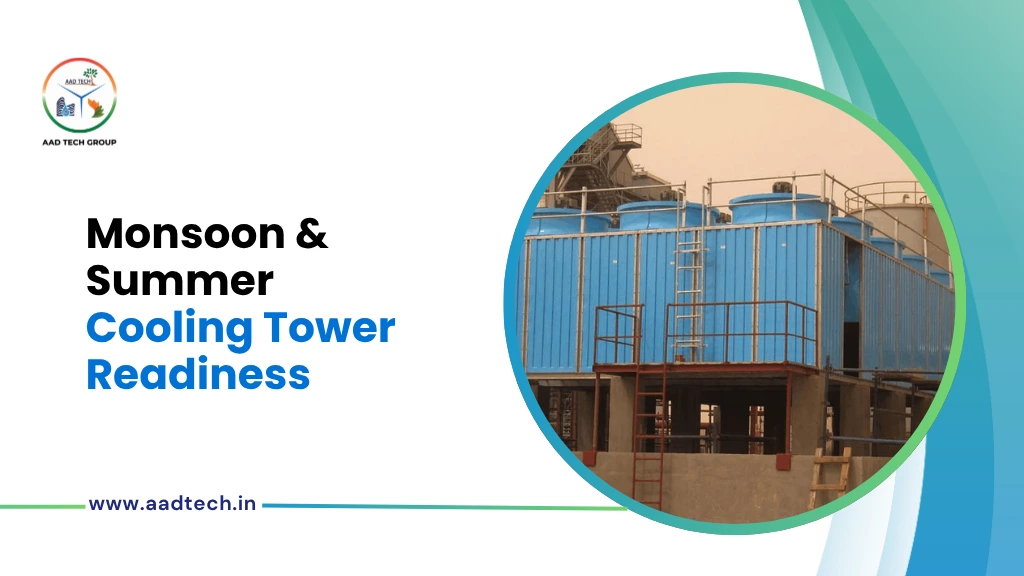
Indian industrial cooling towers operate through intense heat, dust, humidity, rain, fluctuating water quality, and continuous process demand. Seasonal readiness helps protect heat rejection, reduce breakdown risk, and keep condenser or process water temperatures under control when site conditions are at their toughest.
Engineering Insight:
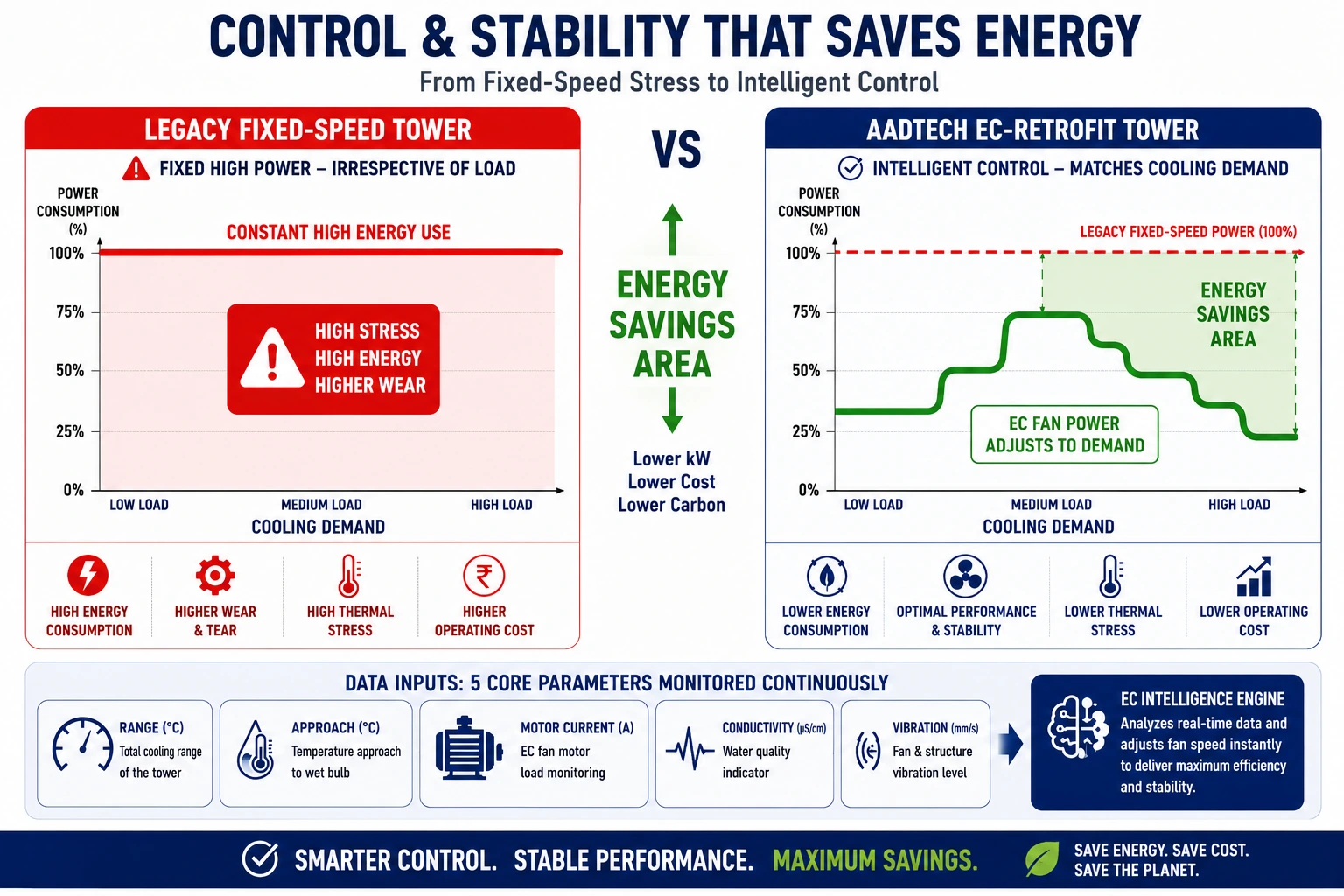
Seasonal readiness helps maintain clean heat-transfer surfaces, balanced water chemistry, healthy airflow, and reliable fan operation. Tracking the five core parameters (range, approach, motor current, conductivity, and vibration) helps plant teams shift from reactive repair work to planned seasonal readiness maintenance.\
4 Summer Failure Modes to Watch
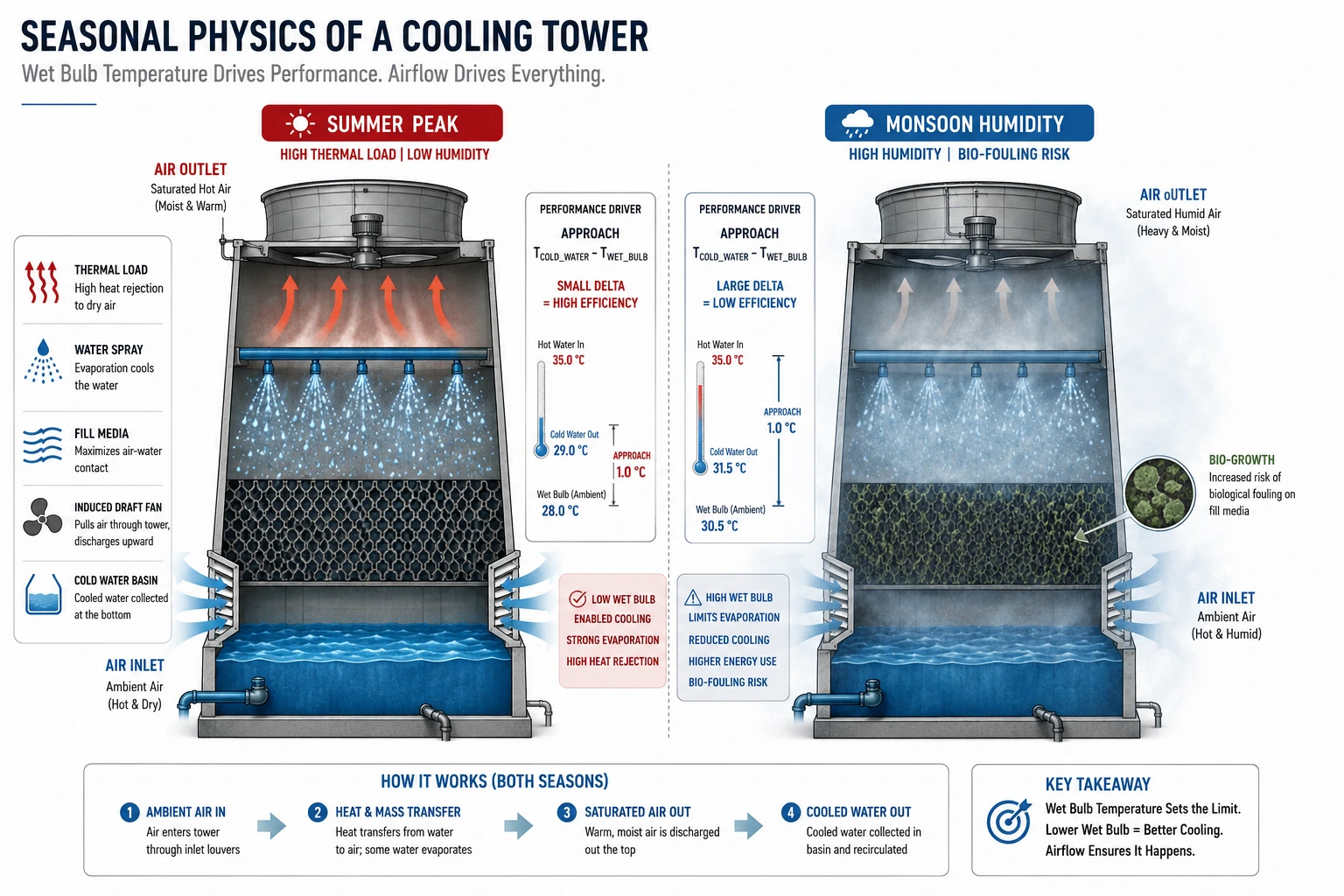
Summer increases heat load, evaporation rates, make-up water demand, and fan run hours.
- Rising wet bulb temperature: Wet bulb temperature is the limiting ambient condition for evaporative cooling performance; as it rises, the tower’s ability to reduce water temperature decreases.
- Fixed-speed fan operation at full load: Running fans at maximum RPM without matching demand ignores the potential for energy savings and increases mechanical stress.
- Scaling and fouling of fill media and distribution surfaces: Intense heat can concentrate mineral content, leading to fouled fill media and reduced thermal conductivity.
- Hot-air recirculation: Poor tower location, blocked air entry, damaged louvres, or exhaust obstruction can cause the tower to re-ingest hot air, lowering cooling efficiency.
4 Monsoon Failure Modes That Impact Performance
Monsoon conditions increase humidity, rainwater dilution, sludge movement, algae formation, corrosion risk, and electrical exposure.
- Reduced evaporative capacity in high humidity: High ambient humidity weakens the evaporative driving force, making it difficult for the tower to reach target temperatures regardless of fan speed.
- Accelerated biological fouling: Warm, damp conditions promote algae and slime; if left unchecked, they can clog nozzles and form biofilm on fill media.
- Electrical exposure and sensor faults: Rain splash, condensation, and water dripping from cable routes can compromise motor terminal boxes, VFDs, and field sensors.
- Drift carryover and airflow instability: High winds and rain splash can disrupt uniform airflow patterns, leading to increased drift carryover losses and mechanical imbalances in the fan assembly.
Seasonal Readiness Checklist
| Category | Action Focus |
| Mechanical & Airflow | Clean fill media, spray nozzles, air inlet louvres, and drift eliminators. Inspect fan assembly, blade balance, gearbox oil condition, make-up valve operation, and circulating pump pressure. |
| Water Treatment | Review and log conductivity, pH, TDS, and hardness levels. Calibrate antiscalant and biocide dosing systems to maintain stable water chemistry and prevent scaling or fouling. |
| Electrical & Structural | Inspect cable glands, earthing continuity, motor sealing integrity, and local isolators. Protect control panels from rain splash, moisture ingress, and condensation buildup during monsoon conditions. |
| Biological Control | Remove basin sludge, algae growth, and floating debris. Maintain adequate biocide residuals and eliminate stagnant water zones in idle cells, bypass lines, and dead legs to reduce microbial risk. |
Control Upgrades for Stable Seasonal Operation
Modern monitoring and fan control can improve seasonal stability:
- EC fan or VFD control: Match airflow to actual cooling demand to reduce unnecessary power use.
- Performance monitoring: Track range (hot water temperature minus cold water temperature) and approach (cold water temperature minus wet bulb temperature) to identify capacity loss early.
- Conductivity-based blowdown: Maintain cycles of concentration and reduce scaling risk.
For further technical insights on seasonal performance, explore our guide on cooling tower efficiency in Indian summers. To understand the broader context of air management, see Why AHU Fans Are Indispensable For HVAC Systems?. We also offer specialised Cooling tower retrofit solutions and EC fan solutions for efficient HVAC retrofits in India to support stable seasonal operation.
Frequently Asked Questions
Approach is the difference between the cold-water temperature and the wet-bulb temperature. A rising approach indicates weaker cooling performance or poor tower condition.
It represents the actual electrical load of the fan motor, helping detect overload, belt issues, airflow resistance, or bearing problems.
Maintain oxidising or non-oxidising biocide residuals and ensure no water stagnates in idle cells, bypass lines, or dead legs.
When the wet bulb temperature rises, the tower’s achievable outlet water temperature also rises, which can affect process cooling temperatures depending on site load.
Protect motor terminal boxes, cable glands, and control panels from rain splash and condensation; ensure water does not accumulate near motor foundations.
Optimise Your Cooling Infrastructure
Ensure your cooling system is ready for the upcoming season. Contact AadTech Group to schedule a performance audit, discuss an EC fan retrofit, or receive expert guidance on seasonal readiness.