In mission-critical aviation infrastructure (hubs such as Hyderabad, Guwahati, Lucknow, and Thiruvananthapuram), cooling systems are the silent heartbeat of terminal operations. These regions, characterised by high ambient humidity and extreme seasonal variance, amplify the inefficiency of legacy cooling systems. For facility engineers tasked with maintaining near-constant uptime, these systems often represent a volatile operational expenditure.
The industry is currently facing a “Fixed-Load Disconnect.” Legacy AC induction motors are fundamentally misaligned with the dynamic, high-occupancy cycles of modern airports. When passenger throughput surges, these motors( typically locked into rigid speed profiles) struggle to modulate, leading to mechanical fatigue, gearbox degradation, and inefficient part-load energy consumption. As noted in ASHRAE‘s technical benchmarks, optimising HVAC control strategies is essential to mitigating the energy intensity of large-scale infrastructure.
The Mechanical Bottleneck: Why “Repair” is a Sunk Cost
Facility teams frequently treat the symptoms of failing cooling towers: replacing burnt-out VFDs, re-tensioning worn belts, or repairing gearbox leaks. However, this reactive approach ignores the system’s physics.
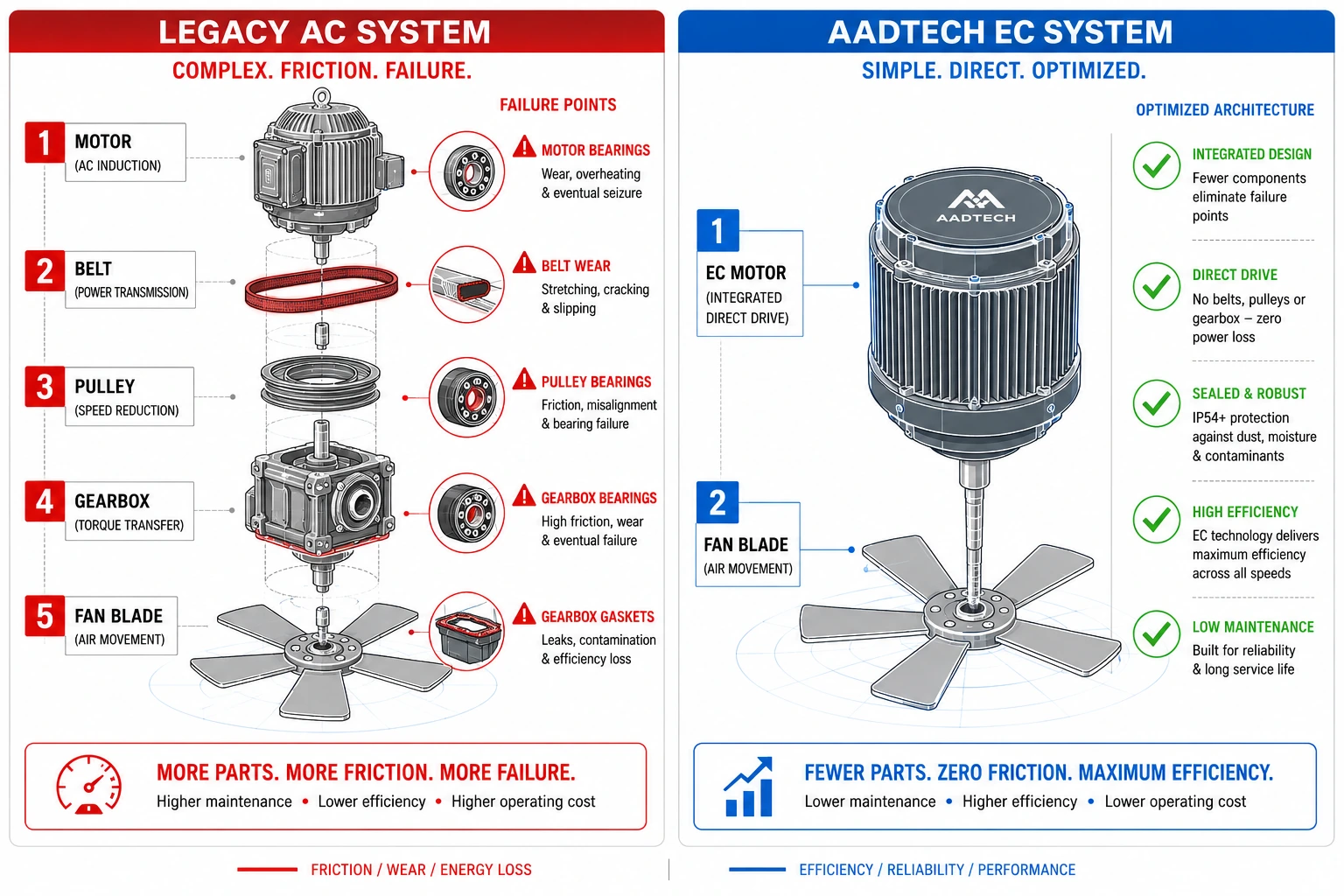
Legacy AC systems rely on a chain of mechanical dependencies:
| Motors → Belts/Pulleys/Gearboxes → Fan Blades |
Every transition point in this chain is a site for friction, torque loss, and mechanical failure, driving down the Mean Time Between Failures (MTBF). Furthermore, belt-drive systems are prone to torque ripple and vibration propagation, which accelerate bearing wear across the entire fan array. Transitioning to direct-drive Electronically Commutated (EC) fan technology eliminates these transmission losses, simplifying the mechanical architecture.
Engineering Field Diagnostic: Is Your System Reaching Its End-of-Life Audit?
If your current cooling tower infrastructure exhibits more than two of the following indicators, the system is no longer operating at peak efficiency and requires an immediate audit:
- Elevated Inrush Current: Frequent electrical trips or visible voltage sags during fan start-up.
- Declining MTBF: Maintenance logs show an increasing frequency of belt replacements, bearing failures, or gearbox oil leaks.
- The Fixed-Speed Penalty: The cooling tower fans run at 100% capacity even during low-ambient-temperature periods (e.g., nighttime or winter).
- Excessive Vibration Profiles: Abnormal vibration levels detected at the fan housing, indicating transmission misalignment.
- Rising Approach Temperatures: A widening gap between your water-out temperature and the ambient wet-bulb temperature, signalling heat-transfer degradation.
If you identified two or more of these signs, your current mechanical configuration is likely exceeding its operational lifecycle cost.
Quantifying Efficiency: From 45% to 55% Gains
The transition to EC technology is supported by empirical efficiency curves that demonstrate superior performance at partial loads, consistently outperforming the non-linear efficiency drops seen in legacy AC induction systems.
Case studies from Hyderabad and Guwahati underscore the hard numbers justification for this shift. By replacing legacy induction hardware with intelligent EC fan grids, these facilities have consistently achieved on-site energy savings of 45–55%. With a projected ROI often achieved in under 1.2 years, the transition is a fiscal imperative. Research into energy demand modelling at Indian airports, as explored by the Department of Science and Technology (DST), highlights that such interventions are critical to minimising total air-conditioning demand in high-humidity climates.
The Intelligent Layer: Cooling Towers as Data-Nodes
To sustain these performance levels, AADTech integrates IoT-driven Smart Controllers. These controllers move the cooling tower from a static mechanical asset to a digital data node. These controllers function as an intelligent layer that integrates with existing Building Management Systems (BMS), rather than replacing them.
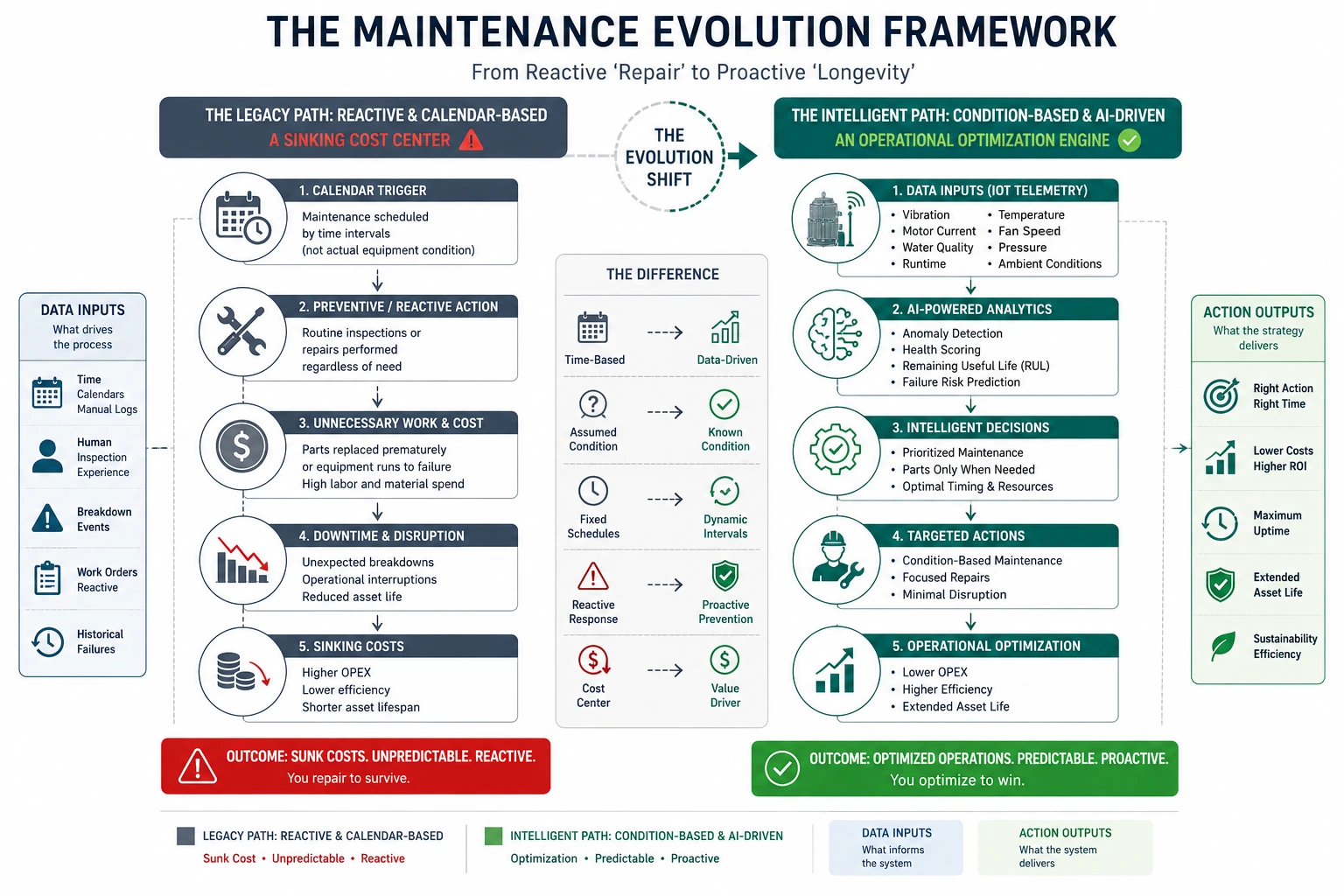
By feeding real-time telemetry (vibration analysis, motor amperage, and thermal signatures) into an intelligent monitoring suite, facility engineers can transition from calendar-based maintenance to Condition-Based Maintenance (CBM).
- Predictive Health: Instead of waiting for a fan to fail during a peak-heat day, the system alerts engineers to bearing wear or insulation degradation weeks in advance.
- Operational Optimisation: The system dynamically seeks the optimal fan speed based on real-time ambient demand, rather than running at design-day maximums.
In an environment of global energy price volatility, the ability to optimise cooling power based on actual terminal load, rather than assumed capacity, is the new benchmark for infrastructure longevity. The size of your cooling tower no longer defines engineering resilience; rather, it is how precisely it responds to the thermodynamic realities of the environment.
Frequently Asked Questions
EC motors utilise integrated power electronics to provide a soft-start, eliminating the high inrush current that typically strains terminal electrical grids during start-up.
Yes, our modular EC fan grids are engineered for drop-in replacement, eliminating the need for extensive structural modifications while removing heavy gearboxes.
No. AADTech’s IoT controllers integrate seamlessly as a secondary intelligent layer, providing real-time analytics without requiring you to replace your entire BMS.
PM is calendar-based, meaning you often replace parts that are still functional. CBM uses real-time telemetry to trigger maintenance only when specific degradation metrics (like vibration or thermal drift) exceed safe thresholds.
High humidity reduces the wet-bulb approach efficiency; static, fixed-speed motors cannot dynamically adjust to the optimal fan speed, leading to constant over-cooling and energy waste.
Ready to Optimise?
Stop paying for wasted kilowatt-hours. Calculate your potential savings with our Energy Savings Calculator or contact our engineering team for a site-specific retrofit audit today.