
Industrial cooling towers often lose efficiency due to hidden thermodynamic and mechanical bottlenecks. If your process water returns above design limits, you do not automatically need a CAPEX-heavy replacement. Facilities managers can rapidly restore plant efficiency by diagnosing root causes. Minor scaling responds perfectly to a routine service contract. Escalating energy draws demand for an aerodynamic retrofit, such as an EC fan array. Only catastrophic basin collapse or widespread structural corrosion mandates a full equipment replacement.
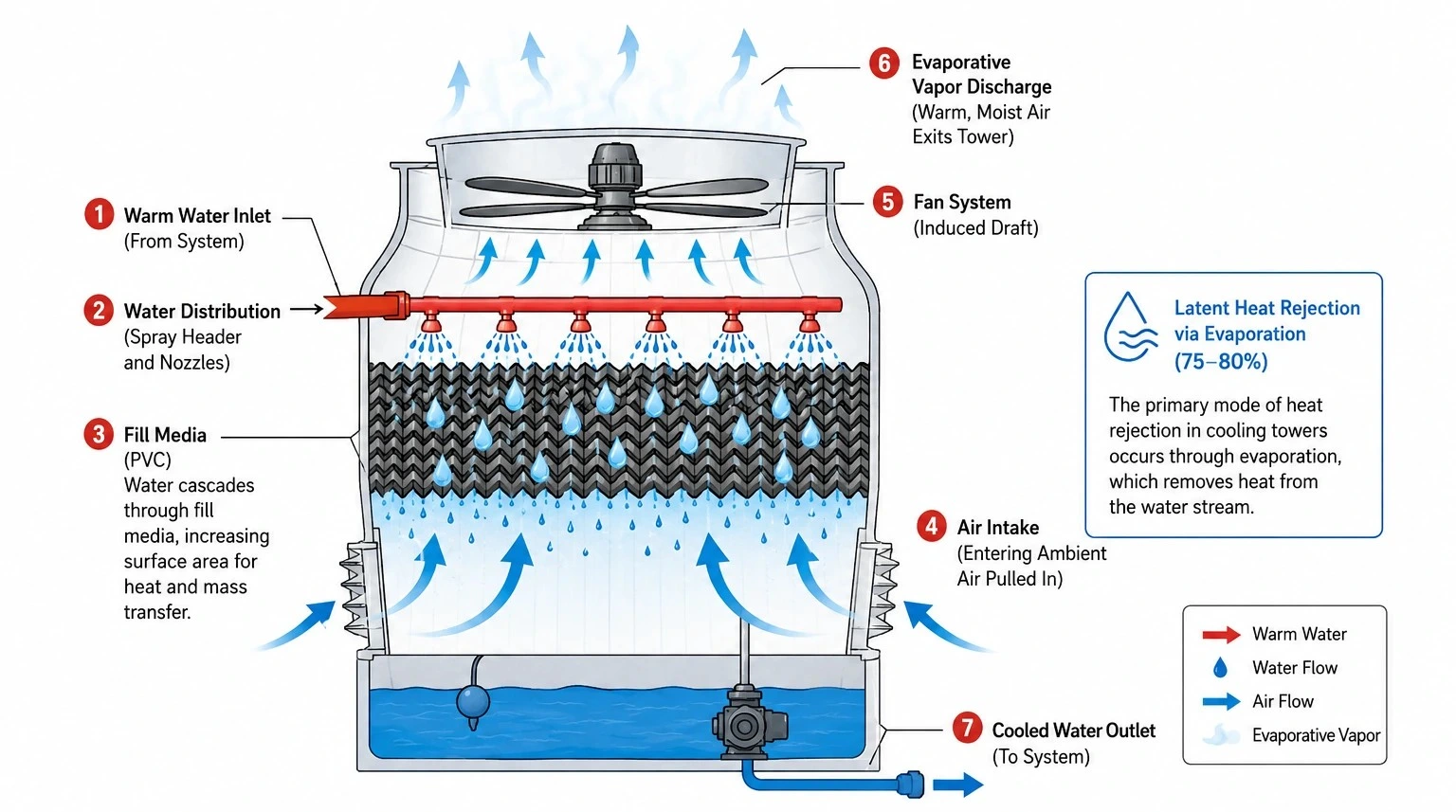
An underperforming cooling tower demands objective diagnostic data. not guesswork. When process water temperatures creep up or chiller energy consumption spikes, facility managers face a critical operational crossroad. Is targeted maintenance sufficient, or is a complete cooling tower installation inevitable? Evaluating the asset requires a structured review of thermal performance metrics, approach temperatures, and mechanical drive train integrity.
What Symptoms Indicate That a Cooling Tower Is Underperforming?
Identifying heat-rejection failures early prevents catastrophic downtime across your chilled-water loop. Watch for these five operational red flags:
- Process water returns above design temperature: Heat exchangers fail to shed thermal loads efficiently, usually due to heavy fouling on the fill media.
- Chillers operate at higher loads: Every 1 degree F increase in condenser water temperature penalises chiller compressor efficiency by up to 4.5%.
- Fan energy consumption surges: VFDs run fan motors at maximum capacity, failing to meet temperature setpoints, indicating aerodynamic drag.
- Unusual mechanical vibrations: Lateral shaft movements or gearbox shuddering signal dynamic imbalance and impending component failure.
- Excessive makeup water usage: Uncontrolled drift or undetected basin leaks require constant, costly water replenishment, which AAD Tech airflow and water-balancing services resolve immediately.
Which Problems Can Be Solved Through a Service Contract?
Targeted maintenance programs resolve operational bottlenecks caused by poor water quality or deferred upkeep without requiring heavy CAPEX.
- Fouling: Descaling and high-pressure washing of fouled film fills restore design air gaps and water pathways.
- Water distribution issues: Unclogging nozzles and adjusting balancing valves eliminates water channelling across the media.
- Minor mechanical wear: Lubricating bearings and aligning drive shafts prevents premature wear during peak operating seasons.
Service Contract Selection Matrix
| Condition | Service Contract Suitable |
| Scaling | Yes |
| Dirty Fill | Yes |
| Water Distribution Issues | Yes |
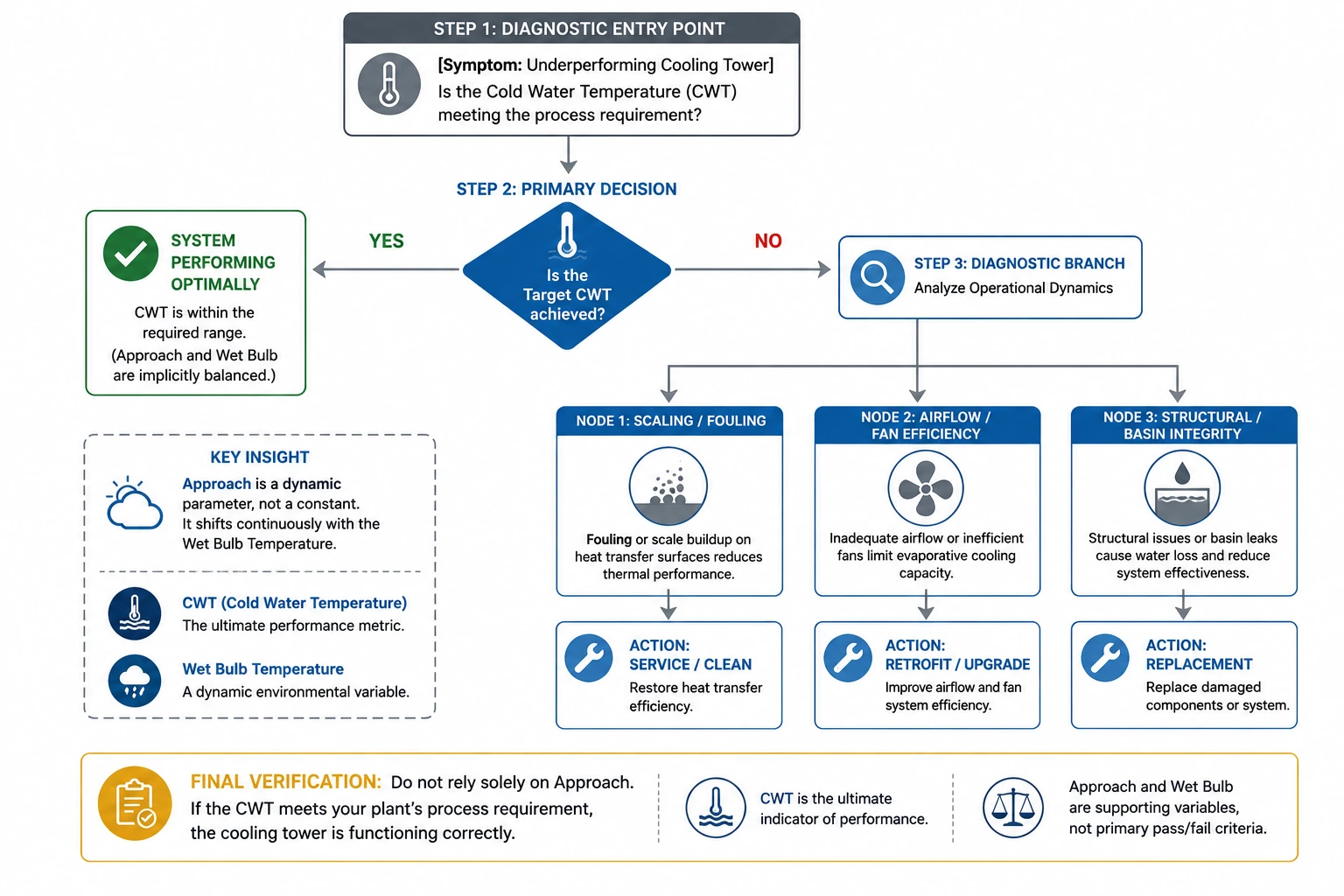
When Does a Cooling Tower Retrofit Become the Better Option?
When the cold-water basin and structural framework remain sound but thermodynamic performance lags behind facility demands, a targeted upgrade makes financial sense.
- Airflow insufficiency: Replacing legacy fixed-pitch blades with aerodynamic FRP blades dramatically increases air induction per kilowatt.
- Motor obsolescence: Swapping ageing motors for direct-drive Electronically Commutated (EC) fan systems eliminates transmission losses.
- High lifecycle costs: Targeted mechanical upgrades lower ongoing utility bills and maintenance overhead.
- Part-load inefficiency: Integrating modern, intelligent VFDs allows precise matching of fan speeds to ambient wet-bulb temperatures.
- System capacity constraints: Upgrading drift eliminators and spray headers boosts overall cooling capacity, a process optimised by AAD Tech’s engineered EC fan retrofits.
When Is Complete Cooling Tower Replacement Unavoidable?
When the cold water basin, structural casing, and distribution headers fail concurrently, capital investment is better directed toward a new installation.
- Extensive structural corrosion: Rusted structural steel members compromise structural safety and violate compliance standards.
- Recurring mechanical failures: When drive train breakdowns occur monthly, retrofitting becomes a sunk cost.
- Obsolescence of capacity: Facility expansion that renders the original footprint fundamentally undersized demands a complete equipment overhaul.
- TCO liabilities: When a 15-year lifecycle cost analysis projects higher OPEX than the capital cost of a new system, AAD Tech manages full, turn-key cooling tower installation projects.
Comparison Table: Triage Indicators
| Indicator | Service | Retrofit | Replacement |
| Dirty Fill | ✓ | — | — |
| High Fan Energy | — | ✓ | — |
| Motor Failure Trend | — | ✓ | — |
| Corroded Structure | — | — | ✓ |
| Basin Failure | — | — | ✓ |
Technical Checklist Before Commissioning New Equipment
- Thermal Load Verification: Audit current process heat loads against ASHRAE design standards to ensure accurate sizing.
- Future Expansion Siting: Size structural steel and electrical feeders to accommodate modular plant growth.
- Lifecycle Cost Analysis: Calculate Total Cost of Ownership over a 15-year operational horizon.
- Retrofit Feasibility: Verify whether structural enhancements can deliver the required heat rejection before committing to CAPEX.
- Site Access Planning: Confirm crane paths, structural load capacities, and plant shutdown windows with AAD Tech’s project management team.
Stop Energy Losses and Secure Your Plant Uptime Today
Your cooling infrastructure dictates the operational profitability of your facility. Do not let degraded efficiency inflate your utility bills or trigger sudden downtime.
Speak directly with our thermal systems engineers to assess your asset, evaluate EC fan retrofit payback periods, and safeguard your operational uptime.
Frequently Asked Questions
These include scaling, airflow restrictions, damaged fill media, poor water distribution, and inefficient fan operation.
When thermal performance is recoverable, energy consumption and equipment age are increasing.
Major structural corrosion, basin failure, or recurring mechanical failures often justify replacement.
Yes. Preventive maintenance often restores lost performance before capital upgrades become necessary.
Reference List
U.S. DOE FEMP Efficiency Guides
https://www.epa.gov/watersense
OSHA Technical Manual
UK HSE Guidance